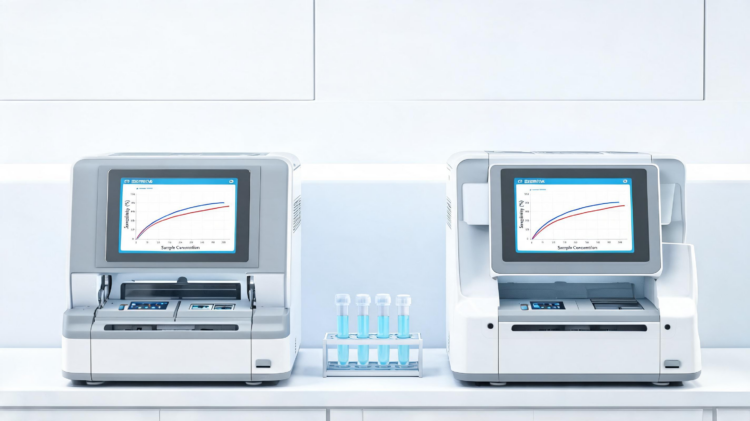
Rapid identification of dangerous biological agents can determine how quickly first responders isolate a hazard, protect exposed populations and begin appropriate countermeasures. A study published in Discover Biotechnology reports that the BIOFIRE BioThreat Panel v2.5 produced broadly comparable detection sensitivity when used with two automated instruments: the established FILMARRAY 2.0 and the newer, more compact SPOTFIRE system. The panel is designed for qualitative, multiplexed polymerase chain reaction, or PCR, testing of environmental samples. In side-by-side testing, SPOTFIRE matched the FILMARRAY 2.0 limit of detection for seven representative analytes, showed sensitivity within fivefold for eight others, and performed better for two targets. One target, Yersinia pestis, was detected with lower sensitivity on SPOTFIRE because the newer platform uses a more stringent interpretation rule. The findings suggest that the same panel chemistry can support biothreat screening across both instrument generations, although the study’s laboratory design and manufacturer affiliation should be considered when interpreting the results.
The BioThreat Panel v2.5 covers 16 biothreat targets spanning bacteria, viruses and toxin-encoding genes. Its bacterial targets include Bacillus anthracis, Brucella melitensis, Burkholderia mallei/pseudomallei, Coxiella burnetii, Francisella tularensis, Rickettsia prowazekii and Y. pestis. Viral targets include Eastern equine encephalitis virus, Venezuelan equine encephalitis virus, Western equine encephalitis virus, variola virus, orthopoxviruses, Orthoebolavirus zairense and Orthomarburgvirus marburgense. The panel also seeks genes encoding botulinum toxin from Clostridium botulinum and ricin toxin from Ricinus communis. Because several targets are represented by multiple assays, the instrument software combines individual assay results into a final qualitative call: “Detected,” “Not Detected” or “Possible Detection.” In the study’s limit-of-detection analysis, “Possible Detection” was treated as equivalent to “Not Detected,” making the reported performance dependent not only on molecular amplification but also on the software’s decision rules.
Both systems use a disposable BIOFIRE pouch containing the reagents needed for sample processing and amplification. Once a sample is loaded, the instrument automatically performs nucleic-acid extraction and purification, reverse transcription when RNA is present, and a multiplex first-stage PCR. The amplified material is then diluted and distributed across a 102-well array, where target-specific primers are pre-spotted for individual nested second-stage PCR reactions. Each assay is placed in triplicate. This architecture allows DNA and RNA targets to be examined in one run while keeping hands-on manipulation low. After amplification, the systems analyze fluorescence and the melting behavior of the resulting DNA products. In melt-curve analysis, each product’s melting temperature is compared with an assay-specific expected range. An assay is considered positive when at least two of its three array wells produce positive melt curves with similar melting temperatures. The software then integrates those assay-level findings according to target-specific algorithms and reports the final result in approximately one hour.
The study evaluated performance in two sequential phases. First, the researchers estimated a preliminary limit of detection by testing analyte pools across multiple dilutions, including at least three tenfold dilution steps. Each dilution was run in three pouches on each instrument. After identifying a useful concentration range, individual analytes were tested at fivefold dilutions, with four pouches at each concentration on each platform. The lowest concentration detected in all four pouches was designated the estimated limit of detection, unless review of amplification curves suggested that the result would be unlikely to hold up in confirmation testing. The second phase tested 20 independently prepared pouches at the estimated limit and another 20 at a tenfold lower concentration. A limit of detection was confirmed when at least 19 of 20 pouches at the proposed concentration produced a “Detected” result, while fewer than 19 of 20 did so at the lower concentration. Testing used contrived samples prepared in phosphate-buffered saline rather than naturally collected environmental material, and all work was performed in a certified Biosafety Level 2 laboratory under institutional biosafety procedures.
In total, the investigators examined 18 representative analytes corresponding to the panel’s 16 targets. All analytes were quantified in-house with digital PCR before testing. Where possible, the researchers used live or inactivated organisms suitable for work in the Biosafety Level 2 setting. When those materials were unavailable, they used genomic nucleic acid; for Eastern equine encephalitis virus, variola virus, C. botulinum and C. burnetii, they used synthetic templates based on reference-organism sequences. The study included both Ames and Sterne 34F2 strains of B. anthracis, whose different genetic content was expected to produce different software interpretations, and the Ravn and Voege virus types of O. marburgense. Variola testing used three nucleic-acid templates together to represent the four assay signals required for a “Variola virus Detected” interpretation. These substitutions allowed the researchers to evaluate the panel’s analytical behavior without introducing all of the relevant high-consequence organisms into the laboratory, but they also mean that the results do not constitute a direct assessment of every possible field sample or strain.
The confirmed results showed that seven analytes had the same limit of detection on both instruments: the Ames and Sterne 34F2 strains of B. anthracis, B. melitensis, B. pseudomallei, C. burnetii, F. tularensis and the German Voege type of O. marburgense. Eight additional analytes displayed similar sensitivity, defined in the study as limits of detection within fivefold between platforms. This group included R. prowazekii, O. zairense, the Ravn type of O. marburgense, modified Vaccinia Ankara virus, variola virus, Venezuelan equine encephalitis virus, Western equine encephalitis virus and ricin-associated sequences. Two analytes, Eastern equine encephalitis virus and C. botulinum toxin-encoding sequences, showed more than fivefold improved sensitivity on SPOTFIRE. These findings do not establish that SPOTFIRE is universally more sensitive; rather, they show that its performance was similar or better for nearly all analytes examined under the study conditions.
The exception was Y. pestis, the bacterium associated with plague. The panel uses two assays for this target, called YPT1 and YPT3, which detect sequences on distinct plasmids. On FILMARRAY 2.0, a positive result from either assay can produce a “Y. pestis Detected” interpretation. On SPOTFIRE, the YPT3 assay must be positive for that final call. The difference was introduced to increase stringency and specificity because the genetic locus targeted by YPT1, the pla gene on the pPCP1 plasmid, has been reported in bacterial species other than Y. pestis. The pPCP1 plasmid is generally more abundant than pMT1, which is targeted by YPT3. As a result, a sample containing enough material to trigger YPT1 but not YPT3 may be called positive on FILMARRAY 2.0 but not on SPOTFIRE. The reduced apparent sensitivity was therefore expected by the investigators and reflects a trade-off between analytical detection and confidence that the detected sequence is specific to the intended organism.
The researchers place the comparison in the context of operational testing, where speed, portability and logistics can be as important as molecular performance. FILMARRAY 2.0 has supported automated biothreat and infectious-disease testing, but it requires an external computer for control. SPOTFIRE integrates its interface into the instrument, occupies less benchtop space and can be configured with up to four vertically stacked modules. Both platforms automate the complete pouch workflow and have a run time of approximately one hour, while the consumables include internal process controls made from lyophilized Schizosaccharomyces pombe cells and a synthetic control incorporated into the final PCR stage. Those controls help indicate whether sample preparation, reverse transcription, amplification and the final reaction have worked as expected. The study concludes that BioThreat Panel v2.5 users can expect similar sensitivity and functionality on the two systems, with special attention to the platform-specific Y. pestis calling rule. The work was funded internally by BioFire Defense, the panel’s legal manufacturer, and all listed authors were company employees; the authors state that the underlying data are available from the corresponding author on reasonable request.
A limit of detection is an analytical measure rather than a guarantee that every field sample will be identified. In this study, the threshold was defined through repeated testing at a proposed concentration and at a tenfold lower concentration. Confirmation required at least 19 of 20 pouches to produce a final “Detected” call at the proposed level, while the lower concentration had to fall below that criterion. This approach incorporates run-to-run variability, but it remains tied to the particular sample preparation, reagent lots, templates and calling algorithms used in the experiment. A fivefold difference between platforms should therefore be interpreted as a comparison under controlled conditions, not as a universal ranking of instrument performance.
The distinction is especially important for environmental surveillance. The investigators used contrived material in phosphate-buffered saline, whereas real samples can contain substances that interfere with nucleic-acid purification, reverse transcription or PCR. Environmental material may also contain unevenly distributed targets, degraded nucleic acids or organisms at concentrations near the assay threshold. The use of genomic nucleic acid and synthetic templates further enabled testing of high-consequence targets under the laboratory’s biosafety arrangements, but it does not reproduce every feature of intact organisms, complex matrices or naturally collected specimens. Additional evaluations would be needed to characterize those factors across the settings in which the instruments might be deployed.
The pouch design places several quality checks inside an otherwise automated workflow. Lyophilized Schizosaccharomyces pombe cells function as an internal process control because they accompany sample handling, purification, reverse transcription and amplification. A separate synthetic control is incorporated into the final PCR stage, helping assess that the downstream reaction and detection components are functioning. These controls can distinguish a technically valid negative result from a failed process, although they do not establish that a particular environmental sample is free of a biothreat agent. Likewise, a positive molecular signal indicates the presence of a target sequence or toxin-associated gene, not necessarily organism viability, infectiousness or toxin activity. Such distinctions are important when laboratory results are incorporated into decisions about confirmatory testing, containment and public-health or security responses.
Subject of Research: Analytical sensitivity of an automated multiplex PCR biothreat panel on two BIOFIRE instrument platforms
Article Title: The BIOFIRE BioThreat Panel v2.5 demonstrates comparable sensitivity on the FILMARRAY 2.0 and SPOTFIRE systems
Article References: Nielson, J., Wright, K., Poloncic, K., Duclos, N., Sanchez, D., Pop, S., Pack, R., Genin, C., Kress, E., Bates, A., Brownlee, W., Lakman, K., & Kim, M. (2026). The BIOFIRE BioThreat Panel v2.5 demonstrates comparable sensitivity on the FILMARRAY 2.0 and SPOTFIRE systems. Discover Biotechnology, 3(1), Article 11. https://doi.org/10.1007/s44340-026-00058-x
Image Credits: AI Generated
DOI: 10.1007/s44340-026-00058-x
Keywords: biothreat detection, multiplex PCR, BIOFIRE, SPOTFIRE, FILMARRAY 2.0, limit of detection, pathogen diagnostics, environmental surveillance, BioThreat, Panel, demonstrates, comparable
Cite Scienmag News
APA MLA Chicago
Scienmag. (August 29, 2026). Biothreat Test Shows Similar Sensitivity on Two Automated PCR Platforms. https://scienmag.com/biothreat-test-shows-similar-sensitivity-on-two-automated-pcr-platforms/
Scienmag. “Biothreat Test Shows Similar Sensitivity on Two Automated PCR Platforms.” Scienmag, 29 August 2026, https://scienmag.com/biothreat-test-shows-similar-sensitivity-on-two-automated-pcr-platforms/. Accessed 29 August 2026.
Scienmag. “Biothreat Test Shows Similar Sensitivity on Two Automated PCR Platforms.” Scienmag. August 29, 2026. https://scienmag.com/biothreat-test-shows-similar-sensitivity-on-two-automated-pcr-platforms/
Copy citation Download RIS
Tags: automated PCR platformsBIOFIREbiological agent identificationBioThreatbiothreat detectionBioThreat Panel v2.5biothreat target pathogenscomparabledemonstratesenvironmental biothreat screeningenvironmental surveillanceFILMARRAY 2.0FILMARRAY 2.0 vs SPOTFIRE comparisonlaboratory validation of biothreat testslimit of detectionmolecular diagnostics for biothreatsmultiplex PCRmultiplex PCR testingPanelpathogen detection sensitivitypathogen diagnosticsrapid biothreat detection technologySPOTFIRE