• HOME
  • NEWS
  • EXPLORE
    • CAREER
      • Companies
      • Jobs
    • EVENTS
    • iGEM
      • News
      • Team
    • PHOTOS
    • VIDEO
    • WIKI
  • BLOG
  • COMMUNITY
    • FACEBOOK
    • INSTAGRAM
    • TWITTER
Tuesday, September 1, 2026
BIOENGINEER.ORG
No Result
View All Result
  • Login
  • HOME
  • NEWS
  • EXPLORE
    • CAREER
      • Companies
      • Jobs
        • Lecturer
        • PhD Studentship
        • Postdoc
        • Research Assistant
    • EVENTS
    • iGEM
      • News
      • Team
    • PHOTOS
    • VIDEO
    • WIKI
  • BLOG
  • COMMUNITY
    • FACEBOOK
    • INSTAGRAM
    • TWITTER
  • HOME
  • NEWS
  • EXPLORE
    • CAREER
      • Companies
      • Jobs
        • Lecturer
        • PhD Studentship
        • Postdoc
        • Research Assistant
    • EVENTS
    • iGEM
      • News
      • Team
    • PHOTOS
    • VIDEO
    • WIKI
  • BLOG
  • COMMUNITY
    • FACEBOOK
    • INSTAGRAM
    • TWITTER
No Result
View All Result
Bioengineer.org
No Result
View All Result
Home NEWS Science News Biology

Biotechnologists developed an effective technology for nutrient biocapture from wastewater

Bioengineer by Bioengineer
February 19, 2021
in Biology
Reading Time: 2 mins read
0
IMAGE
Share on FacebookShare on TwitterShare on LinkedinShare on RedditShare on Telegram

IMAGE

Credit: RUDN University

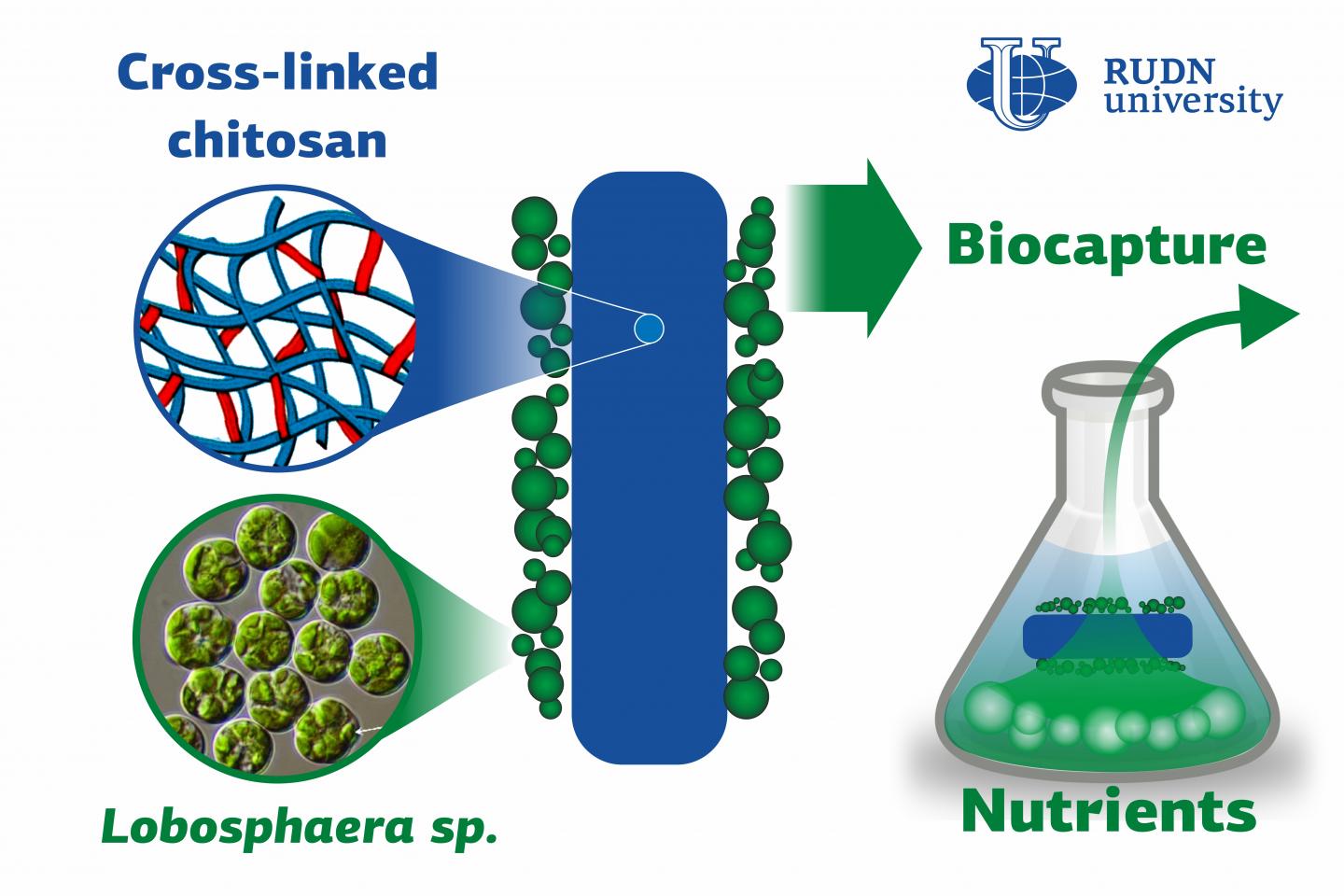
Biotechnologists from RUDN University in collaboration with Lomonosov MSU and Kurchatov institute made an important contribution to the technology of phosphate and nitrate biocapture from wastewater using Lobosphaera algae fixed on the filters.The biomass obtained in the course of this process can be used as a fertilizer. The results of the study were published in the Journal of Water Process Engineering.

Phosphates and nitrates get to the wastewater together with industrial and household waste, especially detergents. Both substances are parts of phosphorus and nitrogen chemical cycles. However, these cycles are disturbed by human activity, as the growing amounts of phosphates and nitrates cannot be processed by water ecosystems. As a result, these substances turn from useful nutrients to pollutants. Wastewater is treated with special equipment and microorganisms, including microalgae that consume phosphates and nitrates. A team of biotechnologists from RUDN University together with their colleagues from MSU and the Kurchatov Institute developed a biopolymer filter on which useful microalgae can be placed. The polymer is chitosan-based, safe for the algae, biodegradable, and captures chemical elements from wastewater more effectively than its existing analogs.

“Our team was the first to successfully use cross-linked chitosan polymers to immobilize unicellular algae and make them effectively consume nutrients while at the same time not preventing them from growing and photosynthesizing,” said Alexei Solovchenko, a PhD in Biology from the Department of Agrobiotechnology, RUDN University.

Chitosan is a polysaccharide with amino groups and its chemical composition is similar to that of chitin that can be found in shellfish crusts and mushroom cell walls. Chitosan is not water-soluble and therefore can be used to grow algae. However, it is biodegradable. Using an original methodology developed in the Kurchatov Institute, it was cross-linked with glutaraldehyde molecules and thus turned into a strong biocompatible polymer. Then, the team grew the IPPAS C-2047 strain of the Lobosphaera incisa algae on it for seven days.

Based on the results of the seven-day long experiment, the team concluded that a complex of microalgae cells and chitosan-based polymer with a total molecular mass of 600 kDa was more effective than that with a molecular mass of 250 kDa. The algae on the filter captured the nutrients more efficiently than those suspended in the wastewater: specifically, they consumed phosphates 16.7 times and nitrates 1.3 times faster.

Used chitosan biofilters could be repurposed as fertilizers. With time, chitosan would degrade without causing any harm to the environment, while the algae would act as a source of accumulated phosphates and nitrates for the plants.

“Our team has demonstrated that cross-linked chitosan polymers are safe for the environment and effectively support the biocapture of nutrients from wastewater by unicellular algae. When added to a non-toxic medium, the algae biomass could be used as a fertilizer that would gradually release the accumulated nutrients into the soil,” added Alexei Solovchenko from RUDN University.

###

Media Contact
Valeriya Antonova
[email protected]

Related Journal Article

http://dx.doi.org/10.1016/j.jwpe.2020.101774

Tags: Biology
Share13Tweet8Share2ShareShareShare2

Related Posts

Methylation puts parasites in motion

Methylation puts parasites in motion

August 31, 2026
Desiccation promotes DNA damage and rifampin resistance in Mycobacterium tuberculosis

Desiccation promotes DNA damage and rifampin resistance in Mycobacterium tuberculosis

August 31, 2026

Gastrointestinal Parasitism in Cattle and Water Buffaloes in Pakistan: Prevalence and Associated Risk Factors

August 31, 2026

Development of HPLC–PDA method for steviol glycosides analysis in food matrices

August 31, 2026
Please login to join discussion

POPULAR NEWS

  • β-Sitosterol from Ipomoea carnea Jacq. As a promising anti-inflammatory agent: Evidence from in silico modeling and in vitro validation

    29 shares
    Share 12 Tweet 7
  • Design, fabrication and characterization of a wearable Fiber Bragg grating sensor for cardiorespiratory monitoring using finger plethysmography

    29 shares
    Share 12 Tweet 7
  • KAIST opens the era of industrial-scale microbial foods, proposing growth strategies for the next-generation protein market

    29 shares
    Share 12 Tweet 7
  • Virologist awarded $2 million NIH grant to investigate how virus-infected cells live and die

    29 shares
    Share 12 Tweet 7

About

We bring you the latest biotechnology news from best research centers and universities around the world. Check our website.

Follow us

Recent News

β-Sitosterol from Ipomoea carnea Jacq. As a promising anti-inflammatory agent: Evidence from in silico modeling and in vitro validation

Design, fabrication and characterization of a wearable Fiber Bragg grating sensor for cardiorespiratory monitoring using finger plethysmography

KAIST opens the era of industrial-scale microbial foods, proposing growth strategies for the next-generation protein market

Subscribe to Blog via Email

Enter your email address to subscribe to this blog and receive notifications of new posts by email.

Join 85 other subscribers
  • Contact Us

Bioengineer.org © Copyright 2023 All Rights Reserved.

Welcome Back!

Login to your account below

Forgotten Password?

Retrieve your password

Please enter your username or email address to reset your password.

Log In
No Result
View All Result
  • Homepages
    • Home Page 1
    • Home Page 2
  • News
  • National
  • Business
  • Health
  • Lifestyle
  • Science

Bioengineer.org © Copyright 2023 All Rights Reserved.