In situ bioprinting, which involves 3D printing biocompatible structures and tissues directly within the body, has seen steady progress over the past few years. In a recent study, a team of researchers developed a handheld bioprinter that addresses key limitations of previous designs, i.e., the ability to print multiple materials and control the physicochemical properties of printed tissues. This device will pave the way for a wide variety of applications in regenerative medicine, drug development and testing, and custom orthotics and prosthetics.
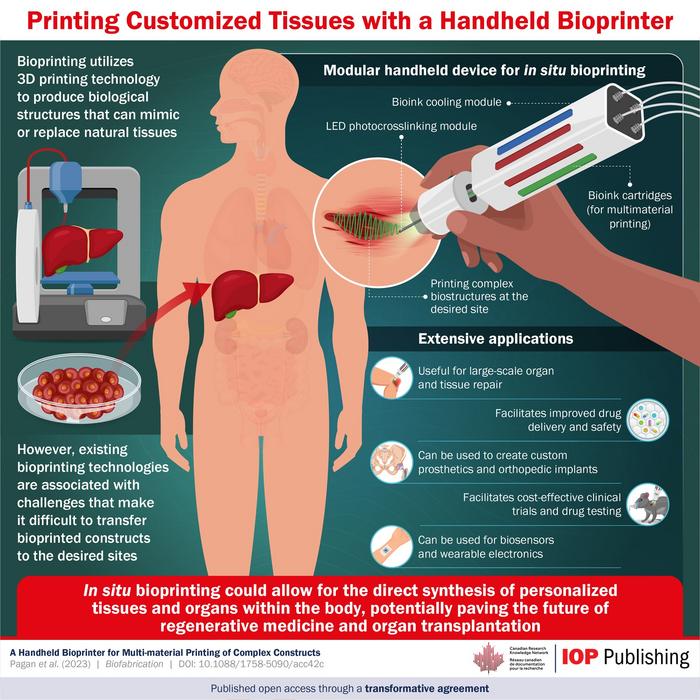
Credit: Pagan et al.
In situ bioprinting, which involves 3D printing biocompatible structures and tissues directly within the body, has seen steady progress over the past few years. In a recent study, a team of researchers developed a handheld bioprinter that addresses key limitations of previous designs, i.e., the ability to print multiple materials and control the physicochemical properties of printed tissues. This device will pave the way for a wide variety of applications in regenerative medicine, drug development and testing, and custom orthotics and prosthetics.
The emergence of regenerative medicine has resulted in substantial improvements in the lives of patients worldwide through the replacement, repair, or regeneration of damaged tissues and organs. It is a promising solution to challenges such as the lack of organ donors or transplantation-associated risks. One of the major advancements in regenerative medicine is on-site (or ‘in situ’) bioprinting, an extension of 3D printing technology, which is used to directly synthesize tissues and organs within the human body. It shows great potential in facilitating the repair and regeneration of defective tissues and organs.
Although significant progress has been made in this field, currently used in situ bioprinting technologies are not devoid of limitations. For instance, certain devices are only compatible with specific types of bioink, while others can only create small patches of tissue at a time. Moreover, their designs are usually complex, making them unaffordable and restricting their applications.
In a breakthrough study published in Biofabrication, a research team including Mr. Erik Pagan and Associate Professor Mohsen Akbari from the University of Victoria in Canada, developed a handheld in situ bioprinter with a convenient modular design, that allows the printing of complex biocompatible structures. “Two decades ago, my mother was diagnosed with breast cancer, which eventually led to the removal of her breast. This affected her well-being considerably. It made me realize that a technology like handheld bioprinting could not only help develop personalized implants for breast reconstruction that match the shape and size of the patient’s tissue, but also be used to create tumor models for the study of breast cancer biology. Such applications could significantly improve treatment outcomes for affected patients,” says Prof. Akbari while discussing his motivation underlying this study.
A key feature of the handheld device is the presence of multiple bioink cartridges, each independently controlled by a pneumatic system. Owing to this, the device operator has ample control over the printing mixture, making it easier to develop structures with the required properties. Moreover, the device has a cooling module and a light emitting diode photocuring module, which provide additional control.
This versatile in situ bioprinter has several applications. Prof. Akbari elaborates, “In situ bioprinting is suitable for repairing large defects caused by trauma, surgery, or cancer, which requires large-scale tissue constructs. In the long term, this technology can eliminate the need for organ donors, while also lowering the risks associated with transplantation, allowing patients to enjoy longer and healthier lives.”
Another notable potential application of this device is the production of drug delivery systems. An operator could construct scaffolds or structures that release a precise quantity of drugs as well as cells at specific locations within the body. This would make drugs more efficient, minimize side effects associated with them, and improve their safety. The technology reported in this paper may also speed up the discovery of new drugs by allowing scientists to develop more accurate drug testing models.
What’s more, it has the potential to develop custom prosthetics and orthopedic implants. Due to its portable nature, this bioprinter may help physicians match a patient’s tissue anatomy with greater accuracy and convenience, thus enhancing the functionality and aesthetic of the bioprinted construct.
The findings of this study can significantly benefit researchers and physicians dedicated to improving the scope of regenerative medicine and enable collaborative research, which can accelerate further development of this technology. Keeping this in mind, Prof. Akbari and his team published this study through a transformative agreement between IOP Publishing and the Canadian Research Knowledge Network. This agreement enables authors to publish their work in more than 70 IOP Publishing journals at no cost to them. These articles are immediately available and free for everyone to access. “By publishing under a transformative agreement, we are promoting a more sustainable and equitable scholarly publishing model that benefits the entire research community. This can address long-standing challenges of access and affordability in academic publishing while also promoting the growth of scientific knowledge,” remarks Prof. Akbari.
Journal
Biofabrication
DOI
10.1088/1758-5090/acc42c
Article Title
A handheld bioprinter for multi-material printing of complex constructs
Article Publication Date
2-May-2023
COI Statement
No COIs have been declared by the authors.