• HOME
  • NEWS
  • EXPLORE
    • CAREER
      • Companies
      • Jobs
    • EVENTS
    • iGEM
      • News
      • Team
    • PHOTOS
    • VIDEO
    • WIKI
  • BLOG
  • COMMUNITY
    • FACEBOOK
    • INSTAGRAM
    • TWITTER
Tuesday, December 30, 2025
BIOENGINEER.ORG
No Result
View All Result
  • Login
  • HOME
  • NEWS
  • EXPLORE
    • CAREER
      • Companies
      • Jobs
        • Lecturer
        • PhD Studentship
        • Postdoc
        • Research Assistant
    • EVENTS
    • iGEM
      • News
      • Team
    • PHOTOS
    • VIDEO
    • WIKI
  • BLOG
  • COMMUNITY
    • FACEBOOK
    • INSTAGRAM
    • TWITTER
  • HOME
  • NEWS
  • EXPLORE
    • CAREER
      • Companies
      • Jobs
        • Lecturer
        • PhD Studentship
        • Postdoc
        • Research Assistant
    • EVENTS
    • iGEM
      • News
      • Team
    • PHOTOS
    • VIDEO
    • WIKI
  • BLOG
  • COMMUNITY
    • FACEBOOK
    • INSTAGRAM
    • TWITTER
No Result
View All Result
Bioengineer.org
No Result
View All Result
Home NEWS Science News Chemistry

Biomedical instrument based on microvesicles

Bioengineer by Bioengineer
July 15, 2020
in Chemistry
Reading Time: 2 mins read
0
IMAGE
Share on FacebookShare on TwitterShare on LinkedinShare on RedditShare on Telegram

A paper saw light in Scientific Reports
IMAGE

Credit: Kazan Federal University

Researchers have proved that a microvesicle-based instrument can be effective in reducing inflammation and immune response.

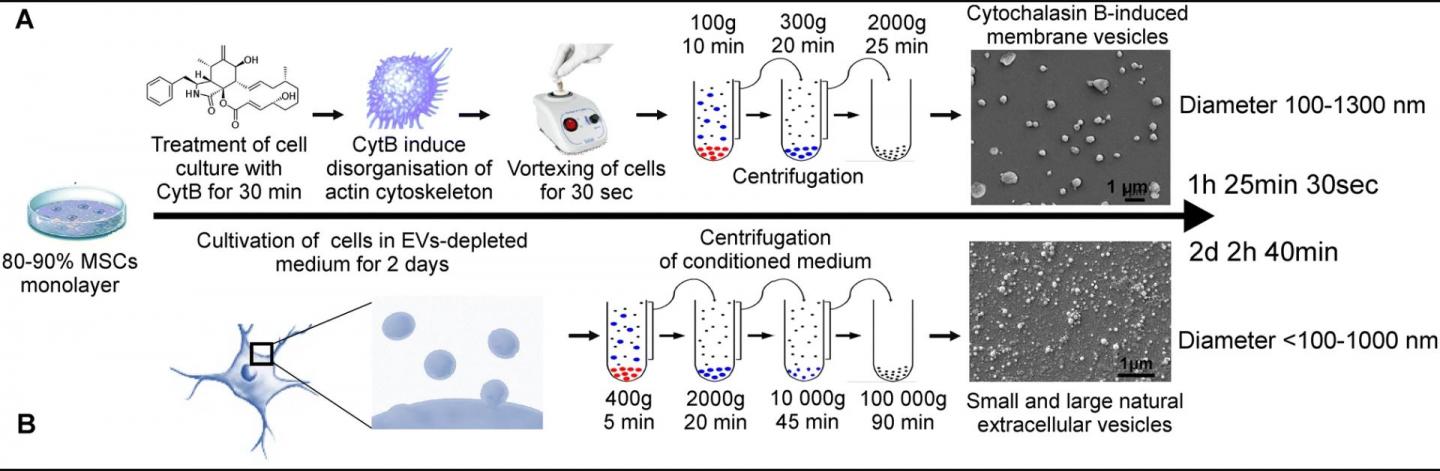
Group leader, Senior Research Associate Marina Gomzikova explains how microvesicles – bubbles surrounded by a natural cell membrane – can be biocompatible therapeutic instruments.

“We created a technology to obtain microvesicles from human stem cells and showed that they have significant biological activity and therapeutic potential. Microvesicles are basically miniature copies of cells. But, unlike stem cells, they are not oncogenic and can be a safe treatment medium,” she says.

The authors compared the activity of induced microvesicles with natural microvesicles and stem cells. The results show that induced microvesicles indeed can reduce the intensity of immune response.

“The uniqueness of induced microvesicles is that their technology is scalable and can be implemented at an industrial level. A new class of biomedical compounds can be based on microvesicles. The immunomodulating activity may be used to treat inflammations and autoimmune syndromes,” adds Albert Rizvanov, Director of Kazan Federal University’s Center for Precision and Regenerative Medicine.

Induced microvesicles can further down the road serve as vehicles to deliver medications against nervous system injuries, locomotor damage, ischemia, and many other illnesses. In contrast to stem cells, microvesicles can be prepared in large quantities, are easily stored and utilized even in facilities not equipped with biobanks or cell labs.

###

Media Contact
Yury Nurmeev
[email protected]

Original Source

https://kpfu.ru/eng/news-eng/microvesicles-for-therapy.html

Related Journal Article

http://dx.doi.org/10.1038/s41598-020-67563-9

Tags: BiochemistryBiologyCell Biology
Share12Tweet8Share2ShareShareShare2

Related Posts

Cutting Electrolyte Reduction Boosts High-Energy Battery Performance

Cutting Electrolyte Reduction Boosts High-Energy Battery Performance

December 19, 2025
Microenvironment Shapes Gold-Catalysed CO2 Electroreduction

Microenvironment Shapes Gold-Catalysed CO2 Electroreduction

December 11, 2025

Photoswitchable Olefins Enable Controlled Polymerization

December 11, 2025

Cation Hydration Entropy Controls Chloride Ion Diffusion

December 10, 2025
Please login to join discussion

POPULAR NEWS

  • Robotic Waist Tether for Research Into Metabolic Cost of Walking

    NSF funds machine-learning research at UNO and UNL to study energy requirements of walking in older adults

    71 shares
    Share 28 Tweet 18
  • Exploring Audiology Accessibility in Johannesburg, South Africa

    51 shares
    Share 20 Tweet 13
  • Nurses’ Views on Online Learning: Effects on Performance

    71 shares
    Share 28 Tweet 18
  • PTSD, Depression, Anxiety in Childhood Cancer Survivors, Parents

    44 shares
    Share 18 Tweet 11

About

We bring you the latest biotechnology news from best research centers and universities around the world. Check our website.

Follow us

Recent News

Revolutionizing Retinal Vessel Classification with Y-Net Networks

Breaking Diffraction Limits: Sharper Eye Imaging Advances

Impact of Dominant Follicle Size on IVF Outcomes

Subscribe to Blog via Email

Enter your email address to subscribe to this blog and receive notifications of new posts by email.

Join 71 other subscribers
  • Contact Us

Bioengineer.org © Copyright 2023 All Rights Reserved.

Welcome Back!

Login to your account below

Forgotten Password?

Retrieve your password

Please enter your username or email address to reset your password.

Log In
No Result
View All Result
  • Homepages
    • Home Page 1
    • Home Page 2
  • News
  • National
  • Business
  • Health
  • Lifestyle
  • Science

Bioengineer.org © Copyright 2023 All Rights Reserved.