• HOME
  • NEWS
  • EXPLORE
    • CAREER
      • Companies
      • Jobs
    • EVENTS
    • iGEM
      • News
      • Team
    • PHOTOS
    • VIDEO
    • WIKI
  • BLOG
  • COMMUNITY
    • FACEBOOK
    • INSTAGRAM
    • TWITTER
Saturday, February 7, 2026
BIOENGINEER.ORG
No Result
View All Result
  • Login
  • HOME
  • NEWS
  • EXPLORE
    • CAREER
      • Companies
      • Jobs
        • Lecturer
        • PhD Studentship
        • Postdoc
        • Research Assistant
    • EVENTS
    • iGEM
      • News
      • Team
    • PHOTOS
    • VIDEO
    • WIKI
  • BLOG
  • COMMUNITY
    • FACEBOOK
    • INSTAGRAM
    • TWITTER
  • HOME
  • NEWS
  • EXPLORE
    • CAREER
      • Companies
      • Jobs
        • Lecturer
        • PhD Studentship
        • Postdoc
        • Research Assistant
    • EVENTS
    • iGEM
      • News
      • Team
    • PHOTOS
    • VIDEO
    • WIKI
  • BLOG
  • COMMUNITY
    • FACEBOOK
    • INSTAGRAM
    • TWITTER
No Result
View All Result
Bioengineer.org
No Result
View All Result
Home NEWS Science News Cancer

Biologists discover process that neutralizes tumors

Bioengineer by Bioengineer
July 10, 2018
in Cancer
Reading Time: 2 mins read
0
Share on FacebookShare on TwitterShare on LinkedinShare on RedditShare on Telegram
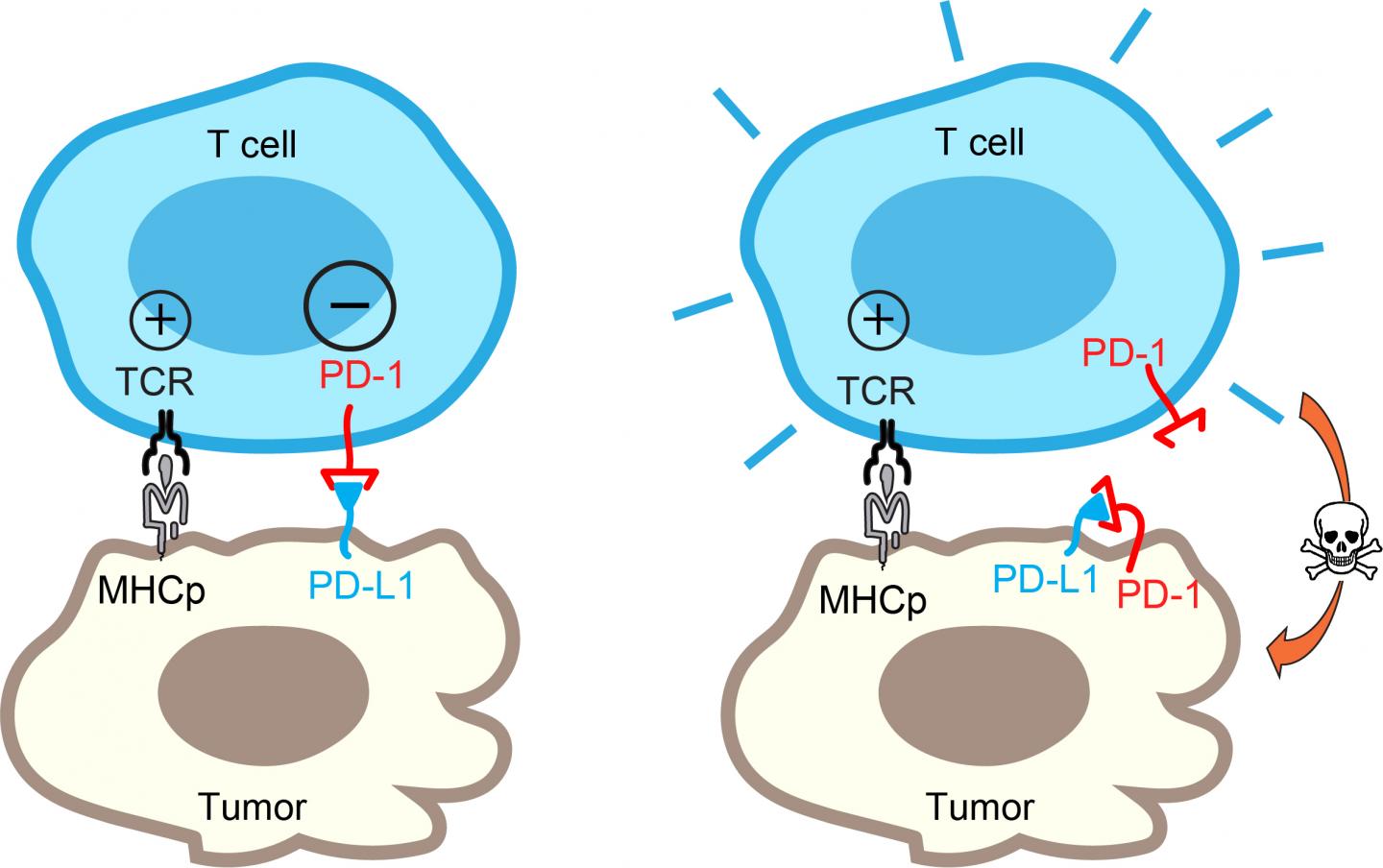
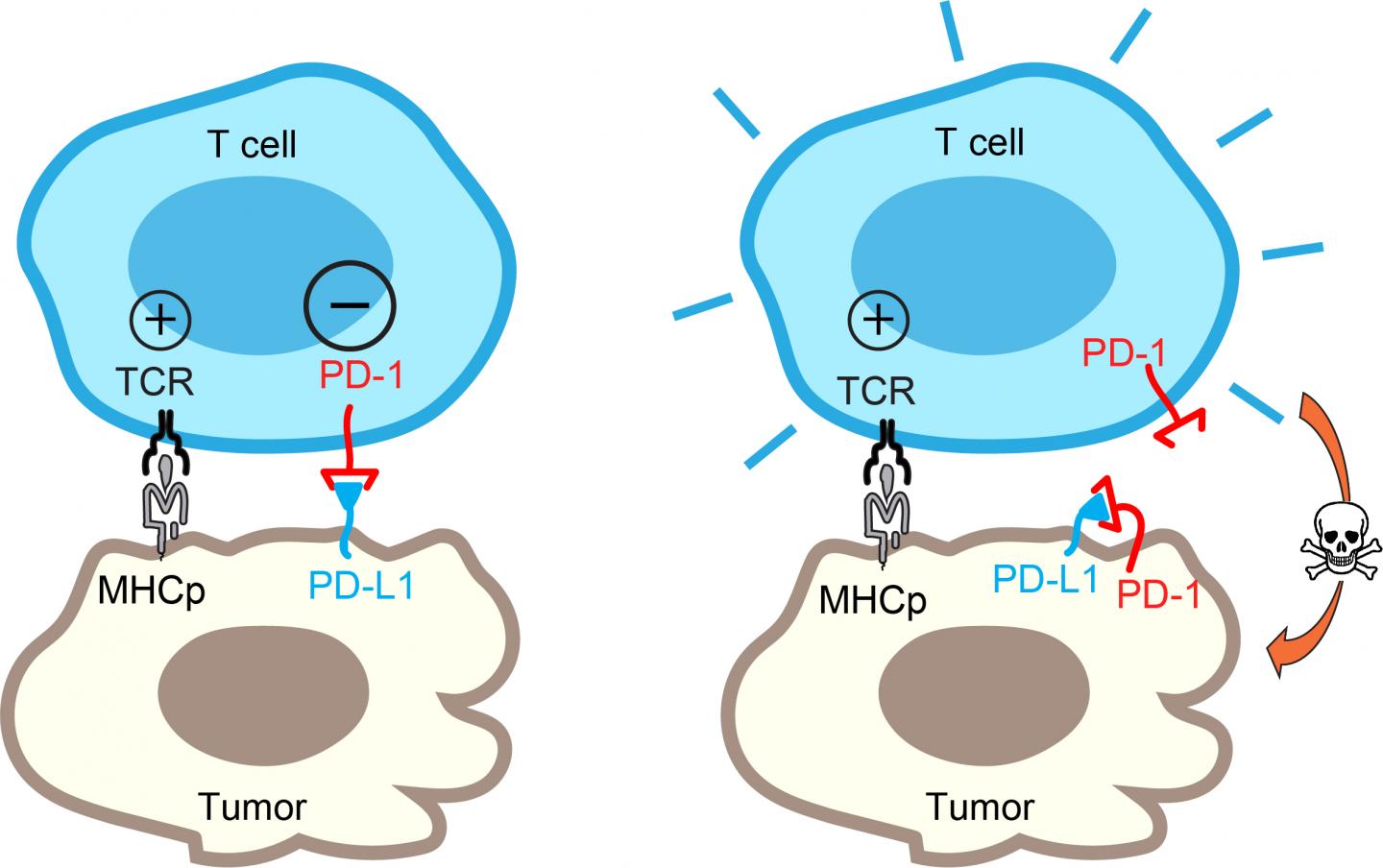
IMAGE

Credit: Hui Lab, UC San Diego

Researchers from the University of California San Diego have identified an unexpected mechanism that could help determine whether a cancer patient will respond to immunotherapy.

Ideally, the immune system identifies tumors as threatening elements and deploys immune cells (T cells) to find and kill them. However, tumor cells have evolved to employ a protein called PD-L1 to blind T cells from carrying out their functions and evade immune defenses. PD-L1 protects tumor cells by activating a "molecular brake" known as PD-1 to stop T cells.

In important therapeutic progress, antibodies developed to block PD-L1/PD-1 have been clinically proven to benefit certain cancer patients. Yet why some patients don't respond to such therapy has remained a mystery. Now, UC San Diego's Yunlong Zhao, Enfu Hui and their colleagues at the University of Chicago and the Nanjing Medical School in China have uncovered some clues.

As described July 10 in the journal Cell Reports, the researchers discovered an unexpected twist in the tumor versus T cell battle. Some tumor cells display not only their PD-L1 weapon, but also the PD-1 "brake." This simultaneous expression leads PD-1 to bind and neutralize PD-L1 on the same tumor cell. Thus, the PD-L1 on these tumor cells can no longer engage the PD-1 brake on T cells.

"It's a very exciting finding," said Hui. "Our study uncovered an unexpected role of PD-1 and another dimension of PD-1 regulation with important therapeutic implications."

This study suggests that patients with high levels of PD-1 on tumor cells may not respond well to the blocking antibodies because the PD-1 pathway is self-canceled. In these patients, mechanisms other than PD-L1/PD-1 are likely employed by the tumors to escape from immune destruction.

Looking to extend the immunotherapy potential of the finding, Hui and his colleagues are now seeking to determine additional mechanisms of "self-cancellation" at the interface of the tumor and immune cells.

"We think that our finding is the tip of the iceberg," said Hui, recently named a Pew Biomedical Scholar and Searle Scholar. "We speculate that self-cancellation is a general mechanism to regulate immune cell function. Understanding these processes more clearly will help develop better immunotherapy strategies and more reliably predict whether a patient will respond or not."

###

Coauthors of the paper, in addition to Zhao (a CRI Irvington Postdoctoral Fellow) and Hui, include Devin Harrison (supported by National Institutes of Health grant T32-EB009412) and Jun Huang (supported by NIH grants R00AI106941 and R21AI120010; and National Science Foundation CAREER award 1653782) from the University of Chicago, Yuran Song of UC San Diego and Jie Li of the Nanjing Medical School (China). The research also was supported by UC San Diego startup funds to Hui.

Media Contact

Mario Aguilera
[email protected]
858-822-5148
@UCSanDiego

http://www.ucsd.edu

Share12Tweet8Share2ShareShareShare2

Related Posts

Deep Learning Uncovers Tetrahydrocarbazoles as Potent Broad-Spectrum Antitumor Agents with Click-Activated Targeted Cancer Therapy Approach

February 7, 2026

Newly Discovered Limonoid DHL-11 from Munronia henryi Targets IMPDH2 to Combat Triple-Negative Breast Cancer

February 7, 2026

New Discovery Reveals Why Ovarian Cancer Spreads Rapidly in the Abdomen

February 6, 2026

New Study Finds Americans Favor In-Clinic Screening Over At-Home Tests for Cervical Cancer

February 6, 2026
Please login to join discussion

POPULAR NEWS

  • Robotic Ureteral Reconstruction: A Novel Approach

    Robotic Ureteral Reconstruction: A Novel Approach

    82 shares
    Share 33 Tweet 21
  • Digital Privacy: Health Data Control in Incarceration

    63 shares
    Share 25 Tweet 16
  • Study Reveals Lipid Accumulation in ME/CFS Cells

    57 shares
    Share 23 Tweet 14
  • Breakthrough in RNA Research Accelerates Medical Innovations Timeline

    53 shares
    Share 21 Tweet 13

About

We bring you the latest biotechnology news from best research centers and universities around the world. Check our website.

Follow us

Recent News

Palmitoylation of Tfr1 Drives Platelet Ferroptosis and Exacerbates Liver Damage in Heat Stroke

Oxygen-Enhanced Dual-Section Microneedle Patch Improves Drug Delivery and Boosts Photodynamic and Anti-Inflammatory Treatment for Psoriasis

Scientists Identify SARS-CoV-2 PLpro and RIPK1 Inhibitors Showing Potent Synergistic Antiviral Effects in Mouse COVID-19 Model

Subscribe to Blog via Email

Enter your email address to subscribe to this blog and receive notifications of new posts by email.

Join 73 other subscribers
  • Contact Us

Bioengineer.org © Copyright 2023 All Rights Reserved.

Welcome Back!

Login to your account below

Forgotten Password?

Retrieve your password

Please enter your username or email address to reset your password.

Log In
No Result
View All Result
  • Homepages
    • Home Page 1
    • Home Page 2
  • News
  • National
  • Business
  • Health
  • Lifestyle
  • Science

Bioengineer.org © Copyright 2023 All Rights Reserved.