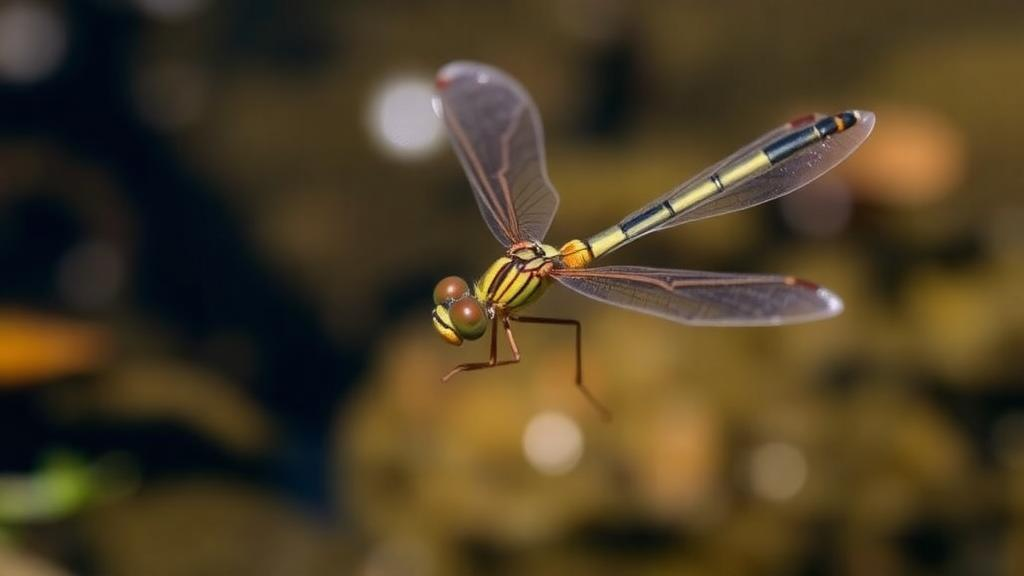
A field study of dragonflies and damselflies in Mexico’s Hidalgo state found that their species assemblages differed significantly among four biogeographic provinces, while the distinction between standing and flowing waters produced no significant difference in overall species richness. Across 64 sampling points visited in March and September 2024, researchers collected 380 adult odonates representing 51 species, six families and 22 genera. The Chihuahuan Desert province contained the largest number of recorded species, 27, followed by the Veracruzan province with 22, the Sierra Madre Oriental with 20 and the Trans-Mexican Volcanic Belt with 10. Community differences among provinces were associated with environmental conditions, but the strongest measured relationship was found for damselflies, whose composition varied significantly with local water and atmospheric variables. Dragonflies showed a different pattern, with their distribution across the landscape more consistent with their greater mobility and broader environmental tolerance.
The work focused on the Mexican Transition Zone, a region where Neotropical and Nearctic biogeographic elements meet. Hidalgo contains parts of the Chihuahuan Desert, the Sierra Madre Oriental, the Trans-Mexican Volcanic Belt and the Veracruzan province, creating a compact landscape in which contrasting climates, elevations, vegetation types and freshwater systems converge. The researchers selected two localities in each province. At every locality they sampled four lentic habitats, including pools, temporary ponds and drainage ditches, and four lotic habitats such as rivers, streams and creeks. Each site was visited during the dry season in March and the rainy season in September, with four hours of adult sampling per visit. The design produced 64 habitat observations per season and 64 hours of sampling effort per site.
Odonates are well suited to comparisons of environmental filtering because adults use both aquatic and terrestrial environments during their life cycles. Their larvae depend on water conditions, including pH, conductivity, dissolved solids, temperature and salinity, while their flying adults encounter variations in air temperature, humidity and solar radiation. Species also differ markedly in movement. Anisoptera, the dragonflies, generally disperse farther and tolerate environmental disturbance more successfully than Zygoptera, the damselflies. That distinction appeared in the study: the damselfly assemblage was linked more closely to local environmental measurements, whereas the dragonfly assemblage was less directly associated with the measured water variables. The authors describe the pattern as evidence that environmental filtering and dispersal limitation act together, rather than as proof that either mechanism alone determines community composition.
The taxonomic inventory included 22 dragonfly species in three families and 15 genera, with Libellulidae the most diverse family at 16 species. The damselfly sample contained 29 species in three families and seven genera, including 21 Coenagrionidae species. The survey also documented restricted-range species such as H. infecta, A. barretti, A. percellulata and C. vibex, alongside migratory species including A. junius, E. umbrata, P. flavescens and S. corruptum. P. longipennis represented a new state record for Hidalgo. With that addition, the state’s documented total reached 151 species, approximately 42% of Mexico’s recorded odonate diversity, making Hidalgo the country’s fifth most diverse state for the group.
Sample coverage was high in every province, ranging from 0.93 in the Chihuahuan Desert to 0.99 in the Sierra Madre Oriental, indicating that most of the regional species pools were captured. The Chihuahuan Desert had the highest estimated species richness, but its 95% confidence interval overlapped those of the Veracruzan and Sierra Madre Oriental provinces. Its richness was significantly higher than that of the Trans-Mexican Volcanic Belt, which contained only 10 species. The finding contradicted the study’s initial expectation that richness would peak in the warmer and more humid Veracruzan and Sierra Madre Oriental provinces. No significant overall difference in richness or Shannon diversity was detected between lentic and lotic habitats, even though 21 species occurred in both types, 18 only in lotic systems and 12 only in lentic systems.
Species composition nevertheless differed among habitats, with total Jaccard dissimilarity of 0.66 between lentic and lotic assemblages. This difference was stronger for dragonflies, at 0.77, than for damselflies, at 0.45. Across biogeographic provinces, average total dissimilarity was 0.70, consisting of an average turnover component of 0.50 and a nestedness component of 0.20. The greatest divergence occurred between the Trans-Mexican Volcanic Belt and the Veracruzan province, which had a dissimilarity value of 0.84. Only A. immunda was found in all four provinces. Dominant species also changed geographically: H. calverti led the Chihuahuan Desert inventory, I. demorsa the Trans-Mexican Volcanic Belt, A. ulmeca the Sierra Madre Oriental and A. sedula the Veracruzan province. These patterns show substantial species replacement rather than a simple sequence of richer and poorer communities.
A permutational multivariate analysis confirmed the importance of province for overall assemblage composition, producing a significant result of F = 3.308 and p < 0.0001. Habitat type, by contrast, did not significantly explain the overall composition, with F = 1.307 and p = 0.1271. Multivariate dispersion differed significantly among provinces for the complete dataset and for Zygoptera, but not for Anisoptera. A canonical correspondence analysis detected a significant relationship between measured environmental attributes and damselfly presence, with a trace of 1.798, p = 0.0257 and 48.01% of the model variance explained. The corresponding relationships were not significant for dragonflies or for the complete species pool, with p = 0.8419 and p = 0.1514, respectively. Damselflies responded positively to pH, minimum air and water temperatures, minimum humidity and conductivity, while dragonflies were most strongly associated with maximum humidity and water temperature.
The measurements suggest several mechanisms behind the geographic differences. Humidity and temperature are central environmental filters for many odonates, and warmer water can influence gas solubility, chemical toxicity, pH, conductivity and biological productivity. Some species collected in the study were positively associated with warmer water, while others were negatively associated with it, indicating that thermal responses are species-specific rather than uniform across the community. Most sampled water was neutral to slightly alkaline, generally between pH 7 and 8, although lentic sites in the Sierra Madre Oriental reached pH 5.5. High total dissolved solids and salinity occurred in the desert province, where seasonal dilution lowered concentrations during the wetter September survey. The authors caution that a high total dissolved solids value does not necessarily imply a negative ecological effect: concentrated desert waters can also support microorganisms and invertebrates that serve as food for odonate larvae.
The survey also highlights practical constraints on conservation. Most sampling localities were in the Panuco hydrographic region, an aquaculture zone that supplies water to cities and towns in Hidalgo, while a smaller portion fell within the Tuxpan-Nautla region, which contains waterbodies supporting the tropical part of the state. Many of these waterbodies lie outside or near protected natural areas and are vulnerable to anthropogenic modification. The authors report that the sampled assemblages combined biogeographic history, environmental filtering and differences in dispersal capacity, rather than identifying a single universal driver. Because damselflies were more sensitive to local conditions and less mobile, they may be especially vulnerable to disturbances in individual waterbodies. The study also records the ecological value of the Chihuahuan Desert, whose unexpectedly rich odonate assemblage was greater than that of the warmer, more humid provinces and challenges the assumption that odonate richness necessarily peaks in humid environments.
Subject of Research: Environmental and biogeographic controls on dragonfly and damselfly assemblages in Hidalgo, Mexico
Article Title: Environmental drivers of Odonate assemblages across biogeographic provinces in the Mexican Transition Zone
Article References: Silva-Hurtado, J., Martínez-Falcón, A., Goyenechea, I., López-Mendoza, S., & Octavio-Aguilar, P. (2026). Environmental drivers of Odonate assemblages across biogeographic provinces in the Mexican Transition Zone. Biodiversity Data Journal, 14, Article e189309. https://doi.org/10.3897/bdj.14.e189309
Image Credits: AI Generated
Keywords: odonates, dragonflies, damselflies, Hidalgo, Mexican Transition Zone, freshwater habitats, environmental filtering, beta diversity, Chihuahuan Desert, biogeography, Environmental, drivers
News Source: Margaret Porter. (October 19, 2026). Biogeography Shapes Odonate Diversity Across Hidalgo’s Waterbodies. Scienmag.