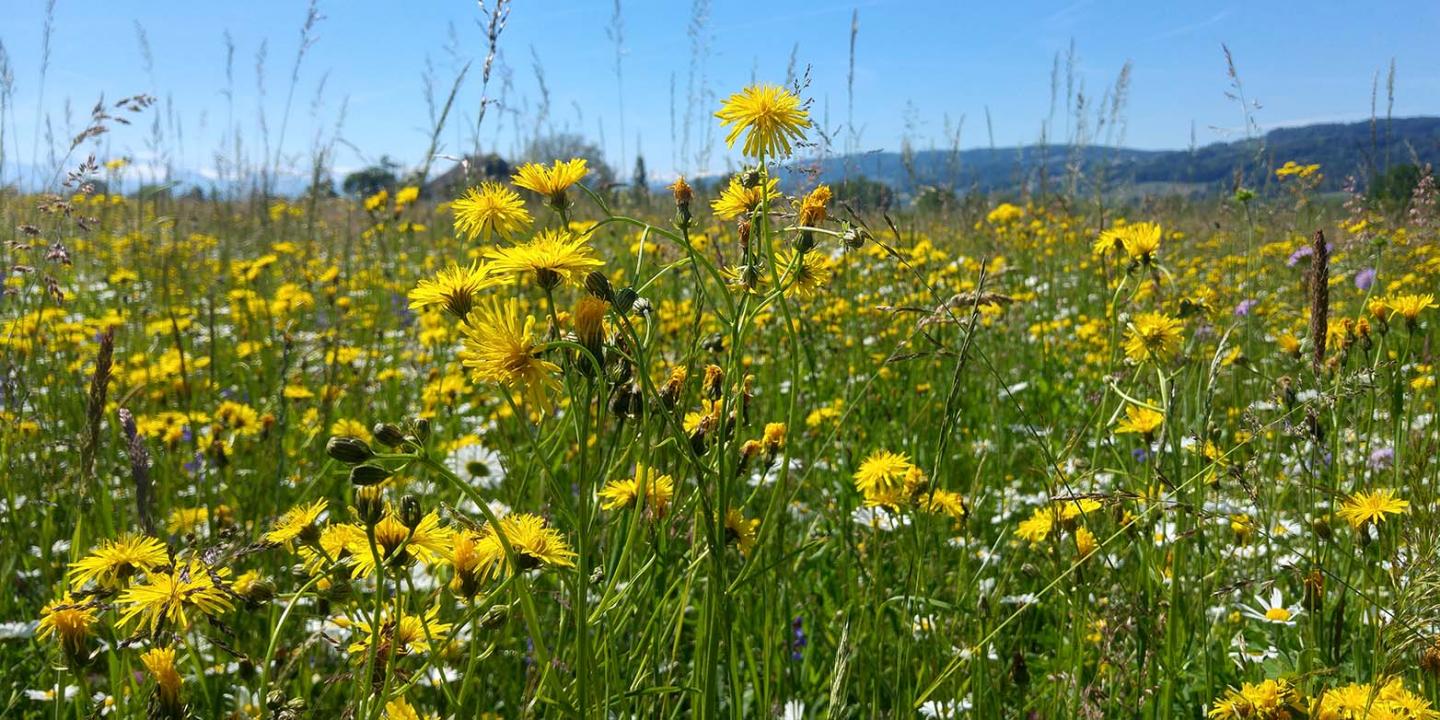
Credit: Valentin Klaus
Many farmers associate grassland biodiversity with lower yields and financial losses. “Biodiversity is often considered unprofitable, but we show that it can, in fact, pay off,” says Nina Buchmann, Professor of Grassland Sciences at ETH Zurich. In an interdisciplinary study at the interface of agricultural sciences, ecology and economics, Buchmann and her colleagues were able to quantify the economic added value of biodiversity based on a grassland experiment that examined different intensities of cultivation. Their paper has just been published in the journal Nature Communications.
Creating higher revenues
“Our work shows that biodiversity is an economically relevant factor of production,” says Robert Finger, Professor of Agricultural Economics and Policy at ETH Zurich. If 16 different plant species grow in a field instead of just one, the quality of the forage remains more or less the same, but the yield is higher – which directly correlates to the income that can be made from milk sales. “The resultant increase in revenues in our study is comparable to the difference in yield between extensively and intensively farmed land,” says Sergei Schaub, lead author of the study and a doctoral student in Finger’s and Buchmann’s groups.
Switzerland has so-called ecological compensation areas, i.e., grasslands for which farmers pay particular attention to promoting biodiversity. However, these areas often have poor soils and the yields they produce cannot be compared with those of high-quality grassland. Fortunately, the researchers were able to use data from the long-term Jena Experiment, which – among other questions – compared different farming practices at the same site.
“Our results show that biodiversity has an economically positive effect on all areas, regardless of whether farmers mow and fertilise them four times a year or just once,” Schaub says. The more intensely the land is farmed, however, the more difficult it becomes to maintain a high level of biodiversity, because only a few plant species can withstand fertilisation and frequent mowing, he notes. Finger adds that Swiss farmers already take more advantage of this economic effect than their counterparts in other countries. Generally speaking, biodiversity on the areas used for forage production in Switzerland is already relatively rich in biodiversity because the seed mixtures are adapted to local conditions, he explains.
Biodiversity as risk insurance
The researchers didn’t expect their results to be so conclusive. And there’s another economic aspect that they didn’t even factor in: “Biodiversity is also a kind of risk insurance,” Buchmann says. Diverse grasslands are better off to cope with extreme events such as droughts or floods, he explains, because different plant species react differently to such environmental influences, which partially compensates for any losses arising. “This means yields become more stable over time,” Buchmann says, as the research team demonstrated in other recent studies.
The researchers believe their results are a clear indication that it’s worthwhile for farmers to increase the diversity of plants growing on their land. “Preserving or restoring diverse grasslands can be a win-win situation,” the researchers note at the end of their paper. Not only because this increases farmers’ yields and operating revenues, but also because it improves and promotes important ecosystem services such as pollination or water quality.
###
Reference
Schaub S, Finger R, Leiber F, Probst S, Kreuzer M, Weigelt A, Buchmann N and Scherer-Lorenzen M. Plant diversity effects on forage quality, yield and revenues of semi-natural grasslands. Nat. Comm. (2020). doi 10.1038/s41467-?020-14541-4
Media Contact
Robert Finger
[email protected]
41-446-325-391
Original Source
https:/
Related Journal Article
http://dx.