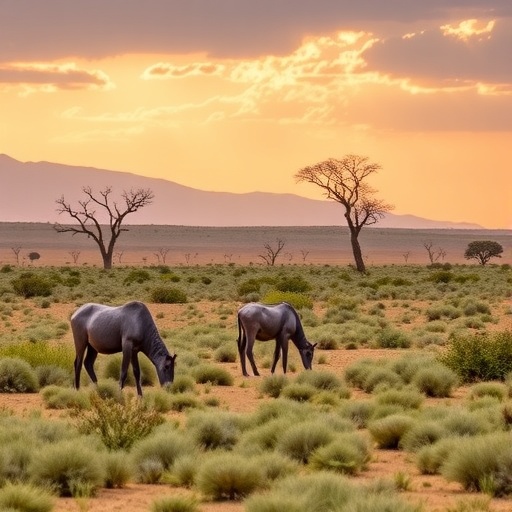
Biodiversity doesn’t boost ecosystem productivity in the same way everywhere when climate extremes hit. A new global synthesis draws on 75 long-term biodiversity experiments and finds that the payoff for having more species depends strongly on where—or how—drought intensifies.
The strongest benefits emerge in more-arid grasslands during years of extreme drought. Under these conditions, diverse plant communities raise productivity more than less-diverse ones, revealing a clear context dependence that is not matched in other settings.
Researchers attribute the drought-driven advantage mainly to complementarity among species. In practice, this means different plants contribute in functionally distinct and sometimes mutually supportive ways when water is scarce, so the community as a whole performs better than species acting alone.
In contrast, drier grasslands show drought-related changes that point to a different mechanism in less-arid sites. Where drought effects are present but less extreme, selection effects become more important—few particularly productive species dominate performance, reducing the overall “portfolio” benefit of diversity.
Forests complicate the picture. Despite biodiversity’s well-known role in ecosystem functioning, the synthesis detects no comparable context-dependent pattern under extreme drought across forest ecosystems. This suggests that diversity effects in forests may be slower to emerge or may depend on different biological signals than those typically measured in experiments.
Extreme heat likewise fails to produce consistent, ecosystem-wide shifts in how biodiversity affects productivity across aridity gradients. In other words, the diversity–performance relationship appears less responsive to heat extremes than to drought extremes in the analyzed dataset.
The study also tests whether soil nutrients reshape diversity effects under stress. No detectable moderation by soil nutrient conditions appears for either drought or heat extremes, pointing to water limitation as the dominant constraint as climatic stress intensifies.
To reach these conclusions, the researchers linked experimental biodiversity outcomes to long-term precipitation and maximum temperature records, along with site-level aridity and soil data, covering 2–23 years of experiment duration across broad climatic gradients.
Ultimately, the work reframes biodiversity conservation as a climate-adaptation strategy with geographic specificity: protecting biodiversity may yield the greatest productivity resilience in the driest grasslands facing worsening droughts.
Subject of Research: Biodiversity effects under climate extremes (drought and heat) in grasslands and forests
Article Title: Biodiversity effects under climate extremes intensify with aridity in grasslands but not forests
News Publication Date: 15-Jul-2026
Web References: https://doi.org/10.1038/s41559-026-03130-1
References: Nature Ecology & Evolution (doi:10.1038/s41559-026-03130-1)
Image Credits: YOKOHAMA National University
Keywords
Biodiversity, drought extremes, aridity, grasslands, forests, ecosystem productivity, complementarity, climate adaptation, soil nutrients, ecological diversity
Tags: biodiversity and ecosystem productivity during droughtbiodiversity effects in forest ecosystems under climate stressclimate change impacts on grassland and forest biodiversitycontext-dependent biodiversity benefitsdrought-dependent benefits of plant diversityecosystem functioning in dry grasslandsimpact of climate extremes on grassland biodiversityinfluence of aridity on biodiversity-benefit relationshipslong-term biodiversity experiments on drought resiliencerole of functional diversity in arid grasslandsselection effects versus complementarity in drought responsespecies complementarity in dry ecosystems