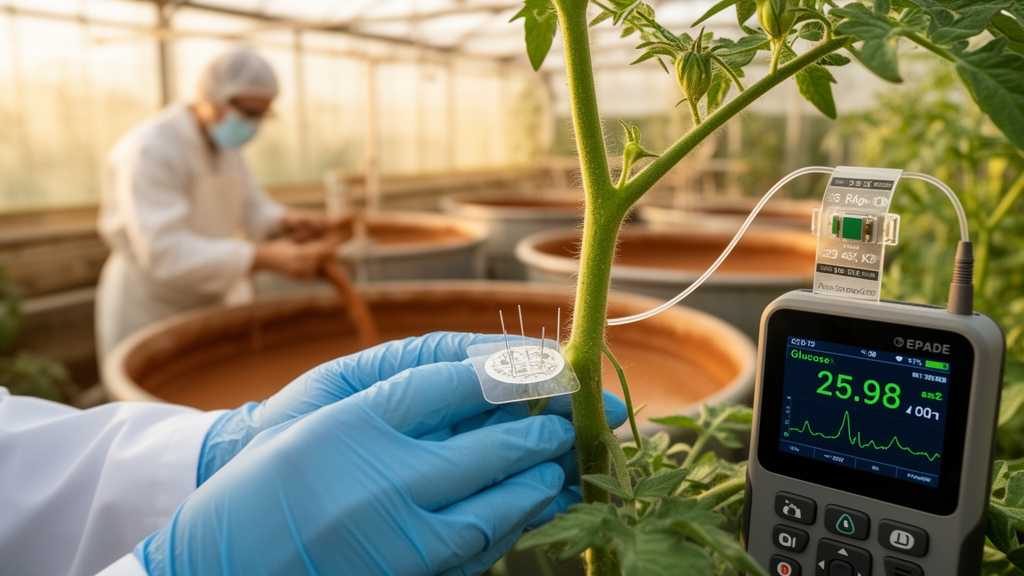
A single patch of biodegradable microneedles can now do two very different jobs at once: eavesdropping on the sugar metabolism of a living leaf and acting as an early-warning alarm for toxic ammonia leaks in leather factories. Researchers report in Collagen and Leather the construction of an electroactive, fully polymer-based microneedle sensor, dubbed PPG-MN, that penetrates plant tissue with minimal damage, monitors glucose continuously for 14 hours, and doubles as a chemiresistive ammonia gas detector covering the concentration range typical of industrial deliming processes.
The device is built from a polyvinyl alcohol hydrogel network interpenetrated with conductive polyaniline and doped with phytic acid, with glucose oxidase immobilized inside to give the sensor its specificity for glucose. The fabrication process is deliberately low-temperature: a 25% polyvinyl alcohol solution is cooled to 3–4 °C, phytic acid solution and aniline monomer are added, and ammonium persulfate is introduced to polymerize aniline in the acidic microenvironment that phytic acid provides. The precursor is injected into a polydimethylsiloxane mold and centrifuged to fill the needle tips, then subjected to three freeze-thaw cycles at −20 °C and 25 °C before demolding. The finished array has slender conical tips 1000 micrometers long, a base diameter of 390 micrometers, and a tip spacing of 1000 micrometers, dimensions that give it both the mechanical strength to pierce a leaf cuticle and the flexibility to conform to the leaf surface.
Phytic acid plays a triple role in the material. It acts as a proton reservoir that protonates amine and imine groups on the polyaniline chains, enabling electrical conductivity and crosslinking while buffering the response against minor pH fluctuations in plant interstitial fluid. Its abundant phosphate groups promote hydrophilic dispersion of polyaniline within the polyvinyl alcohol network. And its antimicrobial chemistry suppresses the bacterial contamination that any invasive tool faces during prolonged exposure to plant tissue. In plate-counting tests against Staphylococcus aureus and Escherichia coli, the microneedles reduced bacterial survival to 0.76% and 2.83% respectively, an inhibition rate exceeding 97% that the authors attribute to phytic acid’s chelation of essential divalent metal ions and the localized acidic environment, below pH 5, that its six phosphate groups create.
Mechanical testing showed the needles withstood 0.8 newtons per needle without failure, matching the reported puncture force of hydrated cocoa leaves and suggesting the array can feasibly penetrate leaves or stems. After insertion into green leaves, ultra-depth-of-field microscopy revealed that the tips did not fracture; they remained structurally intact with only slight bending, confirming penetration through the epidermal layer. The hydrogel base then swells: the swelling ratio of PPG-MN reached 94.7%, far higher than the 53.8% of plain polyvinyl alcohol, and the water contact angle dropped from 69.5° to 50.7°, indicating enhanced absorption of tissue fluid. This softening upon fluid absorption establishes a stable electrode-tissue interface without inducing secondary mechanical stress or micro-tearing in adjacent plant cells, the researchers report. The sensor retained approximately 95.4% of its sensitivity after leaf insertion, and calibration curves measured before and after insertion retained good linearity, with sensitivity falling only from 0.0218 to 0.0207 microamperes per millimolar.
The glucose-sensing chemistry relies on glucose oxidase, which catalyzes glucose oxidation and produces hydrogen peroxide that is oxidized at the electrode surface, generating a measurable current. Cyclic voltammetry showed distinct redox peaks for PPG-MN that were absent in undoped polyvinyl alcohol-polyaniline electrodes, confirming enzyme activity. In chronoamperometric tests, the sensor produced a linear current response across glucose concentrations of 10 to 100 millimolar, with the relationship y = 0.0218x + 3.8128 linking concentration to signal. Because glucose oxidase activity varies with temperature, the team calibrated the sensor across 10 to 40 °C and derived a temperature-adjusted equation that corrects the glucose reading using the sensor’s own temperature signal. Interference tests with sodium ions, L-ascorbic acid, dopamine, D-lactic acid, uric acid, and fructose at 10 millimolar showed negligible cross-reactivity against a 10 millimolar glucose reference. The response time is under 30 seconds.
Applied to Epipremnum aureum, the common pothos, the sensor tracked glucose dynamics over a full 14-hour diurnal cycle. At 8 a.m., after overnight respiration, glucose was low. Photosynthesis drove accumulation through the late morning, then a midday photosynthetic lunch break, in which stomata partially close to limit water loss under high temperature and light, briefly lowered glucose as sugars were converted to sucrose or starch. Levels peaked around 3 p.m. as stomata reopened, then declined through the evening as photosynthesis waned and respiration continued. The measured concentrations fluctuated within roughly 10 to 80 millimolar, consistent with established physiological levels of soluble sugars in pothos leaves. Spike-and-recovery validation in pothos leaf sap returned recoveries of 98.5% to 103.0% with relative standard deviations below 3.5%, indicating the complex plant matrix does not significantly interfere with the electrochemical response.
Controlled stress experiments reinforced the physiological picture. Plants kept in darkness for four days at 25 °C saw glucose fall to 14.3% of initial levels, reflecting impaired production and ongoing respiratory consumption. One-hour exposures to different light qualities produced distinct patterns: blue light inhibited starch synthesis and promoted glucose accumulation, while red light enhanced starch synthesis and limited immediate glucose accumulation but supported slower consumption in the dark through sufficient starch reserves. Temperature shifts also moved the needle: raising plants from 25 °C to 40 °C suppressed photosynthesis, closed stomata, and accelerated respiration, decreasing glucose, whereas lowering the temperature to 10 °C inhibited respiration and raised net glucose accumulation through photosynthesis. The authors note that for longer monitoring periods, such as 48 to 72 hours, stability would need enhancement through slow-release coatings or degradation-resistant materials.
The second function exploits the reversible doping and de-doping chemistry of the phytic acid-doped polyaniline network. When exposed to ammonia, the conductive emeraldine salt form of polyaniline undergoes deprotonation into the insulating emeraldine base, producing a sharp increase in electrical resistance. Tested at 40% humidity with a programmable gas-sensing device, the sensor showed rapid, distinct responses to 10, 200, 300, and 500 parts per million of ammonia, reaching stable plateaus of approximately 6%, 19%, 28%, and 37% respectively, and recovered steadily after gas removal at around 720 seconds. The calibration curve was strongly linear across the full 10 to 500 ppm range, with the regression y = 0.064x + 6.125 and a correlation coefficient of R² = 0.98644. That range encompasses the hazardous ammonia levels generated during leather deliming, a conventional tannery process that relies on ammonium salts and releases substantial toxic gas posing severe respiratory risks to workers.
The same polyaniline structure that senses ammonia also responds to ambient temperature and humidity, which the team turned into a feature. Resistance decreased rapidly as surface temperature rose from 25 °C to 50 °C and increased again upon cooling, driven by enhanced carrier mobility in polyaniline and intensified thermal electron motion. Resistance fell with rising humidity across the 25% to 50% relative humidity range, as adsorbed water molecules ionize protons and enhance conductivity. By calibrating these responses under known conditions and subtracting their influence from the current baseline, the researchers isolate glucose-specific signal changes, a compensation mechanism they describe as effective across the tested temperature and humidity spans.
Environmental disposability is a central claim of the work. Embedded in soil planted with sunflowers and watered weekly at approximately 25 °C, the sensor degraded completely within 35 days without impacting soil health or plant growth, according to photographic documentation at predetermined intervals. The authors position the platform as a candidate for agricultural Internet of Things systems and industrial gas pre-warning alike, while acknowledging the current limitation: operational stability is confined to roughly 14 hours, restricting multi-day phenotyping without sensor replacement. Future work, they write, will pursue an integrated microneedle-based three-electrode patch, enhanced enzyme stability, optimization for a broader range of plant species, and wireless IoT modules for continuous industrial gas leakage monitoring.
Subject of Research: A biodegradable conductive hydrogel microneedle sensor for minimally invasive in situ plant glucose monitoring and industrial ammonia gas detection
Article Title: Electroactive biodegradable microneedles for minimally invasive real-time, in-situ plant physiological monitoring and industrial NH3 sensing
Article References: Jiang, H., Zhao, T., Chen, L., Guo, P., Zou, L., Yang, L., & Liu, X. (2026). Electroactive biodegradable microneedles for minimally invasive real-time, in-situ plant physiological monitoring and industrial NH3 sensing. Collagen and Leather, 8(1), Article 33. https://doi.org/10.1186/s42825-026-00254-9
Image Credits: AI Generated
DOI: 10.1186/s42825-026-00254-9
Keywords: microneedles, biosensors, plant physiology, glucose monitoring, polyaniline, phytic acid, hydrogels, ammonia sensing, precision agriculture, leather industry, biodegradable sensors, Epipremnum aureum
News Source: Denise Maddox. (October 28, 2026). Biodegradable Microneedle Sensor Tracks Plant Glucose in Real Time and Sniffs Out Toxic Ammonia Leaks in Tanneries. Scienmag.