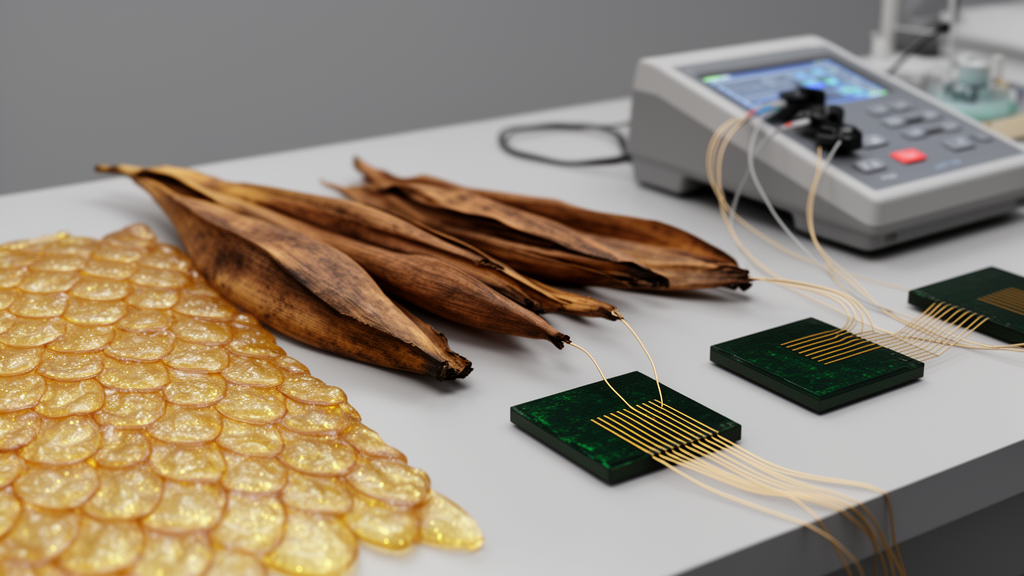
What if the solution to one of electronics’ most persistent environmental problems was lying in a vegetable market’s waste bin or a fishmonger’s discard pile? A research team in Bengaluru, India, has now shown that ordinary biodegradable materials, including banana bracts, fish scales, and even printing paper, can serve as functional electrode substrates for room-temperature gas sensors when coated with a specially engineered form of the conducting polymer polyaniline. The work, published in Frontiers in Sensors, tackles two chronic weaknesses of conventional gas sensing technology at once: the high operating temperatures that burn energy in traditional metal-oxide sensors, and the mountains of non-biodegradable electronic waste that discarded sensor devices leave behind.
The context for the study is stark. Ammonia, carbon monoxide, and sulfur dioxide are among the most consequential toxic gases in both industrial and domestic settings. Ammonia is ubiquitous in fertilizer production, refrigeration, and the chemical industry, and excessive exposure irritates the eyes, skin, and respiratory tract. Carbon monoxide is a colorless, odorless byproduct of incomplete fuel combustion, and even low concentrations can cause serious poisoning or death. Sulfur dioxide, released from industrial emissions and fossil fuel combustion, drives respiratory illness, acid rain, and broader atmospheric pollution. Sensors capable of monitoring these gases in real time at room temperature, without heating elements, are therefore a major goal in environmental sensing research.
Yet the environmental cost of sensors themselves has rarely been front and center. Most modern gas sensors are fabricated on petroleum-based polymer substrates such as polydimethylsiloxane, polyurethane, polystyrene, polyethylene terephthalate, polycarbonate, nylon, and polyimide. These materials are not biodegradable, which makes recovering valuable metals from the electrode materials of used devices a genuinely difficult process. As electronic waste has become one of the fastest-growing global waste streams, the research team argues that biodegradable substrates offer a promising alternative: at the end of a sensor’s lifetime, the substrate can disintegrate naturally, easing the recovery of harmful and valuable materials.
The active material at the heart of the new sensors is a modified polyaniline the authors call PAMD, standing for polyaniline doped with maleic acid and integrated with the anionic surfactant dioctyl sodium sulfosuccinate. Polyaniline is one of the most celebrated conducting polymers for gas sensing, but it has an Achilles heel: it is notoriously difficult to dissolve in either aqueous or organic media, which limits how it can be processed and applied. Solubility can be introduced by attaching alkyl or alkoxy groups to the aromatic ring through copolymerization, or, as in this study, by integrating surfactant molecules directly with the polymer chain.
To make PAMD, the team used chemical oxidative polymerization of aniline in water, adding ammonium peroxydisulfate as the oxidizing initiator, maleic acid as the dopant, and dioctyl sodium sulfosuccinate as the surfactant. After screening different molar ratios, they settled on an aniline to oxidant to dopant to surfactant ratio of 1:1:1:0.2, which yielded a dark green material with an electrical conductivity of about 10 to the power of minus 4 siemens per centimeter and, crucially, good solubility in organic solvents such as dimethylformamide and dimethyl sulfoxide. The surfactant’s role is to graft hydrophilic and hydrophobic functionality onto the polyaniline chains, rendering the polymer processable in both aqueous and non-aqueous conditions. At low surfactant concentrations the material was extremely difficult to prepare, while higher concentrations gave a well-dispersed product.
Characterization confirmed the design worked as intended. Ultraviolet-visible spectroscopy showed absorption bands at 300, 430, 590, and 880 nanometers, a pattern indicating the protonated, doped state of the polymer, with the band at 590 nanometers revealing incomplete doping that accounts for the modest conductivity. Fourier-transform infrared spectroscopy revealed the telltale signatures of the surfactant’s aliphatic carbon-hydrogen stretches alongside the quinoid and benzenoid ring vibrations characteristic of polyaniline, plus a strong carbonyl band confirming that the maleic acid dopant was incorporated into the chain. X-ray diffraction displayed peaks near 20 and 25 degrees in two-theta, corresponding to periodicity parallel and perpendicular to the polymer chains, indicating that the dopant and surfactant left the essential structural features of conventional polyaniline intact.
The coating process is strikingly simple. The researchers stirred 0.1 grams of PAMD into a milliliter of dimethylformamide to form a thick green paste, which was brushed onto cleaned, dried substrates cut into one-centimeter squares. Fish scales were recovered from fish waste, banana bracts were collected from a local vegetable market, and ordinary A4 printing paper was used as received. Two coats were applied and dried, and silver paint was added at two diametrically opposed edge points to provide electrical contact. The weight gain from coating was only about 26 milligrams, underscoring how little active material is needed.
When the coated substrates were exposed to ammonia at 5 parts per million, carbon monoxide at 7.1 parts per million, and sulfur dioxide at 3 parts per million, all at room temperature, the results revealed a clear hierarchy among the substrates. Fish scales coated with PAMD gave the strongest responses by far: exposure to ammonia drove resistance from 6.024 megaohms up to 7.001 megaohms in just two minutes, carbon monoxide dropped resistance from 7.416 to 6.808 megaohms, and sulfur dioxide lowered it from 5.202 to 4.955 megaohms. By contrast, the pressed PAMD pellets, with resistances in the kiloohm range, showed almost negligible changes, and paper and banana bract substrates fell in between. The explanation lies in morphology: a compact pellet packs polymer particles too tightly for gases to penetrate effectively, while the loosely packed coating on fish scales leaves ample polymer surface accessible to analytes. On paper and banana bracts, PAMD tends to occupy the pores of the substrate, limiting gas access.
The direction of the resistance change is itself diagnostic. Polyaniline is a p-type conducting polymer, so ammonia, a reducing gas, donates electrons that fill holes in the polymer, raising resistance. Carbon monoxide, through the positive charge of its resonance structure, withdraws electrons from unprotonated amine nitrogens and introduces additional holes, lowering resistance. Sulfur dioxide acts as an electron acceptor, drawing electrons from the polymer and likewise decreasing resistance. Recovery behavior was excellent: for both carbon monoxide and sulfur dioxide, resistance returned to within a fraction of its baseline in under two minutes, faster than the response time, and the sensors maintained repeatable performance over ten exposure cycles, retaining a high percentage of their initial response. Ammonia showed a larger residual drift, particularly on the fish scale substrate, because adsorbed ammonia molecules adhere more firmly and desorb more slowly.
Placed in context, the performance is genuinely competitive. Comparable polyaniline-based sensors typically detect ammonia at tens to hundreds of parts per million or sulfur dioxide at 10 to 50 parts per million, sometimes requiring elevated temperatures or ultraviolet light assistance, whereas the PAMD-coated biodegradable sensors responded to ammonia at 5 ppm, carbon monoxide at 7.1 ppm, and sulfur dioxide at 3 ppm with no additives and no heating. The authors suggest future work on optimizing coating thickness, selectivity, humidity effects, and flexible, wearable formats. If the field follows through, the humble fish scale, usually destined for the bin, may become a template for a new generation of disposable, compostable environmental monitors that protect human health without costing the planet.
Subject of Research: Processable polyaniline coated on biodegradable substrates for room-temperature chemiresistive detection of toxic gases
Article Title: Processable polyaniline modified biodegradable substrates as the electrode material for gas sensor application
Article References: Processable polyaniline modified biodegradable substrates as the electrode material for gas sensor application. (n.d.). https://doi.org/10.3389/fsens.2026.1889042
Image Credits: AI Generated
DOI: 10.3389/fsens.2026.1889042
Keywords: gas sensors, polyaniline, biodegradable substrates, fish scales, banana bracts, ammonia detection, carbon monoxide, sulfur dioxide, conducting polymers, room-temperature sensing, electronic waste, surfactant doping
News Source: Denise Maddox. (October 15, 2026). Biodegradable Fish Scales and Banana Bracts Turn Into Gas Sensors Thanks to Processable Polyaniline. Scienmag.