• HOME
  • NEWS
  • EXPLORE
    • CAREER
      • Companies
      • Jobs
    • EVENTS
    • iGEM
      • News
      • Team
    • PHOTOS
    • VIDEO
    • WIKI
  • BLOG
  • COMMUNITY
    • FACEBOOK
    • INSTAGRAM
    • TWITTER
Saturday, July 11, 2026
BIOENGINEER.ORG
No Result
View All Result
  • Login
  • HOME
  • NEWS
  • EXPLORE
    • CAREER
      • Companies
      • Jobs
        • Lecturer
        • PhD Studentship
        • Postdoc
        • Research Assistant
    • EVENTS
    • iGEM
      • News
      • Team
    • PHOTOS
    • VIDEO
    • WIKI
  • BLOG
  • COMMUNITY
    • FACEBOOK
    • INSTAGRAM
    • TWITTER
  • HOME
  • NEWS
  • EXPLORE
    • CAREER
      • Companies
      • Jobs
        • Lecturer
        • PhD Studentship
        • Postdoc
        • Research Assistant
    • EVENTS
    • iGEM
      • News
      • Team
    • PHOTOS
    • VIDEO
    • WIKI
  • BLOG
  • COMMUNITY
    • FACEBOOK
    • INSTAGRAM
    • TWITTER
No Result
View All Result
Bioengineer.org
No Result
View All Result
Home NEWS Science News Chemistry

Biochemistry: Versatile recycling in the cell

Bioengineer by Bioengineer
July 18, 2019
in Chemistry
Reading Time: 2 mins read
0
IMAGE
Share on FacebookShare on TwitterShare on LinkedinShare on RedditShare on Telegram

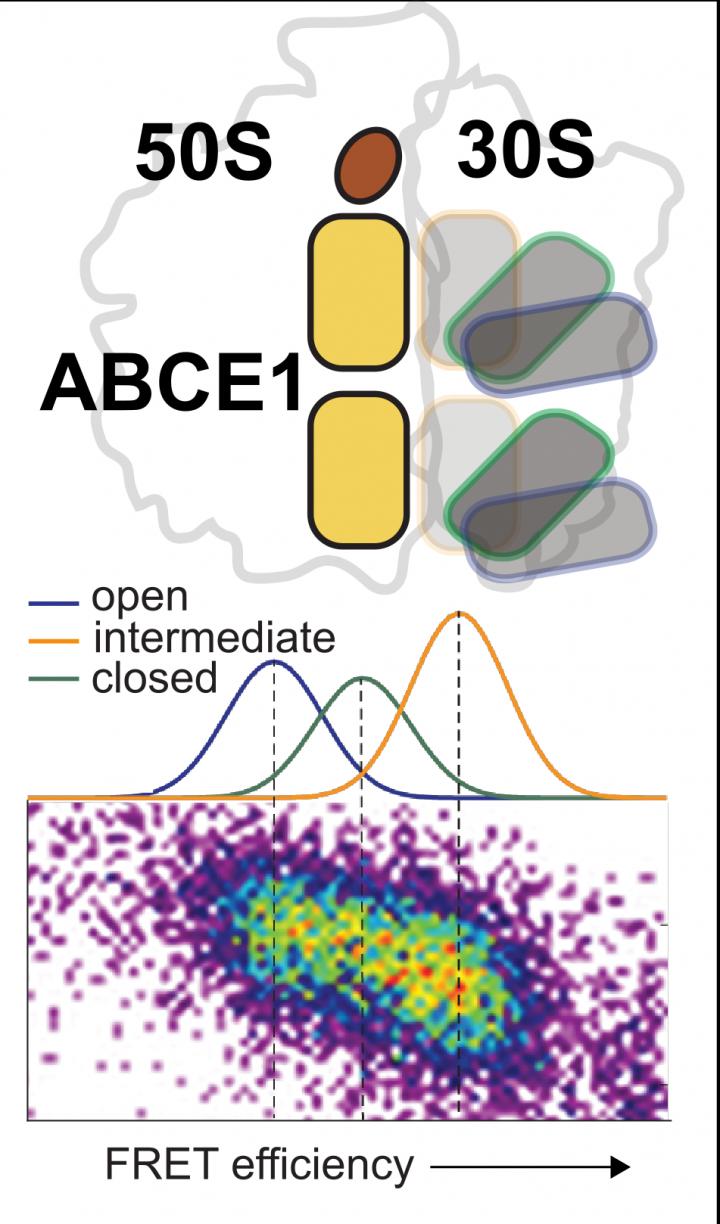
New insights into ribosome recycling with enzyme ABCE1
IMAGE

Credit: T. Cordes, LMU Munich

Ribosomes are molecular machines that produce proteins in cells. Having finished the job, the ribosomes need regenerating. This process is important for the quality of the proteins produced and thus for the whole cell homeostasis as well as for developmental and biological processes. Biochemists from Goethe University Frankfurt together with biophysicists at LMU Munich have now watched one of the most important enzymes for ribosome recycling at work – ABCE1 – and shown that it is unexpectedly versatile in terms of structure.

Ribosomes decode the genetic information from the messenger RNAs and translate it into proteins. Once they have produced a protein, but also if defective proteins have come to a halt in the ribosome, the ribosomes have to be “recycled” so that they are in good working order for a new round of synthesis. In all organisms (except bacteria), the enzyme ABCE1 coordinates this process, in which the ribosome is split into its two subunits. Biochemist Robert Tampé and LMU biophysicist Thorben Cordes, in collaboration with researchers at the University of Groningen (Netherlands), have shown that ABCE1 adopts three structural conformations to boost recycling. Their results are presented in the current issue of the journal Cell Report.

The ABCE1 enzyme can split ATP, the energy currency of cells, and use the energy released to separate the two ribosomal subunits. “Recent structural and functional data have shown that a conformational change of the enzyme, that is, a change in its spatial structure, is essential within this process for the diverse functions of ABCE1,” says Cordes. Using an integrated test approach – among others with the help of what is known as the single-molecule FRET method – his team has now observed at first hand the structural variability of ABCE1 at the level of single molecules.

In the course of this work, the researchers established that the two ATP binding sites of ABCE1 can adopt three conformations – open, intermediate and closed – which are in a state of dynamic equilibrium. Interaction of ABCE1 with both the ribosome and the ATP influences the structural dynamics of the two ATP binding sites. This results in a complex network of different states, in which ribosome and ATP shift the equilibrium in the direction of the closed conformation.

“We assume that the conformations perform functionally different roles in the dissociation of the ribosome as well as for the many other diverse functions of ABCE1,” says Cordes. “Ribosome recycling is governed by an extraordinarily complex and conserved machinery, which has medical significance as yet unimagined,” adds Robert Tampé.

###

Media Contact
Robert Tampe
[email protected]

Related Journal Article

http://dx.doi.org/10.1016/j.celrep.2019.06.052

Tags: BiochemistryBiologyCell Biology
Share12Tweet8Share2ShareShareShare2

Related Posts

Blue Light and Chemistry Simplify Complex Drug Production Steps

Blue Light and Chemistry Simplify Complex Drug Production Steps

July 10, 2026
New Discovery Promises Brighter, More Energy-Efficient Digital Displays

New Discovery Promises Brighter, More Energy-Efficient Digital Displays

July 10, 2026

New Crystalline 3D Frameworks Linked by Spiroborates Developed

July 10, 2026

IBEC Joins Major European Grant on Living Matter Physics

July 10, 2026
Please login to join discussion

POPULAR NEWS

  • Detection of EDCs in Breast Milk and Infant Urine Up to Six Months Highlights Early Exposure Risks

    77 shares
    Share 31 Tweet 19
  • New Drug Candidate Developed at McMaster Shows Potential for Treating Brain Cancer

    58 shares
    Share 23 Tweet 15
  • KTU Researchers Explore Ultrasound’s Role in Enhancing Blood Flow Beyond Diagnostics

    53 shares
    Share 21 Tweet 13
  • 高齢者の骨粗鬆症治療の持続性比較

    51 shares
    Share 20 Tweet 13

About

We bring you the latest biotechnology news from best research centers and universities around the world. Check our website.

Follow us

Recent News

Long-Term Home Deep Sleep Modulation Shows Promise in Parkinson’s Disease

Multi-Omics Reveal DNA Methylation Changes in Obesity Rat Model

Plasma pTau217 and pTau231 Forecast Dementia Progression in Parkinson’s Disease

Subscribe to Blog via Email

Enter your email address to subscribe to this blog and receive notifications of new posts by email.

Join 85 other subscribers
  • Contact Us

Bioengineer.org © Copyright 2023 All Rights Reserved.

Welcome Back!

Login to your account below

Forgotten Password?

Retrieve your password

Please enter your username or email address to reset your password.

Log In
No Result
View All Result
  • Homepages
    • Home Page 1
    • Home Page 2
  • News
  • National
  • Business
  • Health
  • Lifestyle
  • Science

Bioengineer.org © Copyright 2023 All Rights Reserved.