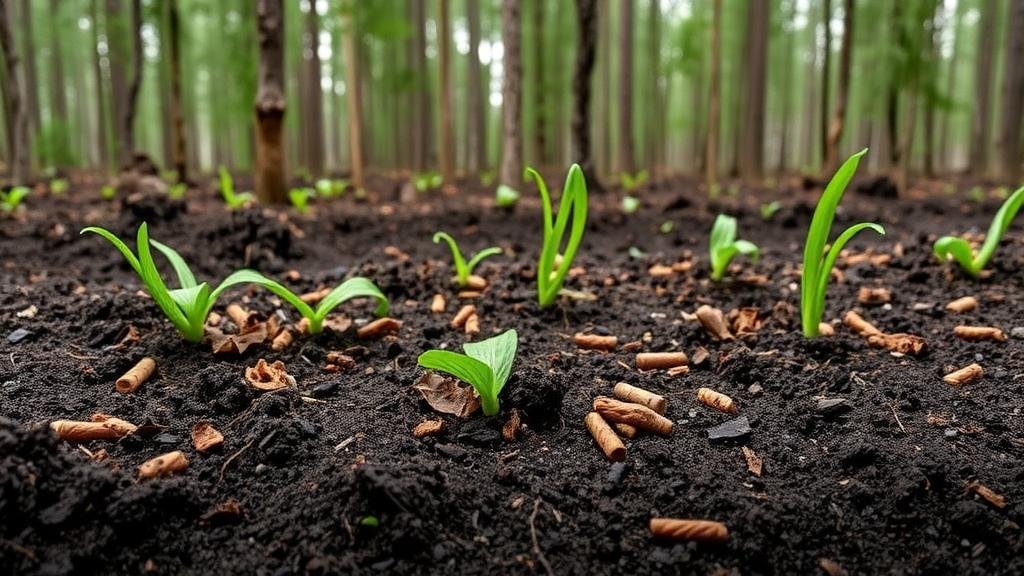
When bulldozers stripped the boreal forest from a patch of sandy ground near Happy Valley–Goose Bay in Labrador, Canada, they exposed something unforgiving: the acidic, iron- and aluminum-rich B horizon of a Podzol, a soil so leached and infertile that agriculture has historically been written off across much of the subarctic. Yet a new field experiment at Taiga Valley Farms, conducted in the very first growing season after forest-to-farmland conversion, shows that the right combination of soil amendments can turn this hostile substrate into productive forage land within a single summer. The findings, published in Discover Soil, carry immediate implications for northern food security as warming climates and regional food sovereignty concerns push agriculture into latitudes once considered agriculturally hopeless.
The research team, led by Aman Dhindsa of the University of Waterloo together with colleagues at Memorial University of Newfoundland, set out to answer a deceptively simple question: can farmers growing crops on freshly cleared boreal soil skip the years of near-barren production that normally follow land conversion? Converting forest to farmland disturbs natural soil horizon development and strips away the organic-rich surface layers, leaving behind mineral soil with poor nutrient retention, low cation exchange capacity, and concentrations of soluble aluminum and iron that suppress root growth and lock up phosphorus. The team hypothesized that pairing nutrient sources with organic matter inputs and liming agents would rapidly relieve these constraints.
To test this, the researchers established a randomized complete block design with 36 treatment combinations replicated across three blocks. Three nutrient sources were compared: a conventional mineral fertilizer blend of 20:10:5 N:P:K supplemented with potash, herring fish meal as a regionally relevant organic alternative, and an unfertilized control. These were crossed with four organic matter and liming treatments: hardwood biochar applied at 20.8 tonnes of carbon per hectare, sphagnum peat at 25.1 tonnes of carbon per hectare, peat combined with limestone at 5,400 kilograms per hectare, and no amendment. Each combination was grown under three cropping systems: monocrop oat, monocrop pea, and an oat-pea intercrop seeded in a 60:40 ratio.
The chemistry behind the two winning amendments tells much of the story. Hardwood biochar, produced by pyrolysis of biomass, carries alkaline ash fractions along with carboxylic, hydroxyl, and phenolic surface functional groups that neutralize acidity and adsorb cations. The biochar used in the trial had a measured calcium carbonate equivalence of 16.1 percent, contributing roughly 3,458 kilograms of CaCO3 equivalent per hectare. The peat-plus-limestone treatment delivered even more neutralizing power, about 4,806 kilograms of CaCO3 equivalent per hectare, dissolving to release calcium and magnesium that displace hydrogen and aluminum ions from exchange sites. Both amendments pushed soil pH from deeply acidic starting values toward the 5.9 to 6.4 range, while plots receiving peat alone or nothing at all languished between 5.27 and 5.63.
Those pH shifts cascaded through the entire soil-plant system. Biochar-amended and peat-with-limestone plots recorded the highest cation exchange capacity, the largest extractable potassium, calcium, and magnesium concentrations, and, critically, the greatest aboveground biomass, nitrogen, phosphorus, and potassium uptake in all three cropping systems, with differences statistically significant at p < 0.05. In oat plots, the best-performing biochar and fish meal combination out-yielded the worst unamended control treatment by more than fivefold. Biochar treatments alone pushed extractable soil potassium to 67.38 milligrams per kilogram in pea plots, while the intercrop system recorded the highest absolute potassium uptake of any cropping arrangement.
Not every expected response materialized. Despite raising pH, neither liming amendment produced a measurable increase in extractable soil phosphorus, a result the authors attribute to the overwhelming dominance of aluminum in these soils. Phosphorus sorption capacity in Podzols is tightly linked to Mehlich-3 extractable aluminum, which was by far the most abundant mineral measured at the site, so phosphate fixation persisted even as acidity eased. Soil organic matter content, meanwhile, remained stubbornly low at 1.01 to 1.87 percent across all plots after one season, confirming that a single growing season is far too short for microbial turnover and humification to build meaningful carbon stocks, even with massive carbon-rich inputs.
The nutrient source comparison delivered a surprise with practical consequences for remote northern farms. Herring fish meal, a dried fisheries byproduct with a carbon-to-nitrogen ratio of roughly 3.9, matched or nominally exceeded mineral fertilizer across most yield and uptake measurements, though the authors caution that statistical separation was limited. The explanation lies in mineralization dynamics: fish meal’s low C:N ratio supports rapid microbial conversion of organic nitrogen into plant-available mineral forms within a single season, whereas the ammonium and nitrate in mineral fertilizer are prone to leaching from coarse, low-CEC sandy soil before roots can capture them. Fish meal may also have fed the soil’s starved microbial community with additional carbon, improving nutrient cycling beyond nitrogen alone.
Nutrient use efficiency indices reinforced the amendment story. Nitrogen and phosphorus agronomic efficiencies and partial factor productivity consistently formed their top statistical groupings under biochar or peat with limestone, regardless of nutrient source. Recovery efficiency of nitrogen was highest under fish meal in every cropping system, reaching 1.20 kilograms of nitrogen taken up per kilogram applied in oat plots with peat and lime. Potassium recovery efficiency under biochar with fish meal ranged from 12.2 in pea to a striking 28.1 in the intercrop, reflecting biochar’s dual role as both a potassium source through its residual ash and a retention medium that keeps monovalent cations from being displaced by hydrogen and aluminum ions on exchange sites.
One agronomic detail stands out for anyone planning northern legume production: pea crops underperformed in nitrogen use efficiency relative to oat and the intercrop, likely because rhizobial nodulation is pH-sensitive and many plots remained below the optimal range for the nitrogen-fixing symbiosis, particularly where peat alone or no amendment was applied. This underscores that liming is not merely a yield booster but a prerequisite for the biological nitrogen fixation that makes legume intercrops attractive in low-input northern systems. The intercrop’s exceptional potassium uptake, combined with its more moderate yield swings between best and worst treatments, suggests mixed cropping adds resilience on newly converted land.
The authors are careful to frame their results as a first-season, single-site demonstration of chemical alleviation rather than long-term soil transformation, and they flag real-world caveats. The hardwood biochar was trucked in from Quebec, and at 20.8 tonnes of carbon per hectare its cost likely exceeds that of conventional limestone or locally harvested peat, though farmers in the Happy Valley–Goose Bay region are now exploring low-cost trench-pyrolysis methods to produce biochar locally. Peat with limestone matched biochar’s performance across many combinations while being cheaper and more available, but peat extraction is environmentally unsustainable over the long term because peatlands regenerate slowly and store regional carbon. What the trial proves, unambiguously, is that the acute fertility crisis of year one on converted boreal Podzol is solvable: with biochar or peat and lime, oat yields above five tonnes per hectare and pea yields above three tonnes per hectare became possible before any long-term organic matter accumulation had even begun. Multi-year, multi-site trials will now be needed to determine whether these rapid chemical gains persist and compound into durable northern farmland.
Subject of Research: Soil amendment effects on nutrient availability and forage crop uptake in recently converted boreal Podzolic soil
Article Title: Amendment-driven changes in nutrient availability and forage uptake in a recently converted boreal soil
Article References: Dhindsa, A., Unc, A., Kedir, A. J., & Oelbermann, M. (2026). Amendment-driven changes in nutrient availability and forage uptake in a recently converted boreal soil. Discover Soil, 3(1), Article 179. https://doi.org/10.1007/s44378-026-00318-6
Image Credits: AI Generated
DOI: 10.1007/s44378-026-00318-6
Keywords: biochar, Podzol, boreal agriculture, soil pH, liming, peat, fish meal, nutrient use efficiency, forage crops, oat-pea intercrop, Labrador, soil fertility
News Source: Alan Morgan. (October 6, 2026). Biochar and lime unlock first-year crops on converted boreal forest soil. Scienmag.