


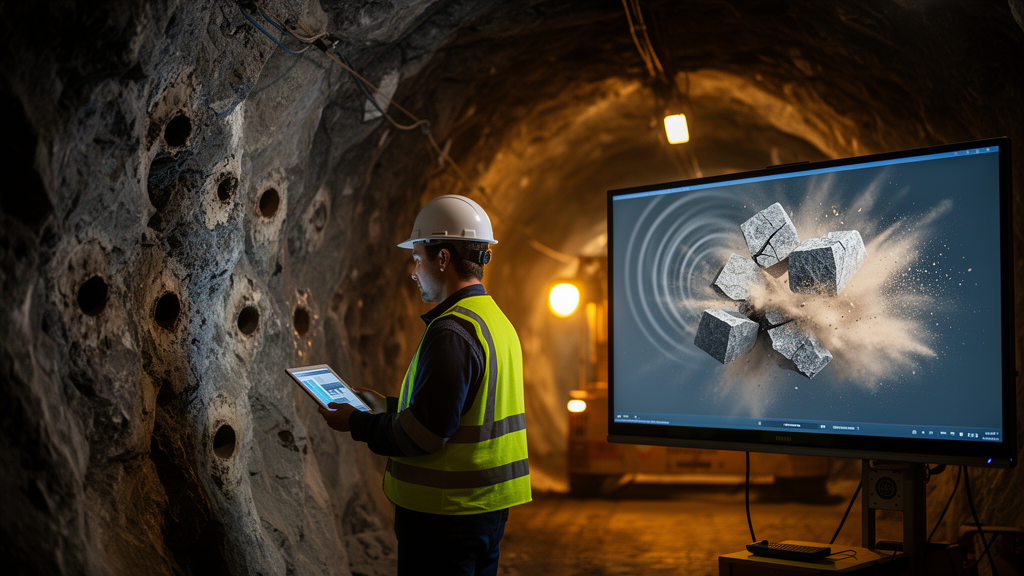
Rock tunnel blasting sends shock waves through the ground that can threaten the stability of surrounding rock, damage support structures, and disturb nearby surface facilities. Predicting those vibrations before the first charge is fired has long depended on laborious manual modeling, and a new study argues that the gap between building information modeling software and geotechnical simulation tools has been a major bottleneck. Researchers now report an automated workflow that links the two worlds, coupling a parametric BIM environment with discrete element numerical simulation to analyze blasting vibration in rock tunnels.
The work, published as an open access research article in Geomechanics and Geophysics for Geo-Energy and Geo-Resources, was led by Chengmeng Shao, Xing Li, Xing Chen, Guangde Jiang, and Jianchun Li, with Mingjia Zhang among the coauthors. According to the abstract, the direct application of BIM in tunnel engineering has been restricted by the linear characteristics of tunnel structures, the strong dependence on geological conditions, and the lack of dedicated modules for dynamic analysis. Numerical simulation, meanwhile, is effective for mechanical analysis, but data exchange between BIM platforms and geotechnical software remains inefficient, particularly for blasting-related dynamic problems.
The team’s answer is a four-part method that automates what was previously a fragmented, hand-driven process. The first component is a Revit-Dynamo-based parametric BIM workflow for rock tunnels, allowing tunnel geometry to be generated and adjusted through parameters rather than rebuilt from scratch. The second is a Dynamo-based equivalent blast load module, which constructs the blasting loads that drive the dynamic analysis. Together, these pieces let an engineer define a tunnel and its blasting scenario inside the BIM environment itself.
The third component tackles the data exchange problem head-on: a BIM-to-3DEC conversion scheme that transfers the model into 3DEC, a discrete element code suited to jointed rock masses, for automated dynamic analysis. The fourth closes the loop in the other direction, with a 3DEC-to-BIM result integration procedure that brings the numerical results back into the BIM platform for visualization. The authors describe the overall interaction mode as an automated analysis method integrating BIM and discrete element simulation, in which zoned blasting loads are applied automatically and numerical results are returned to BIM, as listed among the article’s highlights.
To test the approach, the researchers applied it preliminarily to the Xiangshan Tunnel of the Huai-Su-Beng intercity railway. Field monitoring data collected at the site were compared with the numerical results produced by the new workflow, providing a preliminary validation of the method in a real engineering environment rather than a purely synthetic demonstration.
The comparison showed that the proposed interaction mode is feasible for tunnel blasting vibration analysis, according to the abstract. The authors conclude that the method is promising for extending the application of BIM into the field of tunnel dynamic analysis, which they argue would improve the informatization and reliability of blasting construction management.
By scripting the tunnel model parametrically in Dynamo, generating equivalent blast loads automatically, converting data to 3DEC without manual reconstruction, and returning results to BIM, the method compresses that cycle into a repeatable pipeline, the highlights state.
The authors are careful about the strength of their claims. The application to the Xiangshan Tunnel is described as preliminary, and the validation rests on comparing field monitoring data with numerical results at a single fault-crossing site. The article itself is being shared early as peer-reviewed, accepted research that is citable and carries a permanent DOI, with the note that this version is subject to further edits and will be replaced by the final Version of Record. Broader performance across different tunnel types, rock conditions, and blasting designs remains to be demonstrated in subsequent work.
Subject of Research: Development of an automated BIM-3DEC workflow for blasting vibration analysis in rock tunnels, preliminarily validated at the Xiangshan Tunnel
Article Title: Development of a BIM-3DEC approach for blasting vibration analysis of rock tunnel
Article References: Shao, C., Li, X., Chen, X., Jiang, G., Zhang, M., & Li, J. (2026). Development of a BIM-3DEC approach for blasting vibration analysis of rock tunnel. Geomechanics and Geophysics for Geo-Energy and Geo-Resources. https://doi.org/10.1007/s40948-026-01248-x
Image Credits: AI Generated
DOI: 10.1007/s40948-026-01248-x
Keywords: BIM, 3DEC, blasting vibration, rock tunnel, discrete element simulation, Revit Dynamo, tunnel dynamics, Xiangshan Tunnel, fault-crossing tunnel, field monitoring, construction management, Development
News Source: Denise Maddox. (October 30, 2026). BIM Meets Discrete Element Simulation to Automate Tunnel Blasting Vibration Analysis. Scienmag.



