• HOME
  • NEWS
  • EXPLORE
    • CAREER
      • Companies
      • Jobs
    • EVENTS
    • iGEM
      • News
      • Team
    • PHOTOS
    • VIDEO
    • WIKI
  • BLOG
  • COMMUNITY
    • FACEBOOK
    • INSTAGRAM
    • TWITTER
Wednesday, May 13, 2026
BIOENGINEER.ORG
No Result
View All Result
  • Login
  • HOME
  • NEWS
  • EXPLORE
    • CAREER
      • Companies
      • Jobs
        • Lecturer
        • PhD Studentship
        • Postdoc
        • Research Assistant
    • EVENTS
    • iGEM
      • News
      • Team
    • PHOTOS
    • VIDEO
    • WIKI
  • BLOG
  • COMMUNITY
    • FACEBOOK
    • INSTAGRAM
    • TWITTER
  • HOME
  • NEWS
  • EXPLORE
    • CAREER
      • Companies
      • Jobs
        • Lecturer
        • PhD Studentship
        • Postdoc
        • Research Assistant
    • EVENTS
    • iGEM
      • News
      • Team
    • PHOTOS
    • VIDEO
    • WIKI
  • BLOG
  • COMMUNITY
    • FACEBOOK
    • INSTAGRAM
    • TWITTER
No Result
View All Result
Bioengineer.org
No Result
View All Result
Home NEWS Science News Chemistry

Big answers from tiny particles

Bioengineer by Bioengineer
September 14, 2020
in Chemistry
Reading Time: 2 mins read
0
IMAGE
Share on FacebookShare on TwitterShare on LinkedinShare on RedditShare on Telegram

IMAGE

Credit: Kanazawa University

Kanazawa, Japan – A team of scientists led by Kanazawa University proposed a new mathematical framework to understand the properties of the fundamental particles called neutrinos. This work may help cosmologists make progress on the apparent paradox of the existence of matter in the Universe.

The Standard Model of particle physics that outlines the basic constituents of matter and the forces that act between them has seen remarkable experimental success, culminating in the discovery of the last predicted particle, the Higgs boson, in 2012. However, the Standard Model does not resolve some of the long-standing issues in cosmology, such as the identity of “dark matter” that we know must be there but we cannot see, and why there is so much matter in the Universe compared with antimatter. Many scientists believe that the ghost-like particles called neutrinos may be an important part of the answer.

Neutrinos, which hardly interact with other matter, are created by nuclear reactions such as those that power our sun, and trillions of them pass through your body every second. Experiments have shown that, while not massless, neutrinos are much lighter than other particles. This has led physicists to hypothesize that neutrinos get their mass from a different process compared with other particles, called the “Seesaw mechanism.”

Now, a research team led by Kanazawa University has developed a new theory to explain the unusual properties of neutrinos.

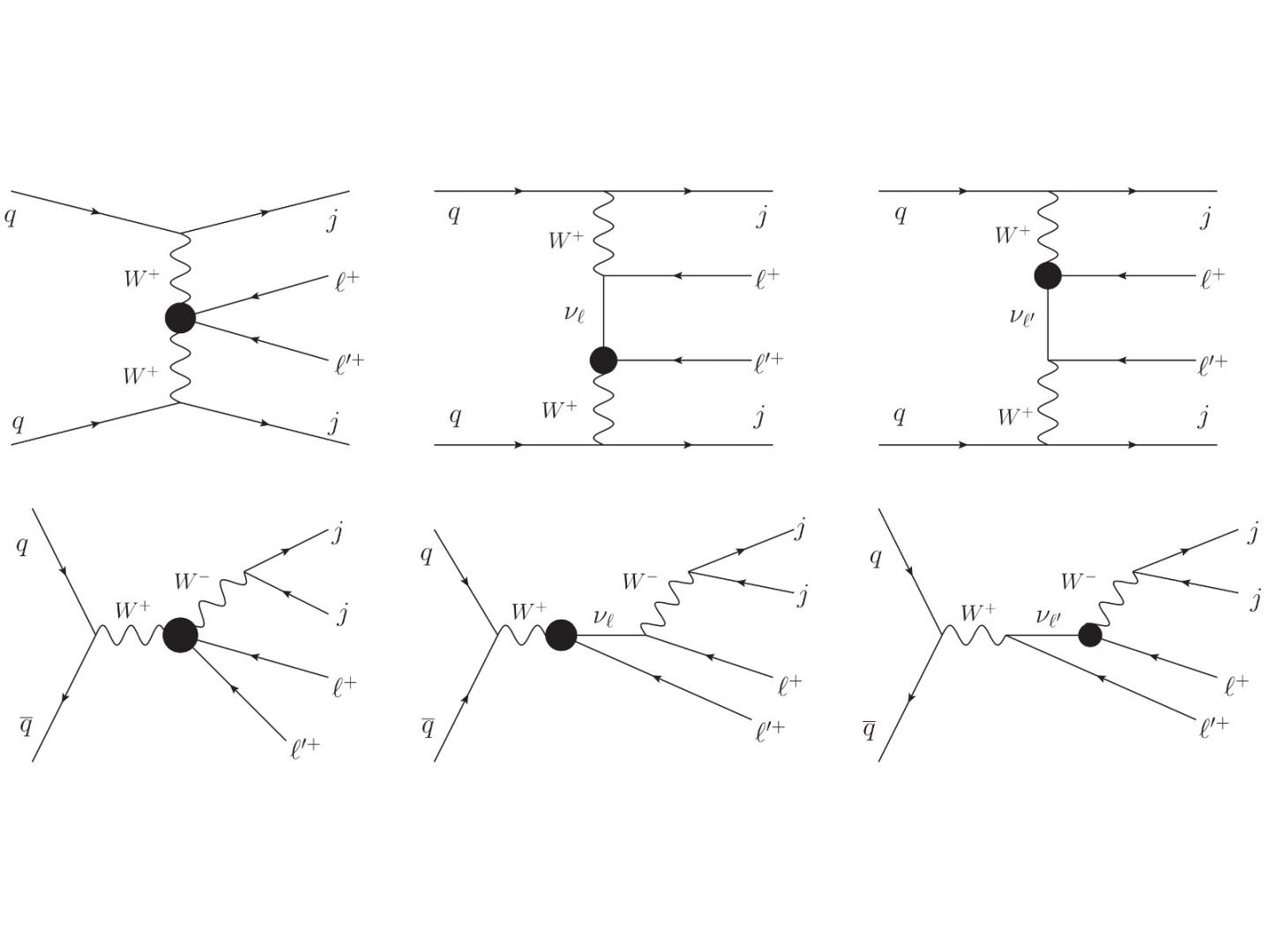
“We used the seesaw mechanisms with five- or seven-dimensional operators to describe the interaction of a neutrino with two lepton particles and two force-carrying W bosons,” explains Mayumi Aoki.

Leptons are a class of elementary particles that include neutrinos, electrons, and so on. Solving these equations showed violations of the Standard Model’s prediction that the number of leptons is always conserved.

“To move beyond the Standard Model, we have to explain why lepton conservation is sometimes violated, albeit to a very small degree,” says Aoki. “A tiny imbalance of one part in a trillion may explain the why all matter didn’t get annihilated by antimatter after the Big Bang.”

“Our work explains the origin of the neutrino mass and also provides predictions directly testable by the Large Hadron Collider,” says Aoki. The very light masses of neutrinos might hold the key to solving the big questions that have challenged humanity for millennia.

###

Media Contact
Tomoya Sato
[email protected]

Related Journal Article

http://dx.doi.org/10.1103/PhysRevD.101.115019

Tags: Chemistry/Physics/Materials SciencesParticle Physics
Share12Tweet8Share2ShareShareShare2

Related Posts

Gravitational Wave Detectors Now Feature Automatic Signal Tuning — Chemistry

Gravitational Wave Detectors Now Feature Automatic Signal Tuning

May 13, 2026
Harnessing Neural Networks for Advances in Nonlinear Optics — Chemistry

Harnessing Neural Networks for Advances in Nonlinear Optics

May 12, 2026

Innovative Method Unveiled to Detect Signs of Dark Matter

May 12, 2026

Illuminating the Science Behind Historical Featherwork Art

May 12, 2026
Please login to join discussion

POPULAR NEWS

  • Research Indicates Potential Connection Between Prenatal Medication Exposure and Elevated Autism Risk

    842 shares
    Share 337 Tweet 211
  • New Study Reveals Plants Can Detect the Sound of Rain

    728 shares
    Share 290 Tweet 182
  • Salmonella Haem Blocks Macrophages, Boosts Infection

    62 shares
    Share 25 Tweet 16
  • Breastmilk Balances E. coli and Beneficial Bacteria in Infant Gut Microbiomes

    57 shares
    Share 23 Tweet 14

About

BIOENGINEER.ORG

We bring you the latest biotechnology news from best research centers and universities around the world. Check our website.

Follow us

Recent News

Postmenopausal Women Face Increased Mortality Risk from Osteoporosis, New Research Shows

AI Predicts Hospital Admissions from Emergency Departments

Robust Magnetoelectric Backscatter System Boosts Bioelectronic Implants

Subscribe to Blog via Email

Enter your email address to subscribe to this blog and receive notifications of new posts by email.

Join 82 other subscribers
  • Contact Us

Bioengineer.org © Copyright 2023 All Rights Reserved.

Welcome Back!

Login to your account below

Forgotten Password?

Retrieve your password

Please enter your username or email address to reset your password.

Log In
No Result
View All Result
  • Homepages
    • Home Page 1
    • Home Page 2
  • News
  • National
  • Business
  • Health
  • Lifestyle
  • Science

Bioengineer.org © Copyright 2023 All Rights Reserved.