• HOME
  • NEWS
  • EXPLORE
    • CAREER
      • Companies
      • Jobs
    • EVENTS
    • iGEM
      • News
      • Team
    • PHOTOS
    • VIDEO
    • WIKI
  • BLOG
  • COMMUNITY
    • FACEBOOK
    • INSTAGRAM
    • TWITTER
Monday, October 5, 2026
BIOENGINEER.ORG
No Result
View All Result
  • Login
  • HOME
  • NEWS
  • EXPLORE
    • CAREER
      • Companies
      • Jobs
        • Lecturer
        • PhD Studentship
        • Postdoc
        • Research Assistant
    • EVENTS
    • iGEM
      • News
      • Team
    • PHOTOS
    • VIDEO
    • WIKI
  • BLOG
  • COMMUNITY
    • FACEBOOK
    • INSTAGRAM
    • TWITTER
  • HOME
  • NEWS
  • EXPLORE
    • CAREER
      • Companies
      • Jobs
        • Lecturer
        • PhD Studentship
        • Postdoc
        • Research Assistant
    • EVENTS
    • iGEM
      • News
      • Team
    • PHOTOS
    • VIDEO
    • WIKI
  • BLOG
  • COMMUNITY
    • FACEBOOK
    • INSTAGRAM
    • TWITTER
No Result
View All Result
Bioengineer.org
No Result
View All Result
Home NEWS Science News Chemistry

Better batteries start with basics — and a big computer

Bioengineer by Bioengineer
March 19, 2021
in Chemistry
Reading Time: 3 mins read
0
IMAGE
Share on FacebookShare on TwitterShare on LinkedinShare on RedditShare on Telegram

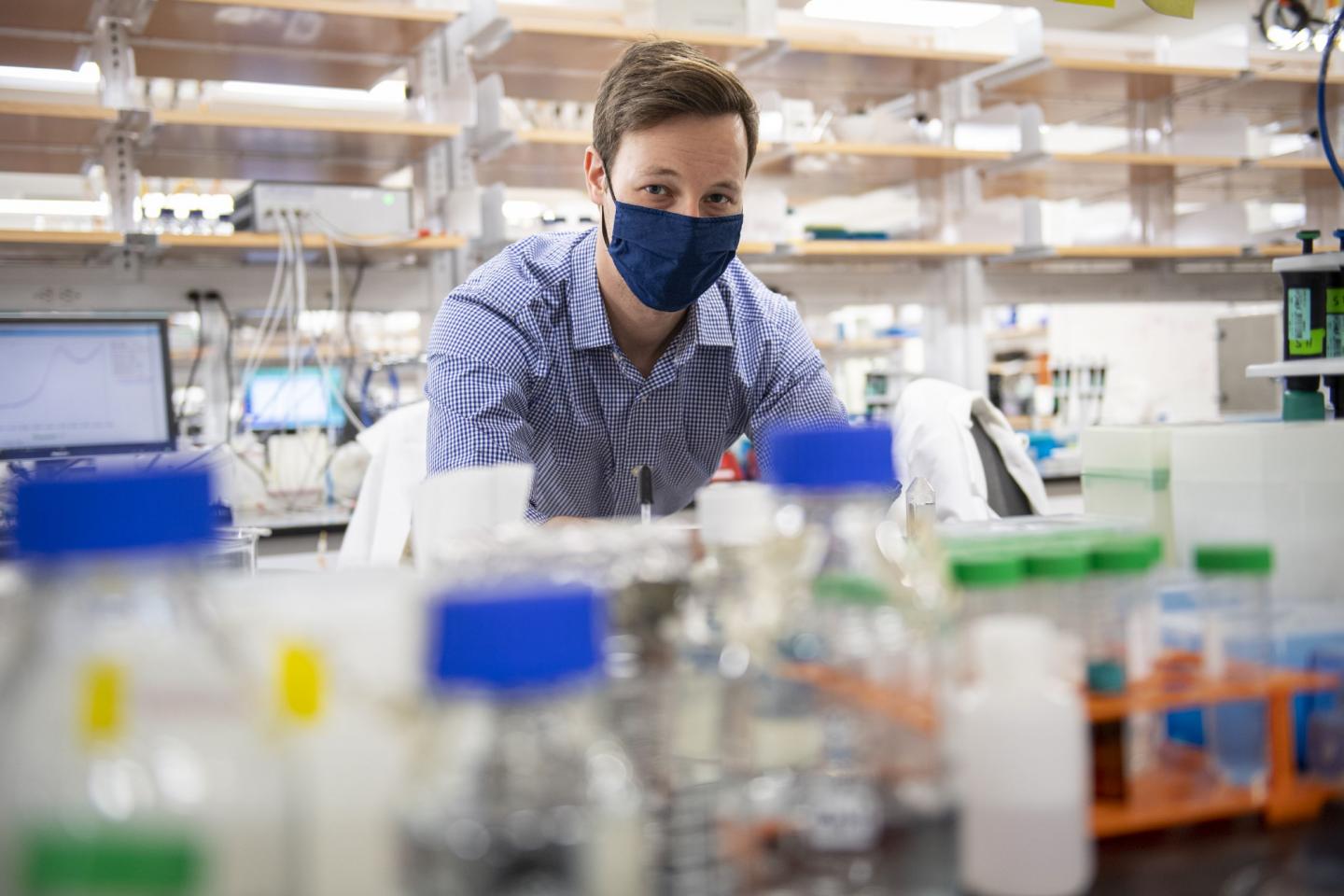
UC chemists used quantum simulations to understand a solvent that holds promise for green energy
IMAGE

Credit: Colleen Kelley/UC Creative

To understand the fundamental properties of an industrial solvent, chemists with the University of Cincinnati turned to a supercomputer.

UC chemistry professor and department head Thomas Beck and UC graduate student Andrew Eisenhart ran quantum simulations to understand glycerol carbonate, a compound used in biodiesel and as a common solvent.

They found that the simulation provided detail about hydrogen bonding in determining the structural and dynamic properties of the liquid that was missing from classical models. The study was published in the Journal of Physical Chemistry B.

Glycerol carbonate could be a more environmentally friendly chemical solvent for things like batteries. But chemists have to know more about what’s going on in these solutions. They studied the compounds potassium fluoride and potassium chloride.

“The study we did gives us a fundamental understanding of how small changes to a molecular structure can have larger consequences for the solvent as a whole,” Eisenhart said. “And how these small changes make its interactions with very important things like ions and can have an effect on things like battery performance.”

Water is a seemingly simple solvent, as anyone who has stirred sugar in their coffee can attest.

“People have studied water for hundreds of years — Galileo studied the origin of flotation in water. Even with all that research, we don’t have a complete understanding of the interactions in water,” Beck said. “It’s amazing because it’s a simple molecule but the behavior is complex.”

For the quantum simulation, the chemists turned to UC’s Advanced Research Computing Center and the Ohio Supercomputer Center. Quantum simulations provide a tool to help chemists better understand interactions on an atomic scale.

“Quantum simulations have been around for quite a while,” Eisenhart said. “But the hardware that’s been evolving recently — things like graphics processing units and their acceleration when applied to these problems — creates the ability to study larger systems than we could in the past.”

“How do ions dissolve in this liquid compared to water? First we had to understand what the basic structure was of the liquid,” Beck said.

The research was funded by a grant from the National Science Foundation. 

Every lithium ion battery contains a solvent. Finding a better one could improve energy storage and efficiency.

“The world is moving in a sustainability direction. It’s pretty clear that wind and solar will be two major contributors along with other green energy,” Beck said. “But the energy generated is intermittent. So you need methods for large-scale energy storage so that if it’s cloudy for two days, a city can stay running.”

###

Media Contact
Michael Miller
[email protected]

Original Source

https://www.uc.edu/news/articles/2021/03/uc-chemists-use-supercomputers-to-understand-solvents.html

Related Journal Article

http://dx.doi.org/10.1021/acs.jpcb.0c10942

Tags: Chemistry/Physics/Materials SciencesEnergy/Fuel (non-petroleum)Materials
Share13Tweet8Share2ShareShareShare2

Related Posts

Castor Plant Chemistry Shows Surprising Anti-Inflammatory Power in Lab Tests

Castor Plant Chemistry Shows Surprising Anti-Inflammatory Power in Lab Tests

October 5, 2026
Physicists Use Rotating Light to Reveal Hidden Eight-Pole Magnetism in Crystals

Physicists Use Rotating Light to Reveal Hidden Eight-Pole Magnetism in Crystals

October 5, 2026

Graphene-Anchored Bismuth-Antimony Sulfide Nanorods Boost Lithium and Sodium Battery Anodes

October 5, 2026

Pomegranate Seeds, Long Thrown Away, Yield Protein Fractions With Surprising Food Power

October 5, 2026
Please login to join discussion

POPULAR NEWS

  • Alloys That Shrink Their Own Grains: New PIX Mechanism Refines Metals With Heat Alone

    Alloys That Shrink Their Own Grains: New PIX Mechanism Refines Metals With Heat Alone

    29 shares
    Share 12 Tweet 7
  • Endurance Exercise Reshapes the Liver in Males and Females Through Distinct Molecular Routes

    29 shares
    Share 12 Tweet 7
  • Single Transcription Factor PU.1 Rapidly Converts Fibroblasts into Macrophage-Lineage Cells

    29 shares
    Share 12 Tweet 7
  • New Scale Measures How Ready Nurse Educators Really Are for the AI Era

    29 shares
    Share 12 Tweet 7

About

We bring you the latest biotechnology news from best research centers and universities around the world. Check our website.

Follow us

Recent News

Alloys That Shrink Their Own Grains: New PIX Mechanism Refines Metals With Heat Alone

Endurance Exercise Reshapes the Liver in Males and Females Through Distinct Molecular Routes

Single Transcription Factor PU.1 Rapidly Converts Fibroblasts into Macrophage-Lineage Cells

Subscribe to Blog via Email

Success! An email was just sent to confirm your subscription. Please find the email now and click 'Confirm' to start subscribing.

Join 85 other subscribers
  • Contact Us

Bioengineer.org © Copyright 2023 All Rights Reserved.

Welcome Back!

Login to your account below

Forgotten Password?

Retrieve your password

Please enter your username or email address to reset your password.

Log In
No Result
View All Result
  • Homepages
    • Home Page 1
    • Home Page 2
  • News
  • National
  • Business
  • Health
  • Lifestyle
  • Science

Bioengineer.org © Copyright 2023 All Rights Reserved.