• HOME
  • NEWS
  • EXPLORE
    • CAREER
      • Companies
      • Jobs
    • EVENTS
    • iGEM
      • News
      • Team
    • PHOTOS
    • VIDEO
    • WIKI
  • BLOG
  • COMMUNITY
    • FACEBOOK
    • INSTAGRAM
    • TWITTER
Monday, March 30, 2026
BIOENGINEER.ORG
No Result
View All Result
  • Login
  • HOME
  • NEWS
  • EXPLORE
    • CAREER
      • Companies
      • Jobs
        • Lecturer
        • PhD Studentship
        • Postdoc
        • Research Assistant
    • EVENTS
    • iGEM
      • News
      • Team
    • PHOTOS
    • VIDEO
    • WIKI
  • BLOG
  • COMMUNITY
    • FACEBOOK
    • INSTAGRAM
    • TWITTER
  • HOME
  • NEWS
  • EXPLORE
    • CAREER
      • Companies
      • Jobs
        • Lecturer
        • PhD Studentship
        • Postdoc
        • Research Assistant
    • EVENTS
    • iGEM
      • News
      • Team
    • PHOTOS
    • VIDEO
    • WIKI
  • BLOG
  • COMMUNITY
    • FACEBOOK
    • INSTAGRAM
    • TWITTER
No Result
View All Result
Bioengineer.org
No Result
View All Result
Home NEWS Science News Biology

Bending with the wind, coral spawning linked to ocean environment

Bioengineer by Bioengineer
January 23, 2020
in Biology
Reading Time: 2 mins read
0
IMAGE
Share on FacebookShare on TwitterShare on LinkedinShare on RedditShare on Telegram

IMAGE

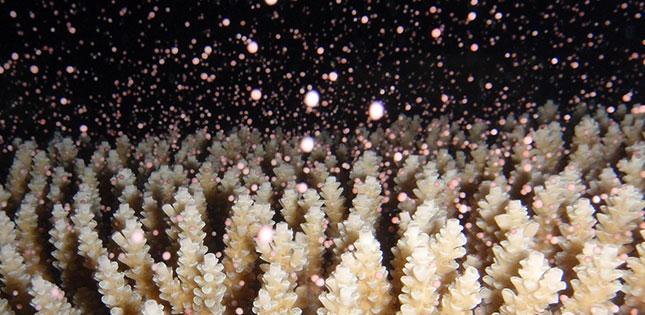
Credit: Masayuki Hatta


During the early summer, corals simultaneously release tiny balls composed of sperms and eggs, known as bundles, that float to the ocean surface. Here the bundles open, allowing the sperm to fertilize the eggs where they eventually settle on the seafloor and become new coral on the reef.

This spectacular annual event is known as “mass-spawning,” and usually occurs at night. Although the occurrence of mass-spawning happens around the time of a full moon, it is difficult to predict precisely when. Now, a research team from Tohoku University, Ochanomizu University, and the National Institute for Basic Biology have utilized modeling analysis to indicate that environmental factors act as a determinant in the timing of mass spawning.

“Coral spawning is a complex phenomenon,” says Shinchiro Maruyama, an assistant professor at Tohoku University. “It is too complicated to model all the factors involved in a spawning event, so we decided to focus on which day they spawn. Although we know that they spawn a few hours after the dusk, the days can differ according to regions, and even within the same reef.”

Maruyama and his team utilized a multidisciplinary approach to address the role of environmental factors, such as temperature; wind speed; and sunlight, to determine the night of spawning, teaming up with specialists in ecology, statistics, physiology, developmental biology, and evolutionary biology. Drawing upon field research, satellite data and literature reviews, they discovered that corals changed the nights of spawning according to the environmental conditions for a period of time before ‘the big night.’

Maruyama adds that, “Such fine-tuning for the night of spawning might be advantageous for corals to maximize their chances or meeting future partners in the vast expanses of the ocean.”

Coral reefs are a natural treasure of biodiversity in the ocean and understanding mass-spawning gives us further insight into their behavior. Identifying that environmental changes play a role in the mass-spawning timing provides a building block for scientists to address corals behavior going forward.

###

Media Contact
Shinichiro Maruyama
[email protected]
81-227-956-689

Original Source

https://www.tohoku.ac.jp/en/press/coral_spawning_linked_to_ocean_environment.html

Related Journal Article

http://dx.doi.org/10.1098/rsbl.2019.0760

Tags: BiologyMarine/Freshwater Biology
Share12Tweet8Share2ShareShareShare2

Related Posts

Conserved Pathway Breaks Down Homarine in Bacteria

Conserved Pathway Breaks Down Homarine in Bacteria

March 30, 2026
Lowering the Risk of Repeat Preterm Births Through Probiotic Therapy

Lowering the Risk of Repeat Preterm Births Through Probiotic Therapy

March 30, 2026

Squid Evolution Ignited 100 Million Years Ago in Deep Ocean, Triggering Rapid Diversification

March 30, 2026

Squirrels Scale Greater Heights to Access Superior Snacks

March 30, 2026
Please login to join discussion

POPULAR NEWS

  • blank

    Revolutionary AI Model Enhances Precision in Detecting Food Contamination

    96 shares
    Share 38 Tweet 24
  • Imagine a Social Media Feed That Challenges Your Views Instead of Reinforcing Them

    1005 shares
    Share 397 Tweet 248
  • Promising Outcomes from First Clinical Trials of Gene Regulation in Epilepsy

    51 shares
    Share 20 Tweet 13
  • Advancements in EV Battery Technology to Surpass Climate Change-Induced Degradation

    45 shares
    Share 18 Tweet 11

About

We bring you the latest biotechnology news from best research centers and universities around the world. Check our website.

Follow us

Recent News

Tetracenomycin Y: Rare Actinomycete’s Plant Growth Booster

Advancing Precision Medicine: Boosting Genetic Diagnoses for More Patients

Self-Evolving AI Transforms Autonomous Biomedical Data Analysis

Subscribe to Blog via Email

Enter your email address to subscribe to this blog and receive notifications of new posts by email.

Join 78 other subscribers
  • Contact Us

Bioengineer.org © Copyright 2023 All Rights Reserved.

Welcome Back!

Login to your account below

Forgotten Password?

Retrieve your password

Please enter your username or email address to reset your password.

Log In
No Result
View All Result
  • Homepages
    • Home Page 1
    • Home Page 2
  • News
  • National
  • Business
  • Health
  • Lifestyle
  • Science

Bioengineer.org © Copyright 2023 All Rights Reserved.