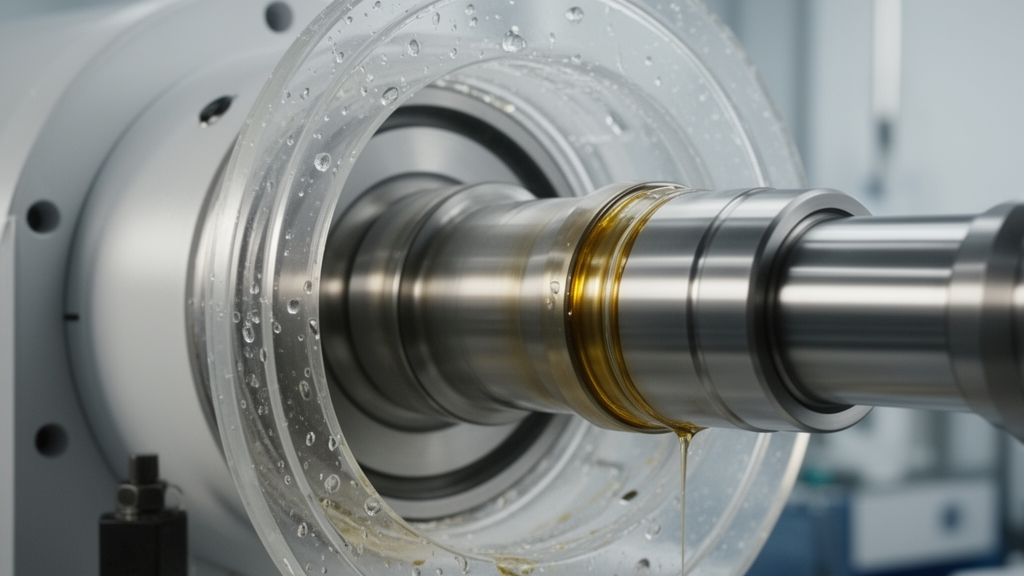
Deep inside the camshafts of heavy-duty engines and the compressors that move industrial gases, a quiet negotiation takes place every time a machine spins up. A flexible steel shaft rests on several oil-lubricated journal bearings, and each bearing generates a thin pressurized film that holds the rotating shaft away from metal contact. Engineers have long treated these supports as roughly independent: load one end, and the bearing at that end responds. A new study published in Mechanical Sciences by Yulin Zhang, Bing Li, Wubin Xu, Hanyu Guo, and Yanpeng Yuan of Guangxi University of Science and Technology shows that this picture is fundamentally incomplete. When a flexible shaft bends under an end load, the deformation travels along the shaft and rewrites the operating state of every bearing at once, producing a dramatic and highly uneven redistribution of the hydrodynamic support that holds the entire rotor aloft.
The research team set out to answer a deceptively simple question: what happens to the oil films at all four supports of a multi-bearing rotor when a load is applied at just one end? The answer required solving a coupled problem that most earlier studies avoided. Previous work on misaligned journal bearings, stretching back to Sun and Gui’s foundational lubrication analyses in 2004 and confirmed experimentally in 2005, established that shaft deformation distorts the convergent wedge of oil, thins the minimum film thickness, and reshapes the pressure field. But those studies largely examined single bearings or prescribed the misalignment in advance. In a real multi-support system, the four journal attitudes are not independent quantities. The deformation of the shared shaft and the hydrodynamic reaction forces generated at all supports collectively determine the global equilibrium, so strengthening one oil film can weaken, shift, or redistribute the constraints at its neighbors.
To capture this system-level coupling, the researchers modeled a three-disk, four-support bearing-rotor system resembling a camshaft under asymmetric loading. The shaft was represented with a Timoshenko beam formulation, which accounts for both bending and shear deformation, while each bearing’s lubricant was described by the Reynolds equation for a finite-length journal bearing under laminar, incompressible, isoviscous assumptions. Crucially, the eccentricity and inclination of all four journals were solved simultaneously through a fluid-structure equilibrium iteration: the shaft deformation determines each journal’s displacement and tilt, the resulting oil-film pressures generate reaction forces, and those forces feed back into the global structural balance until the two fields become mutually consistent. The team also introduced a compact descriptor, a flexible-deformation index denoted M_r, that combines the journal’s eccentricity ratio with a dimensionless measure of its inclination, allowing the coupled eccentricity-inclination state at each support to be summarized in a single number.
The numerical campaign was ambitious. The team built an offline database spanning end loads from 0 to 30 newtons and speeds from 1000 to 8000 rpm, sampling 211,001 load-speed states, of which 200,304, or 94.93 percent, returned valid directly converged fluid-structure solutions. At each converged state, the full oil-film stiffness and damping matrices were extracted by differential perturbation of the journal position and velocity, then stored for interpolation into a finite-element rotordynamic model. Validation was layered: the predicted maximum oil-film pressures under journal inclination agreed closely with the established results of Sun and Gui and of Lv and colleagues, with deviations of roughly 9 to 11 percent only at the most extreme inclination of 0.010 degrees, where the exact peak is known to be sensitive to cavitation treatment and thermal effects. The dynamic coefficients matched the classic calculations of Lund and Orcutt, and the computed bending mode shapes near 53 and 89 hertz agreed well with an independent ANSYS three-dimensional finite-element model.
The headline finding concerns how violently the support conditions redistribute under end loading. At rest, the journal attitudes are nearly symmetric, with the outer pair of bearings mirroring each other. Apply a modest end load, and that symmetry collapses. Within the 0 to 25 newton range, the flexible-deformation index at the loaded-end bearing, labeled J4, surges by 266.5 to 402.2 percent, while the inner supports J1 and J3 actually decrease and J2 barely moves. At 25 newtons, the index at J4 reaches 4.19 to 6.02 times that of J1 and 1.76 to 2.33 times that of J3. The physical picture is one of concentration: shaft flexibility funnels the eccentricity-inclination coupling into the loaded-end bearing while the inner supports respond mainly through load redistribution.
The consequences for the oil films themselves are even more striking. At 3000 rpm, the non-dimensional stiffness trace of the loaded-end support increases by 4298.0 percent and its damping trace by 293.6 percent. At 2884 rpm, the direct-stiffness trace of J4 climbs from 2.66 million to 125 million newtons per meter, roughly 47 times its initial value. Meanwhile the neighboring support J3 weakens markedly, its stiffness and damping traces falling by 62.4 and 36.8 percent, and J1 and J2 change only modestly. The cross-coupled stiffness term at the loaded end even reverses sign near a deformation index of 0.96, signaling a strongly asymmetric pressure field at high tilt. In short, the four-bearing boundary evolves from a comparatively shared support distribution into a strongly nonuniform, loaded-end-dominated one. The authors are careful to note that the exact extreme pressure peaks and coefficient amplitudes near the limiting thin-film state remain model-dependent, since the formulation is isothermal with a non-mass-conserving half-Sommerfeld cavitation treatment, but the direction and ordering of the redistribution proved robust across sensitivity checks.
Here is where the story takes its most counterintuitive turn. One might expect that a support suddenly 47 times stiffer would dramatically shift the rotor’s critical speeds, the rotation rates at which synchronous vibration resonates. It barely does. By continuously tracking the synchronous modal branches with a mass-weighted complex modal assurance criterion, which prevents closely spaced modes from being confused with one another, the team found that the two low-order forward and backward whirl branches near 2884 and 2895 rpm shift by only minus 0.00037 percent and plus 0.00039 percent respectively, essentially nothing. The higher-order branches H1 and H2 move a bit more, by plus 0.0140 and plus 0.1477 percent, and an additional high-order synchronous intersection appears at 5843.2 rpm in the highly deformed state. Yet even these larger shifts are tiny compared with the local stiffness explosion, and the global mode shapes themselves remain almost unchanged.
The resolution of this paradox lies in modal participation. The bearing locations are simply not very important players in the low-order bending modes: the shaft flexes between the supports in ways that barely engage the oil films, so even a massive local stiffness change barely registers. In the higher-order modes, and especially H2, the bearings matter far more. The generalized bearing-stiffness participation and the bearing-location displacement participation for H2 reach 1.449 percent and 0.0568 percent in the low-deformation state, approximately 23.6 and 22.1 times the corresponding forward-whirl values, and its critical-speed sensitivity rises in the same order. The support redistribution acts as a filter: the same local hydrodynamic change is transmitted into the global dynamics only in proportion to how strongly each modal branch involves the bearing locations. This explains why the first bending mode is reshaped more clearly in character than the main low-order critical speeds are shifted in frequency.
For engineers designing camshafts, compressors, and any flexible rotor carried on multiple oil-film bearings, the message is practical and profound. Local bearing coefficients measured or assumed in isolation cannot predict system behavior, because the four supports form a single coupled hydrodynamic network whose state emerges from shared shaft deformation. A designer who hardens one bearing without accounting for the induced weakening of its neighbors may misjudge both the lubrication regime and the vibration margin. The study’s framework, linking shaft flexibility, journal attitude redistribution, oil-film coefficient evolution, and branch-dependent modal sensitivity in one coherent chain, extends misaligned-bearing research from local lubrication analysis to the evolution of dynamic boundaries in whole multi-support systems. The authors note that conditions involving mixed lubrication, mass-conserving cavitation dynamics, or large-amplitude transient squeeze would require extended formulations, but within the converged hydrodynamic regime they examined, the mechanism is clear: the global dynamic consequence of local oil-film strengthening is governed not by the magnitude of the local change alone, but by how the redistributed support couples into each mode of the spinning shaft.
Subject of Research: Hydrodynamic support redistribution and modal response in flexible multi-support bearing-rotor systems
Article Title: Shaft-flexibility-induced hydrodynamic support redistribution and modal response in a multi-support bearing-rotor system
Article References: Zhang, Y., Li, B., Xu, W., Guo, H., & Yuan, Y. (2026). Shaft-flexibility-induced hydrodynamic support redistribution and modal response in a multi-support bearing-rotor system. Mechanical Sciences, 17(2), 857-871. https://doi.org/10.5194/ms-17-857-2026
Image Credits: AI Generated
Keywords: journal bearings, rotor dynamics, shaft flexibility, hydrodynamic lubrication, journal misalignment, oil-film stiffness, critical speeds, modal analysis, fluid-structure interaction, Timoshenko beam, Reynolds equation, camshaft
News Source: Denise Maddox. (October 9, 2026). Bending Shafts Quietly Reshape the Hidden Oil Films That Keep Rotors Stable. Scienmag.