Modified haptic vest has applications for search and rescue, service animal programs — presented in World Haptic Conference paper
Credit: Jonathan Atari
BEER-SHEVA, Israel…July 9, 2019 – Dogs can be trained to respond to haptic vibration commands while wearing a modified canine vest developed by an interdisciplinary research team at Ben-Gurion University of the Negev (BGU).
The paper, “Vibrotactile Vest for Remote Human-Dog Communication,” will be presented at the World Haptics Conference on July 12 in Tokyo, Japan. Haptics technology simulates the senses of touch and motion, which is especially helpful in a remote operation or computer simulation where the user is not able to interact with and feel physical objects.
The technology may be useful for delivering remote commands to dogs for use in search and rescue, assisting disabled handlers, and other service animal applications.
“Our research results showed that dogs responded to these vibrotactile cues as well or even better than vocal commands,” says Prof. Amir Shapiro, director of the Robotics Laboratory within BGU’s Department of Mechanical Engineering. “Our current proof-of-concept study shows promising results that open the way toward the use of haptics for human-canine communication.”
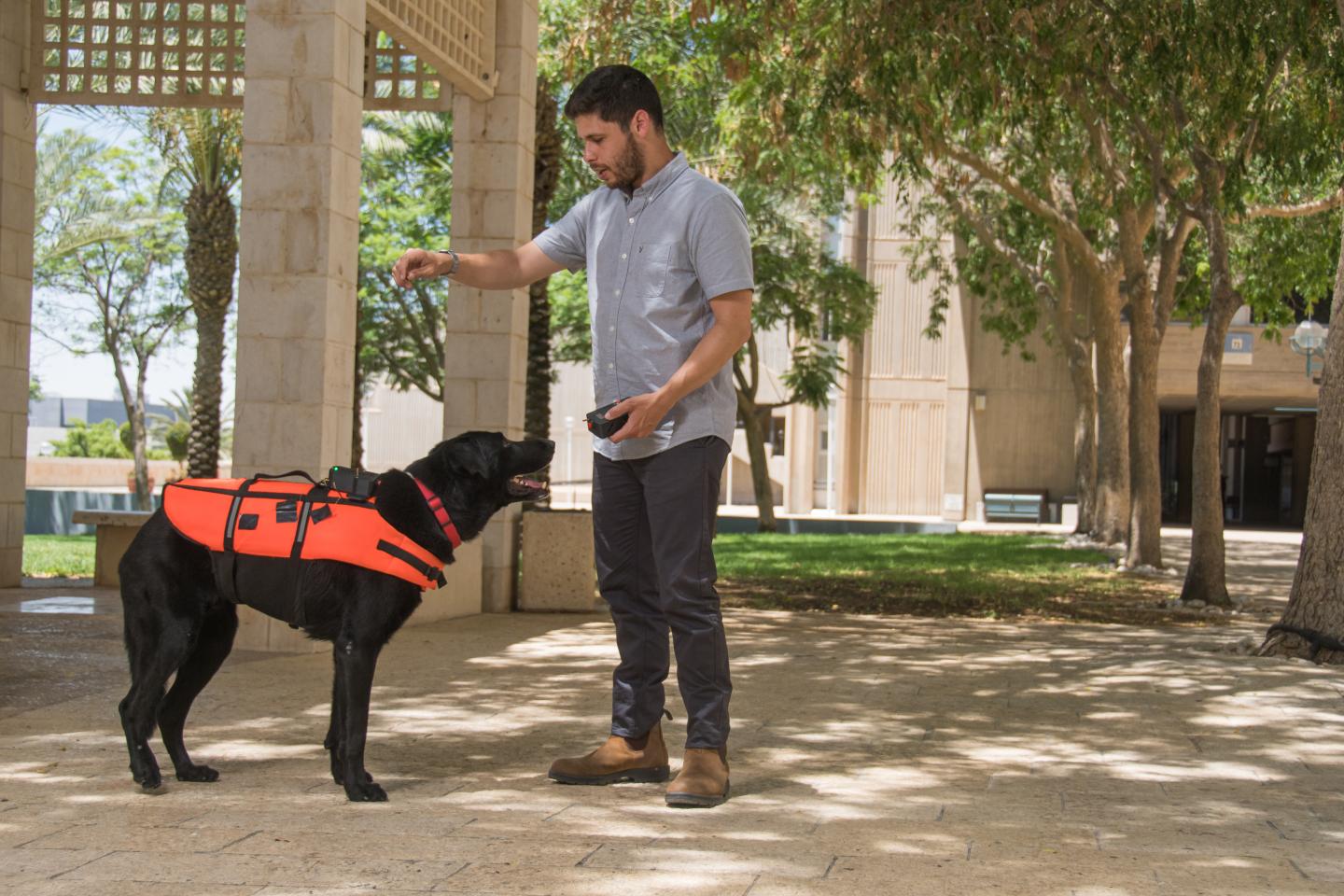
The modified, commercially available mesh canine vest contains four small vibrating motors positioned over a dog’s back and sides that can be used to train or direct dogs to respond to different vibrations sent via wireless remote control. The handler can elicit different commands by controlling the site and duration of vibrations. In this demonstration video, Tai, a six-year-old Labrador retriever/German shepherd crossbreed, responds to several distinct commands, such as “spin,” “down,” “to me,” or “backpedal.”
The haptic vest may also be used with existing dog training devices that detect posture and automate reward systems. “Integrating devices will allow us to further advance the potential of fully or partially autonomic dog training to assess general behavior, responsiveness to commands and the effectiveness of rewarding dogs for desired behavior,” says Prof. Shapiro.
Future research will test the haptic vest technology on different breeds, ages and training experience, and will integrate more advanced devices into search and rescue, military work dog and service dog programs.
###
Yoav Golan, a Ph.D. student in BGU’s Department of Mechanical Engineering, and Ben Serota, who earned his M.A. in neuroscience at BGU began this research as a graduate project for a “Haptic Sensing and Perception” course taught by Dr. Ilana Nisky, a senior lecturer in BGU’s Department of Biomedical Engineering and the Zlotowski Center for Neuroscience, and the head of BGU’s Biomedical Robotics Lab. The team also includes Dr. Oren Shriki, head of BGU’s Computational Psychiatry Lab in the Department of Cognitive and Brain Sciences.
The research was supported by the Helmsley Charitable Trust for BGU’s Agricultural, Biological and Cognitive (ABC) Robotics Initiative.
About American Associates, Ben-Gurion University of the Negev
American Associates, Ben-Gurion University of the Negev (AABGU) plays a vital role in sustaining David Ben-Gurion’s vision: creating a world-class institution of education and research in the Israeli desert, nurturing the Negev community and sharing the University’s expertise locally and around the globe. As Ben-Gurion University of the Negev (BGU) looks ahead to turning 50 in 2020, AABGU imagines a future that goes beyond the walls of academia. It is a future where BGU invents a new world and inspires a vision for a stronger Israel and its next generation of leaders. Together with supporters, AABGU will help the University foster excellence in teaching, research and outreach to the communities of the Negev for the next 50 years and beyond. Visit vision.aabgu.org to learn more.
AABGU, which is headquartered in Manhattan, has nine regional offices throughout the United States. For more information, visit http://www.
Media Contact
Andrew Lavin
[email protected]