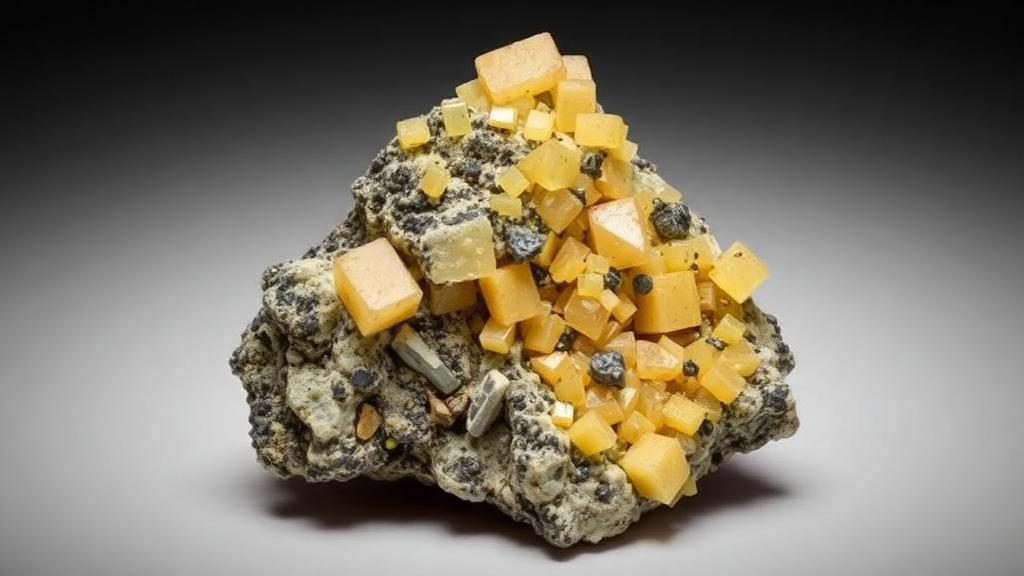
Deep in the Graveglia Valley of eastern Liguria, Italy, where miners once extracted rich manganese ores from veins threaded through ancient Jurassic cherts, a mineral that sat unnoticed in a university collection for more than three decades has finally revealed its identity. Belmonteite, a hydrated calcium manganese arsenate with the ideal formula CaMn2(AsO4)2(H2O)5·2H2O, has been officially approved as a new mineral species by the International Mineralogical Association’s Commission on New Minerals, Nomenclature and Classification under proposal number 2024-040. The discovery, published in the European Journal of Mineralogy by Cristian Biagioni of the University of Pisa and colleagues Jiří Sejkora and Zdeněk Dolníček of the National Museum in Prague, adds a strikingly new entry to the already remarkable roster of minerals from one of Italy’s most celebrated mineralogical regions.
The story of belmonteite begins not in a high-tech laboratory but with a handwritten label. A specimen collected by mineral collector Corrado Balestra on the dumps of the Gambatesa mine in the early 1990s carried a tantalizing annotation reading “Ca-Mn arsenate?” The sample passed through the hands of collector Andrea Palenzona and was eventually donated to the mineralogical collection of the Dipartimento di Scienze della Terra, dell’Ambiente e della Vita at the University of Genoa. There it waited, catalogued and accessible, until modern crystallographic techniques could answer the question posed on its label. When researchers re-examined the specimen, X-ray diffraction revealed that the unknown phase matched no mineral species ever described before. The mineral was named in honor of Donato Belmonte, born in 1978, whose work has documented seven previously new mineral species from Liguria and contributed original insights into the region’s rodingitic rocks.
Belmonteite is, by any visual standard, an unassuming mineral. It occurs as aggregates up to half a millimeter in length, composed of thin tabular crystals that are white in color with a silky luster and a white streak. The mineral is transparent, brittle, and displays a perfect cleavage on the {010} plane. It does not fluoresce under either short- or long-wavelength ultraviolet light. Its calculated density is 2.677 grams per cubic centimeter, and its mean refractive index of 1.578 was derived indirectly from the Gladstone-Dale relationship, because the extremely limited quantity of available material made direct optical measurement impossible. The tiny crystals formed in vugs within a carbonate vein, accompanied by tennantite-(Cu), calcite, luzonite, and a still-unidentified calcium-copper arsenate phase whose powder diffraction pattern resembles but does not match that of mahnertite.
Chemical analysis, performed with a Cameca SX 100 electron microprobe in wavelength-dispersive mode at the National Museum in Prague, yielded an empirical formula of (Ca0.86Mn0.11K0.01)(Mn1.90Cu0.08Al0.02)As2.01O8·7H2O based on eight spot analyses. The measurements confirmed that belmonteite is dominated by calcium, divalent manganese, and pentavalent arsenic, with only trace substitutions of copper, potassium, and aluminum. Notably, the mineral proved partially unstable under the electron beam, dehydrating within the microprobe chamber, so its water content had to be calculated from the crystal structure rather than measured directly. Raman spectroscopy independently confirmed the presence of water molecules, showing characteristic O-H stretching bands in the 2900 to 3700 per centimeter range alongside a strong band at 839 per centimeter assigned to the asymmetric and symmetric stretching vibrations of the arsenate tetrahedra.
The crystallographic heart of the study lies in the single-crystal X-ray diffraction work conducted at the University of Pisa’s Center for the Integration of Scientific Instrumentation. Using a Bruker D8 Venture diffractometer with microfocus molybdenum radiation, the team refined the structure in the orthorhombic space group Cmce to a conventional R1 factor of 0.0385 using 1195 unique reflections and 129 refined parameters. The unit cell measures a = 8.8418, b = 23.031, and c = 13.5270 angstroms, with a volume of 2754.6 cubic angstroms and eight formula units per cell. The resulting picture is one of elegant layered architecture: sheets parallel to {010} are built from edge-sharing octahedra centered on six-fold-coordinated manganese atoms, which assemble into zig-zag ribbons running along the a axis and link to neighboring ribbons through corner-sharing along c.
These manganese oxide layers are decorated on both faces by arsenate tetrahedra and calcium atoms, creating heteropolyhedral slabs that are stacked along the b axis and held together solely by hydrogen bonds. It is this hydrogen-bonded cohesion that explains the mineral’s perfect {010} cleavage, since the weakest links in the structure are the water-mediated contacts between layers. Two of the seven water molecules per formula unit sit free in the structure, unbonded to any cation and serving exclusively as hydrogen-bond donors, while the remainder coordinate directly to calcium. Bond-valence calculations, using the parameters of Gagné and Hawthorne, confirmed the expected valences: arsenic sums to roughly 5.1 valence units, manganese to about 2.0, and calcium to 1.87, all consistent with As5+, Mn2+, and Ca2+ respectively.
Perhaps the most scientifically intriguing aspect of belmonteite is its structural disorder. The calcium site is only half-occupied, and the arsenate tetrahedron centered on the As(2) position exhibits rotational disorder, forcing two mutually exclusive oxygen positions, O(7a) and O(7b), to be statistically occupied at half each. The researchers tested whether a hidden superstructure or a lower-symmetry space group might resolve this ambiguity. They refined the structure in a monoclinic P21/c setting and in the orthorhombic groups Cmc21, Abm2, and Aba2, but each alternative either worsened the refinement or introduced physically implausible distortions. The team ultimately proposed that the observed disorder arises from the superposition of two ordered configurations along rods of calcium polyhedra running parallel to the a axis, a form of one-dimensional disorder that, in better-diffracting crystals, would manifest as streaking in diffraction patterns similar to that documented in volaschioite and parnauite.
Structurally, belmonteite belongs to a small and fascinating family. Its {010} manganese layers, with the composition Mn4O10(H2O)4, are topologically similar to those in the phosphate mineral switzerite, Mn3(PO4)2·7H2O, and its dehydration product metaswitzerite, as well as the arsenate castellaroite, Mn3(AsO4)2·4.5H2O, which was the first arsenate known to feature this layer type. Belmonteite is also the sixth mineral species containing both arsenic and manganese to have its type locality in the manganese ore deposits of eastern Liguria, following tiragalloite, coralloite, castellaroite, arsenmedaite, and monteneroite. The Gambatesa mine itself, which exploited braunite ore bodies near the base of the Upper Jurassic Diaspri di Monte Alpe metachert sequence, is already the type locality for six other species, including saneroite, gravegliaite, reppiaite, vanadomalayaite, poppiite, and cavoite.
The formation of belmonteite tells a geological story of fluids and transformation. The Ligurian manganese ores were metamorphosed under prehnite-pumpellyite facies conditions, at pressures of roughly 0.25 gigapascals and temperatures near 275 degrees Celsius, and later remobilized by hydrothermal fluids percolating along fractures as temperature and pressure declined. These late-stage fluids concentrated dispersed elements such as arsenic, vanadium, and tellurium, giving rise to the region’s famously unusual mineral assemblages. Belmonteite’s genesis is attributed to the circulation of arsenic-rich, oxidizing fluids during the final evolutionary stages of the Gambatesa ore deposit, precipitating the hydrated calcium manganese arsenate in the protected cavities of a carbonate vein.
Beyond its intrinsic scientific value, the discovery carries a broader message about the hidden wealth of museum collections. The only known specimen of belmonteite spent more than thirty years in a publicly accessible collection, labeled with a question and waiting for technology to catch up with curiosity. As analytical methods grow ever more sensitive, specimens once deemed unidentifiable are becoming fertile ground for discovery, and the authors suggest that the manganese deposits of eastern Liguria, and the old collections they spawned, may yet conceal further surprises. For now, belmonteite stands as both a tribute to a dedicated Ligurian mineralogist and a reminder that even the most familiar drawers of a museum cabinet can hold a mineral the world has never seen.
Subject of Research: Crystal structure and genesis of the new arsenate mineral belmonteite from the manganese ore deposits of eastern Liguria, Italy
Article Title: Belmonteite, CaMn2(AsO4)2(H2O)5 ⋅ 2H2O, a new arsenate mineral from the Mn ore deposits of the Graveglia Valley, eastern Liguria, Italy
Article References: Biagioni, C., Sejkora, J., & Dolníček, Z. (2026). Belmonteite, CaMn 2 (AsO 4 ) 2 (H 2 O) 5 ⋅ 2H 2 O, a new arsenate mineral from the Mn ore deposits of the Graveglia Valley, eastern Liguria, Italy. European Journal of Mineralogy, 38(4), 531-543. https://doi.org/10.5194/ejm-38-531-2026
Image Credits: AI Generated
Keywords: belmonteite, new mineral, arsenate, manganese, Gambatesa mine, Graveglia Valley, Liguria, crystal structure, X-ray diffraction, hydrothermal fluids, mineralogy, IMA approval
News Source: Bethany Barker. (October 8, 2026). Belmonteite: New Arsenate Mineral Discovered in Italy’s Historic Manganese Mines. Scienmag.