One explanation for why some species decline is that human modifications make existing habitat unsuitable for them. For other species, these modifications are advantageous and make the habitat available for them to expand into.
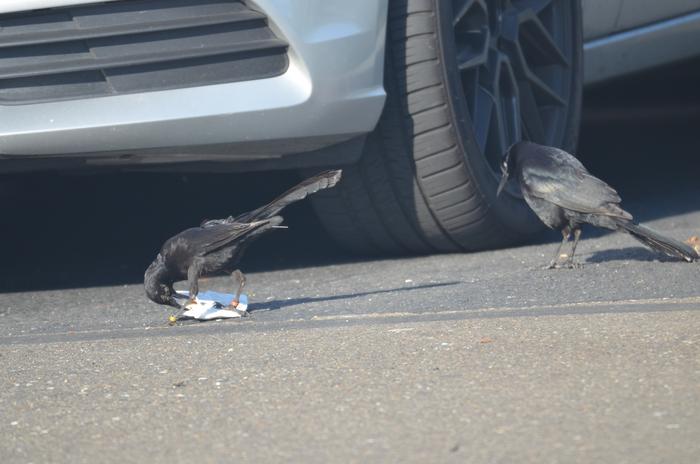
Credit: © Corina Logan
One explanation for why some species decline is that human modifications make existing habitat unsuitable for them. For other species, these modifications are advantageous and make the habitat available for them to expand into.
Researchers from the Max Planck Institute of Evolutionary Anthropology in Germany, and the University of California Santa Barbara and the University of Rochester in the USA investigated the role that increased habitat availability might have played. They compared the rapidly expanding great-tailed grackle with their closest relative, the boat-tailed grackle, who are not rapidly expanding their range.
Based on citizen science observations of bird occurrences, the researchers found that, between 1979 and 2019, great-tails did not just move into new available habitats that matched their earlier requirements, but they increased their habitat breadth to move into more urban, arid environments. In contrast, boat-tails only moved their range slightly northwards in response to climate change making these habitats suitable for them.
Behavior facilitates rapid range expansions into new habitats
This means that the great-tails are not simply expanding their range because more habitat is available to them. “These results support the possibility that their behavior played a role in the great-tailed grackle’s ability to increase habitat breadth,” says Corina Logan, a research group leader in the Department of Human Behavior, Ecology and Culture at the Max Planck Institute of Evolutionary Anthropology, and Gates Cambridge Scholar.
The likely role of behavior in taking advantage of new habitats led researchers to investigate behavior in two great-tailed grackle populations: a recently established population on the northern edge of the range, and an older population closer to the center of the range.
The researchers found that the edge population had a wider range of flexibility and was more persistent than the non-edge population. “We know that this is a highly flexible species and that they are rapidly expanding their geographic range. What surprised us was that it ended up being persistence, and not a higher average flexibility, that stood out as the behavior associated with the range expansion,” says Logan.
Flexibility and persistence
Being persistent might allow individuals to accidentally find solutions to the challenges they face in their new environments, for example by exposing new food sources. Having more variability of flexibility within a population means that there is a higher chance that at least some individuals in the population will be highly flexible and that other individuals could learn from them, thus facilitating that population’s expansion.
Previous research by the grackle team discovered that great-tailed grackles (including individuals who were not on the range edge) have higher average flexibility than most other species. This indicates that flexibility might interact with other abilities to shape the behavior necessary to move into new areas. For example, grackles on the edge might be successful because they keep trying new solutions, rather than giving up quickly or persisting in trying the same solution over and over again.
The grackle team is continuing their work over the past 10 years on this species to untangle these mysteries and provide robust findings that can bear on the broader question of which behavioral traits are associated with a rapid geographic range expansion. “Discovering how great-tailed grackles solve challenges differently from boat-tailed grackles and other species could reveal ways to help declining species adapt to the changes in their environment,” says Logan.
Journal
Peer Community Journal
DOI
10.24072/pcjournal.320
Article Title
Implementing a rapid geographic range expansion – the role of behavior changes
Article Publication Date
20-Sep-2023