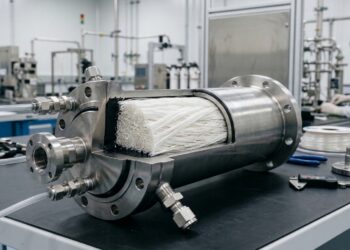
In a groundbreaking move to democratize neutron diagnostics in nuclear fusion research, a new tutorial unveils a streamlined approach to detecting fast neutrons using a single EJ-309 liquid organic scintillation detector. Despite the significant role fast neutron detection plays in understanding and advancing fusion reactions, the field has often been hindered by the complexity and niche expertise required to deploy current diagnostic tools effectively.
Central to this innovative tutorial is a bespoke benchtop reactor designed to facilitate deuterium–deuterium nuclear fusion reactions, serving as a practical neutron source. By harnessing such a reactor, the study simplifies the otherwise intricate environment necessary for fast neutron generation, offering researchers a manageable and accessible platform. This development paves the way for more widespread adoption of neutron diagnostics beyond specialized nuclear physics laboratories into broader scientific disciplines.
The tutorial rigorously addresses the technical hurdles traditionally encountered in neutron detection. From the detector’s physical configuration to its meticulous calibration and characterization, the guidance ensures users can optimize the EJ-309 detector’s performance. Such thorough procedural details are crucial, considering the detector operates in a mixed neutron/gamma-ray radiation field, where distinguishing between particle types is essential and technically demanding.
Crucially, the EJ-309 detector leverages liquid organic scintillation, which exhibits excellent pulse shape discrimination capabilities, enabling it to differentiate fast neutron interactions from gamma-ray events effectively. The tutorial elaborates on the data processing algorithms necessary to interpret the scintillation signals accurately, allowing for precise quantification of neutron flux and energy spectra.
This comprehensive resource demystifies fast neutron detection, typically viewed as a highly specialized domain, making it accessible to emerging research communities, including those in materials science, medical physics, and radiation protection. By enabling broader accessibility, the tutorial is poised to galvanize interdisciplinary research that benefits from real-time neutron monitoring and measurement.
Moreover, the article also emphasizes reproducibility and practical adaptability. The step-by-step calibration processes are accompanied by examples that help users understand detector response characteristics under various operational conditions. This detail is vital to ensure consistent and reliable neutron detection across different experimental setups.
With neutron diagnostics often regarded as a barrier to entry due to cost and complexity, this tutorial signals a shift towards more inclusive and user-friendly methodologies. Such advances are imperative as fusion research accelerates globally, and efficient neutron detection becomes integral to both fundamental studies and applied technologies.
Ultimately, this tutorial not only advances the technical knowledge surrounding EJ-309 detectors but also cultivates a new era of accessible neutron detection, carrying enormous potential to catalyze fusion research and allied scientific fields.
Subject of Research: Fast neutron detection in nuclear fusion research
Article Title: Tutorial: a beginner’s guide to fast neutron detection with an EJ-309 detector
Article References:
Issinski, S., Vakili, A.E., Oldford, R. et al. Tutorial: a beginner’s guide to fast neutron detection with an EJ-309 detector. Nat Protoc (2026). https://doi.org/10.1038/s41596-026-01372-8
DOI: https://doi.org/10.1038/s41596-026-01372-8
Tags: advancements in fusion research diagnosticsbeginner-friendly neutron detection tutorialsbenchtop reactor for neutron generationcalibration techniques for organic scintillation detectorshigh detection efficiency for fast neutronsliquid organic scintillator advantagesneutron detection in mixed radiation environmentsneutron/gamma discriminationneutron/gamma radiation field analysisnuclear fusion neutron diagnosticspractical neutron source designsimplified neutron detection methods