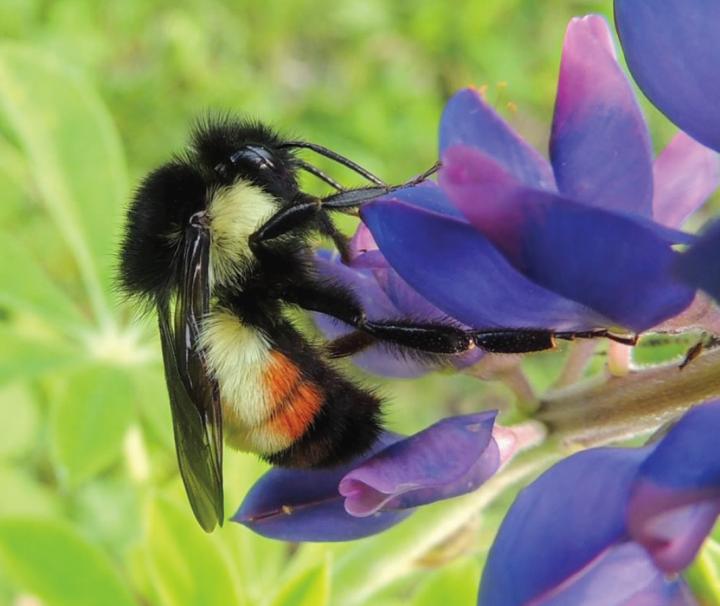
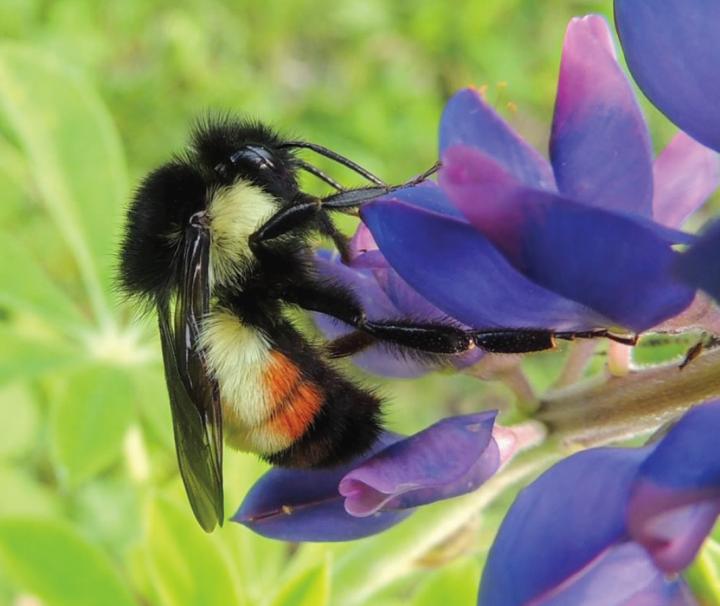
Credit: Alejandro Muñoz-Urias, Alvaro Edwin Razo Leon
Changes in land use negatively affect bee species richness and diversity, and cause major shifts in species composition, reports a recent study of native wild bees, conducted at the Sierra de Quila Flora and Fauna Protection Area and its influence zone in Mexico.
Having registered a total of 14,054 individual bees representing 160 species, 52 genera, and five families over the span of a year, the scientists conclude that the studied preserved areas demonstrated "significantly greater" richness and diversity.
In their paper, published in the open-access Journal of Hymenoptera Research, a research team from the University of Guadalajara, Mexico, led by Alejandro Muñoz-Urias, compare three conditions within the tropical dry forest study site: preserved vegetation, an agricultural area with crops and livestock, and an urbanised area.
The researchers confirm earlier information that an increase in anthropogenic disturbances leads to a decrease in bee richness and diversity. While availability of food and nesting sites are the key factors for bee communities, changes in land use negatively impact flower richness and floral diversity. Thereby, turning habitats into urbanised or agricultural sites significantly diminishes the populations of the bees which rely on specific plants for nectar and pollen. These are the species whose populations are threatened with severe declines up to the point of local extinction.
According to their data, about half of the bees recorded were Western honey bees (49.9%), whereas polyester bees turned out to be the least abundant (1.2 %).
On the other hand, some generalist bees, which feed on a wide range of plants, seem to thrive in urbanised areas, as they take advantage of people watering wild and ornamental plants at times where draughts might be eradicating native vegetation.
"That is the reason why bees that can use a wide variety of resources are often able to compensate when circumstances change, although some species disappear due to land use changes," explain the scientists.
In conclusion, the authors recommend that the tropical dry forests of both the study area and Mexico in general need to be protected in order for these essential pollinators to be conserved.
"Pollinators are a key component for global biodiversity, because they assist in the sexual reproduction of many plant species and play a crucial role in maintaining terrestrial ecosystems and food security for human beings," they remind.
###
Original source:
Razo-León AE, Vásquez-Bolaños M, Muñoz-Urias A, Huerta-Martínez FM (2018) Changes in bee community structure (Hymenoptera, Apoidea) under three different land-use conditions. Journal of Hymenoptera Research 66: 23-38. https://doi.org/10.3897/jhr.66.27367
Additional literature:
Potts SG, Biesmeijer JC, Kremen C, Neumann P, Schweiger O, Kunin WE (2010) Global pollinator declines: trends, impact and drivers. Trends in Ecology and Evolution 25(6): 345-353.
van der Sluijs JP, Vaage NS (2016) Pollinators and Global Food Security: the Need for Holistic Global Stewardship. Food Ethics 1(1): 75-91.
Media Contact
Alejandro Muñoz-Urias
[email protected]
@Pensoft
http://www.pensoft.net
Related Journal Article
http://dx.doi.org/10.3897/jhr.66.27367