


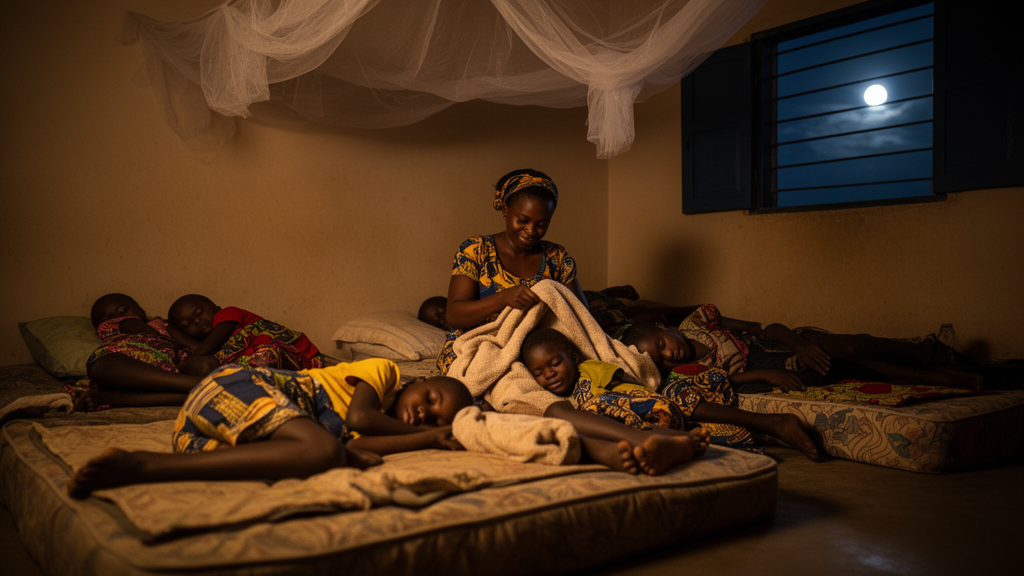
Children who wet the bed at night in Bukavu, in the eastern Democratic Republic of the Congo, showed no higher rates of depressive symptoms, ADHD, or low self-esteem than classmates without nocturnal enuresis, according to a school-based case-control study published in BMC Pediatrics. The one unexpected finding ran in the opposite direction: parents of children with bedwetting actually reported fewer school performance problems than parents of matched controls.
Researchers led by Gloire Chubaka Magala screened families of 3,370 children aged 6 to 12 years, but screening information was returned for only 1,278 of them, a response rate of 37.9 percent. Within that group, 320 children — one in four — were reported by parents or guardians to have nocturnal bedwetting. After 196 families declined participation, 124 children completed interviews and clinical assessment, met DSM-5 criteria for nocturnal enuresis, and were enrolled as cases. Each case was matched to a non-enuretic control from the same classroom, producing a total sample of 248 children with a mean age of 8.5 years, of whom 59.7 percent were boys.
The study assessed three psychosocial and neurodevelopmental outcomes using validated instruments. Depressive symptoms were measured with the Children’s Depression Rating Scale, using a predefined threshold score of 30 or higher, while self-esteem was evaluated with the Rosenberg Self-Esteem Scale after reverse-coding negatively worded items. ADHD was diagnosed according to DSM-5 criteria. Parents or guardians also reported on their children’s school performance.
The results challenged the assumption that bedwetting is consistently accompanied by psychological difficulties in this setting. Depressive symptoms at the predefined threshold were present in 8 of 124 cases, or 6.5 percent, compared with 14 of 124 controls, or 11.3 percent. ADHD was found in 22 children in each group, an identical rate of 17.7 percent. Low self-esteem affected 34 cases, or 27.4 percent, and 43 controls, or 34.7 percent. In multivariable logistic regression, none of these outcomes was independently associated with enuretic case status: the adjusted odds ratio was 0.45 for depressive symptoms, 1.30 for ADHD, and 0.75 for low self-esteem, with all confidence intervals crossing 1.
The single statistically significant association concerned schooling. Low parent-reported school performance was less frequent among children with nocturnal enuresis than among their classroom controls, with an adjusted odds ratio of 0.35 and a 95 percent confidence interval of 0.19 to 0.65.
The study’s authors emphasize that the findings should be read within a narrow frame. Because only 37.9 percent of eligible families returned screening information, and because fewer than half of the children reported to wet the bed ultimately participated, the sample may not represent the broader population of Bukavu’s schoolchildren. Families who agreed to take part may differ systematically from those who declined, and the modest number of cases limits the precision of the estimates. The published conclusions state explicitly that the low return of screening information limits the representativeness of the results.
Nevertheless, the research fills a noted gap.
For clinicians and families in the region, the practical message is a measured one: among the children studied, bedwetting was common, affecting a quarter of those whose families returned screening information, yet it was not independently tied to the mental health, attention, or self-esteem measures assessed.
Subject of Research: Psychosocial and neurodevelopmental correlates of nocturnal enuresis among schoolchildren in the Democratic Republic of the Congo
Article Title: Beyond bedwetting: mental health, self-esteem, ADHD and school performance among children with nocturnal enuresis in Bukavu, Democratic Republic of the Congo
Article References: Chubaka Magala, G., Muhindo Muyisa, R., Ganza Bivunga, O., Ntumba-Tsitenge, O., Mafuta Musalu, E., & Kaputu-Kalala-Malu, C. (2026). Beyond bedwetting: mental health, self-esteem, ADHD and school performance among children with nocturnal enuresis in Bukavu, Democratic Republic of the Congo. BMC Pediatrics. https://doi.org/10.1186/s12887-026-07885-1
Image Credits: AI Generated
DOI: 10.1186/s12887-026-07885-1
Keywords: nocturnal enuresis, bedwetting, children, ADHD, depressive symptoms, self-esteem, school performance, case-control study, Democratic Republic of the Congo, Bukavu, pediatrics, mental health
News Source: Glenn Wilkins. (October 29, 2026). Bedwetting not linked to mental health or self-esteem in Congolese children study. Scienmag.



