• HOME
  • NEWS
  • EXPLORE
    • CAREER
      • Companies
      • Jobs
    • EVENTS
    • iGEM
      • News
      • Team
    • PHOTOS
    • VIDEO
    • WIKI
  • BLOG
  • COMMUNITY
    • FACEBOOK
    • INSTAGRAM
    • TWITTER
Wednesday, May 13, 2026
BIOENGINEER.ORG
No Result
View All Result
  • Login
  • HOME
  • NEWS
  • EXPLORE
    • CAREER
      • Companies
      • Jobs
        • Lecturer
        • PhD Studentship
        • Postdoc
        • Research Assistant
    • EVENTS
    • iGEM
      • News
      • Team
    • PHOTOS
    • VIDEO
    • WIKI
  • BLOG
  • COMMUNITY
    • FACEBOOK
    • INSTAGRAM
    • TWITTER
  • HOME
  • NEWS
  • EXPLORE
    • CAREER
      • Companies
      • Jobs
        • Lecturer
        • PhD Studentship
        • Postdoc
        • Research Assistant
    • EVENTS
    • iGEM
      • News
      • Team
    • PHOTOS
    • VIDEO
    • WIKI
  • BLOG
  • COMMUNITY
    • FACEBOOK
    • INSTAGRAM
    • TWITTER
No Result
View All Result
Bioengineer.org
No Result
View All Result
Home NEWS Science News Chemistry

Beat the heat

Bioengineer by Bioengineer
July 10, 2019
in Chemistry
Reading Time: 3 mins read
0
IMAGE
Share on FacebookShare on TwitterShare on LinkedinShare on RedditShare on Telegram

University of Utah engineers develop chip that converts wasted heat to usable energy
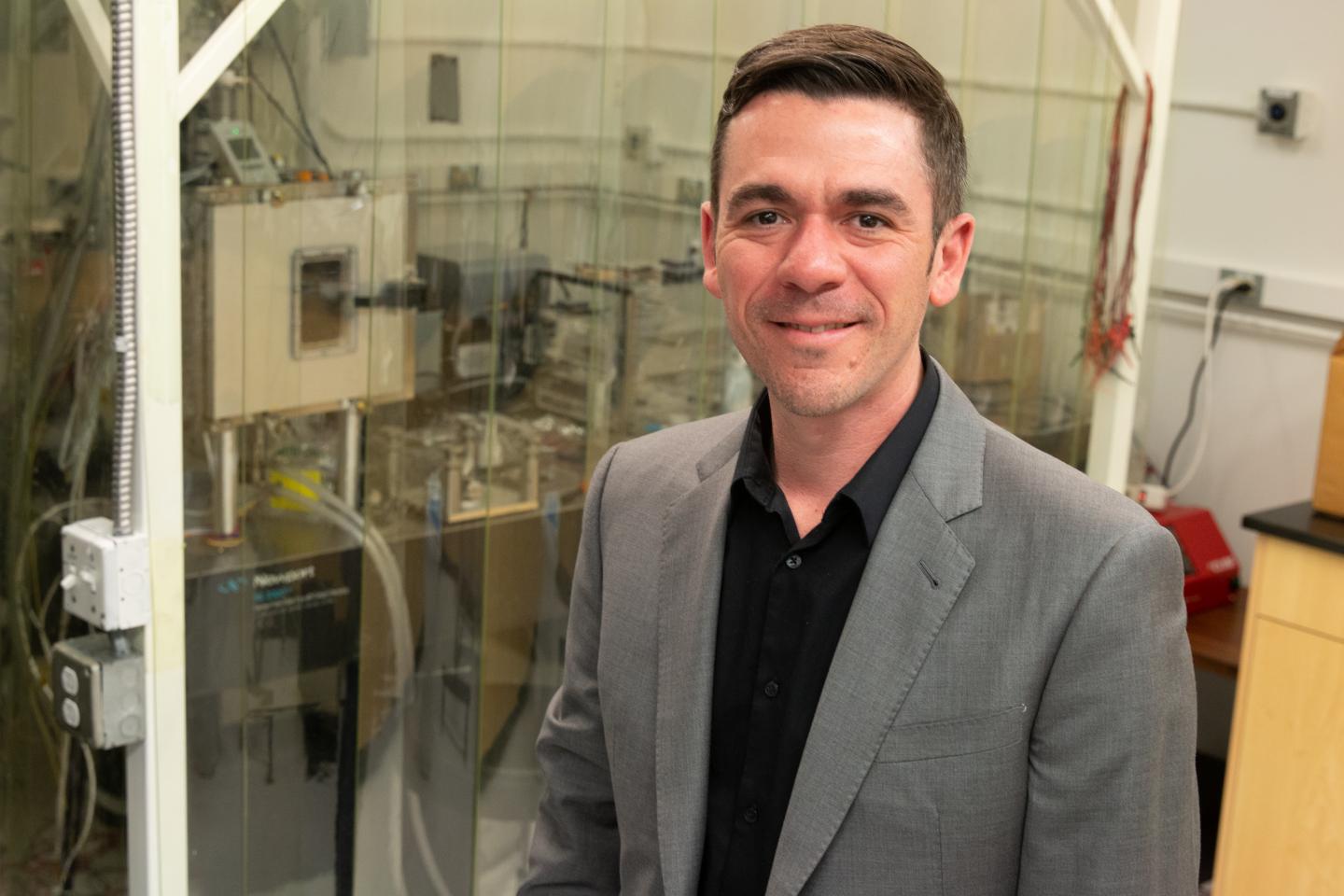
IMAGE

Credit: Dan Hixson/University of Utah College of Engineering

It’s estimated that as much as two-thirds of energy consumed in the U.S. each year is wasted as heat. Take for example, car engines, laptop computers, cell phones, even refrigerators, that heat up with overuse.

Imagine if you could capture the heat they generate and turn it into more energy.

University of Utah mechanical engineering associate professor Mathieu Francoeur has discovered a way to produce more electricity from heat than thought possible by creating a silicon chip, also known as a “device,” that converts more thermal radiation into electricity. His findings were published in the paper, A Near-Field Radiative Heat Transfer Device, in the newest issue of Nature Nanotechnology.

Researchers have previously determined that there is a theoretical “blackbody limit” to how much energy can be produced from thermal radiation (heat). But Francoeur and his team have demonstrated that they can go well beyond the blackbody limit and produce more energy if they create a device that uses two silicon surfaces very close together. The team produced a 5mm-by-5mm chip (about the size of an eraser head) of two silicon wafers with a nanoscopic gap between them only 100 nanometers thick, or a thousandth the thickness of a human hair. While the chip was in a vacuum, they heated one surface and cooled another surface, which created a heat flux that can generate electricity. The concept of creating energy in this manner is not unique, but Francoeur and his team have discovered a way to fit the two silicon surfaces uniformly close together at a microscopic scale without touching each other. The closer they are to each other, the more electricity they can generate.

“Nobody can emit more radiation than the blackbody limit,” he said. “But when we go to the nanoscale, you can.”

In the future, Francoeur envisions that such technology could be used to not only cool down portable devices like laptops and smartphones but also to channel that heat into more battery life, possibly as much as 50% more. A laptop with a six-hour charge could jump to nine hours, for example.

The chips could be used to improve the efficiency of solar panels by increasing the amount of electricity from the sun’s heat or in automobiles to take the heat from the engine to help power the electrical systems. They could also be designed to fit in implantable medical devices such as a pacemaker that would not require replaceable batteries.

Another benefit is such technology can help improve the life of computer processors by keeping them cool and reducing wear and tear, and it will save more energy otherwise used for fans to cool the processors. It also could help improve the environment, Francoeur argued.

“You put the heat back into the system as electricity,” he said. “Right now, we’re just dumping it into the atmosphere. It’s heating up your room, for example, and then you use your AC to cool your room, which wastes more energy.”

###

Co-authors on the paper include former U mechanical engineering doctoral student John DeSutter and former U mechanical engineering master’s student Lei Tang.

This news release and photos may be downloaded from unews.utah.edu.

Media Contact
Mathieu Francoeur
[email protected]

Original Source

https://www.nature.com/articles/s41565-019-0483-1

Tags: Electrical Engineering/ElectronicsHardwareMechanical EngineeringNanotechnology/MicromachinesTechnology/Engineering/Computer Science
Share12Tweet8Share2ShareShareShare2

Related Posts

How Olympic Weightlifting Harnesses the Barbell’s ‘Whip’ for Peak Performance #ASA190 — Chemistry

How Olympic Weightlifting Harnesses the Barbell’s ‘Whip’ for Peak Performance #ASA190

May 13, 2026
Just how effective are torpedo bats? #ASA190 — Chemistry

Just how effective are torpedo bats? #ASA190

May 13, 2026

Liquid-like Behavior Observed in Gold Nanoparticles

May 13, 2026

Vortex-Induced Triboelectric Nanogenerator Enables Efficient Multidirectional Wind Energy Harvesting in Low Wind and High Humidity Conditions

May 13, 2026
Please login to join discussion

POPULAR NEWS

  • Research Indicates Potential Connection Between Prenatal Medication Exposure and Elevated Autism Risk

    842 shares
    Share 337 Tweet 211
  • New Study Reveals Plants Can Detect the Sound of Rain

    728 shares
    Share 290 Tweet 182
  • Salmonella Haem Blocks Macrophages, Boosts Infection

    62 shares
    Share 25 Tweet 16
  • Breastmilk Balances E. coli and Beneficial Bacteria in Infant Gut Microbiomes

    57 shares
    Share 23 Tweet 14

About

We bring you the latest biotechnology news from best research centers and universities around the world. Check our website.

Follow us

Recent News

Advancing Closed-Loop Recycling: Enhancing Plastics Recovery from End-of-Life Vehicles

Engineering B Cells for Customizable, Enhanced Antibody Functions

How Olympic Weightlifting Harnesses the Barbell’s ‘Whip’ for Peak Performance #ASA190

Subscribe to Blog via Email

Enter your email address to subscribe to this blog and receive notifications of new posts by email.

Join 82 other subscribers
  • Contact Us

Bioengineer.org © Copyright 2023 All Rights Reserved.

Welcome Back!

Login to your account below

Forgotten Password?

Retrieve your password

Please enter your username or email address to reset your password.

Log In
No Result
View All Result
  • Homepages
    • Home Page 1
    • Home Page 2
  • News
  • National
  • Business
  • Health
  • Lifestyle
  • Science

Bioengineer.org © Copyright 2023 All Rights Reserved.