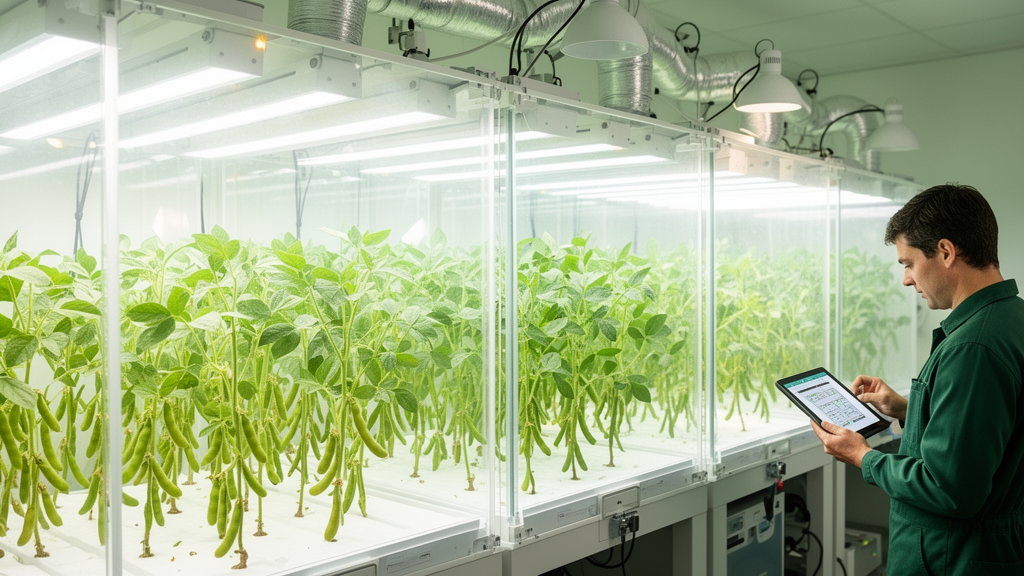
Elevated carbon dioxide was associated with shorter times to the soybean R6 reproductive stage in a controlled-environment study of 21 cultivars, with the response appearing to level off between 1,000 and 1,400 parts per million. The experiment produced 210 cultivar-by-treatment observations from 1,050 plants across 10 combinations of CO₂ concentration, photoperiod and LED light quality. Researchers analyzed time from sowing to R6 with a workflow combining Kaplan–Meier survival analysis and a Bayesian Weibull accelerated failure time model, retaining observations from plants that had not reached the stage by the end of the observation window.
Some observations were right-censored, meaning that the target developmental stage had not been reached within the available observation period. The researchers treated these records as time-to-event data rather than ordinary endpoint measurements, allowing the analysis to use the information that the plants had not yet reached R6 during the study window. Across the 10 tested treatment combinations, the conditions were classified as favorable, intermediate or strongly inhibitory for reproductive progression. Increasing CO₂ from ambient levels to 1,000–1,400 ppm was associated with a reduction in median survival time, which represented time to R6 in this analysis. The additional change from 1,000 to 1,400 ppm was minimal, indicating a saturating response within the tested range rather than an indefinitely increasing effect.
Blue–red spectral treatments and photoperiods of 6–8 hours formed a favorable profile among the tested conditions for rapid and synchronized progression toward R6. The reported results do not establish that any one factor acts independently of the others, because CO₂ concentration, light quality and day length were evaluated as treatment combinations. The findings therefore describe associations within the experimental design rather than isolated causal effects of individual environmental variables. The study’s scope was also limited to the selected cultivars, controlled treatment combinations, experimental chamber and observation period; the source does not establish that the same pattern would occur in field-grown soybeans or under different lighting, temperature and cultivation conditions.
The Bayesian accelerated failure time model supplied treatment-specific estimates while including treatment as a random effect to account for the chamber-level experimental structure. The estimated between-treatment standard deviation was 0.02, with a 95% credible interval of 0.00–0.06, which the authors interpreted as negligible chamber-to-chamber variation in this dataset. The model’s highest-ranked predicted combination was 1,400 ppm CO₂, a blue-to-red light ratio of 2:1 and a six-hour photoperiod. For that combination, the predicted median time to R6 was 66.90 days and the predicted mean was 72.18 days. These figures are model-based estimates for the tested conditions, not direct measurements of a universal flowering schedule. By combining established survival analysis with a Bayesian Weibull model, the workflow offers a transferable approach for censored plant phenology data in controlled-environment research, phenotyping and breeding studies where time to a developmental milestone is the outcome of interest.
Subject of Research: Statistical analysis of censored soybean time to R6 under controlled CO₂, light and photoperiod treatments
Article Title: A practical workflow combining Kaplan-Meier and Bayesian accelerated failure time analyses for censored reproductive phenology data in soybean
Article References: Zhang, F., Cui, X., Liu, K., Hong, H., Su, X., Xiong, Y., Jadoon, S., Yu, H., Chen, Y., Qiu, L., & Wang, J. (2026). A practical workflow combining Kaplan-Meier and Bayesian accelerated failure time analyses for censored reproductive phenology data in soybean. BMC Plant Biology. https://doi.org/10.1186/s12870-026-09851-6
Image Credits: AI Generated
DOI: 10.1186/s12870-026-09851-6
Keywords: soybean phenology, R6 development, Bayesian AFT model, Kaplan–Meier analysis, right-censored data, controlled environments, elevated CO₂, LED light quality, photoperiod, survival analysis, practical, workflow
News Source: Alan Morgan. (October 20, 2026). Bayesian workflow analyzes censored soybean R6 timing across CO₂, light and photoperiod treatments. Scienmag.