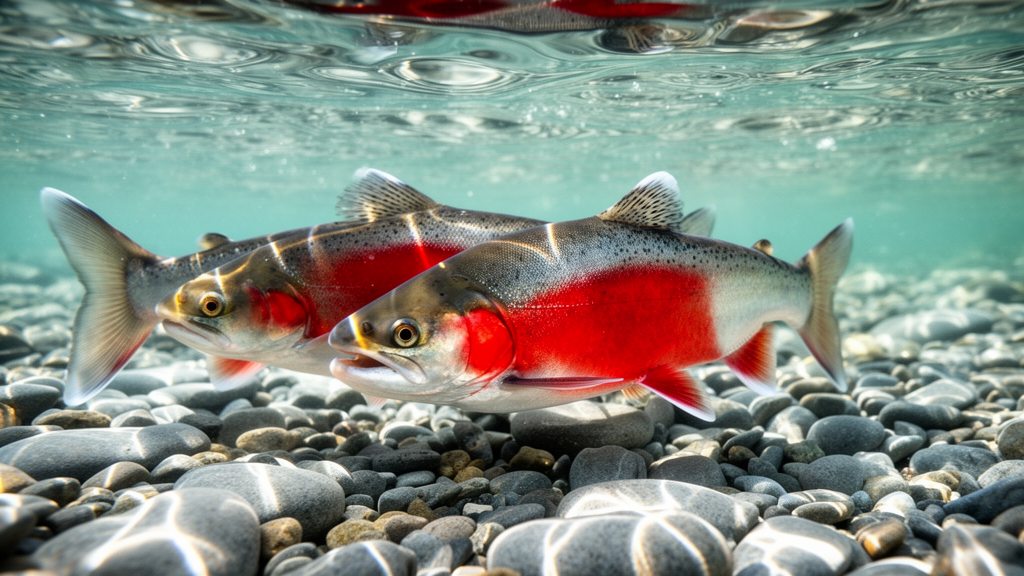
In a study published in Genetics Selection Evolution, a research team analyzed seventeen years of controlled spawning records comprising 3,248 artificial mating events between 1,969 sires and 3,016 dams at Hólar University. The work introduces two complementary computational pathways—a bivariate Bayesian animal model implemented with Hamiltonian Monte Carlo sampling and a two-tower multilayer perceptron neural network driven by ancestral relationships—to quantify heritability and forecast cross outcomes in commercial aquaculture stocks without requiring expensive physiological gamete assays.
Sustainable and economically viable finfish farming relies heavily on consistent reproductive success, particularly in salmonid production where individual breeding candidates carry substantial monetary value due to their extensive reproductive capacity. In commercial salmonid aquaculture, artificial reproduction involves external fertilization, a biological process that is acutely sensitive to fluctuating environmental conditions and operational stress. Spawning windows, especially for mature females, are narrow and unforgiving, meaning that unviable or poorly timed stripping of gametes leads to complete batch failures. Such fertilization breakdowns waste valuable hatchery resources, operational labor, and tank capacity, while concurrently restricting effective population size and eroding genetic diversity by eliminating entire familial lineages from subsequent breeding tiers. Historically, breeding stations have attempted to safeguard reproductive output by evaluating direct phenotypic proxies such as sperm motility metrics, gamete counts, and egg diameter measurements. However, systematically collecting these laboratory measurements across thousands of candidate breeders remains prohibitively expensive, labor-intensive, and largely impractical at commercial scales, highlighting the necessity for genetic merit predictions that operate without individual gamete phenotyping.
Addressing this diagnostic bottleneck requires an analytical paradigm that reflects the underlying biology of mating outcomes, which are inherently governed by the joint contributions of two separate individuals acting in a non-additive, multiplicative manner. Rather than treating fertilization as a simple linear trait attributed to an individual animal, the researchers conceptualized mating viability as a probabilistic game where overall success requires both the sire and the dam to exceed latent reproductive thresholds. Under this probit-link formulation, the observed binary outcome of a cross is modeled as a Bernoulli trial where the overall success probability equals the standard normal cumulative distribution function of the female liability multiplied by the standard normal cumulative distribution function of the male liability. This multiplicative formulation captures the biological reality that a viable family cannot be established if either parent produces non-functional gametes, regardless of how superior the partner’s latent reproductive potential might be. By decoupling the composite phenotype into distinct sex-limited liabilities, the framework allows independent modeling of paternal and maternal genetic contributions while explicitly accommodating the non-linear interaction that determines the viability of their union.
The empirical foundation of the investigation comprised operational records collected between 2008 and 2024 from the selective breeding nucleus maintained at Hólar University in northern Iceland. Across the seventeen-year recording window, artificial matings involved 1,969 sires and 3,016 dams, with males frequently contributing to two separate mating events while females typically contributed to a single family. Following the introduction of optimal contribution selection strategies in the 2022 breeding cohort, several elite sires and dams were allocated to multiple family crosses, while others were utilized only once. In the hatchery setting, viable fertilized eggs were counted up to an operational threshold of 400 eyed eggs per cross, introducing substantial right-censoring because healthy Arctic charr females routinely produce several thousand eggs per spawning cycle. Because this 400-egg threshold represents the standard family quota retained to establish full-sib families within the breeding nucleus, crosses yielding at least 400 eyed eggs were classified as successes, while crosses falling below this ceiling were treated as failures. Across all recording years, this conservative operational threshold yielded an overall baseline fertilization success rate of approximately 88 percent.
To estimate the variance components of these latent fertility traits, the investigators constructed a sex-specific bivariate generalized linear mixed model within a Bayesian hierarchical framework. After removing mating events with phantom or unrecorded parentage, a retained dataset of 3,087 mating events was evaluated alongside an extensive pedigree structure comprising 9,219 individual entries spanning multiple ancestral generations without direct phenotypic records. The additive genetic relationship matrix was computed using the R package AGHmatrix to trace genealogical relationships back through the complete pedigree. Within the generalized linear mixed model, each sex-limited latent phenotype incorporated an independent intercept and year-specific random effects, with additive genetic variances modeled on the liability scale. To account for repeated utilization of males across multiple matings, the model incorporated a permanent environmental effect for sires, while female and male liabilities shared a residual covariance term. The model was programmed in Stan via the rstan package and executed using the No-U-Turn Sampler algorithm under weakly informative priors across three independent Markov chains running for 10,000 iterations each, with 4,000 initial warmup iterations discarded per chain to ensure stable posterior convergence verified through potential scale reduction factors and visual trace-plot inspection.
The Bayesian posterior estimates revealed meaningful, sex-differentiated genetic architecture underlying fertilization success in the Icelandic population. Female fertility demonstrated a moderate heritability of 0.36 on the latent liability scale, accompanied by a 95 percent credible interval spanning from 0.20 to 0.56, whereas male fertility displayed a lower heritability estimate of 0.15 with a 95 percent credible interval ranging from 0.00 to 0.43. Phenotypic variance point estimates were slightly elevated in dams, yielding a posterior mean of 2.80 with a credible interval between 1.74 and 4.96, compared to a male phenotypic variance posterior mean of 2.25 with a credible interval from 1.20 to 4.56, although the substantial overlap between these intervals suggests caution when inferring broader sex-based variability. Male reproductive potential exhibited a repeatability posterior mean of 0.38 with a 95 percent credible interval between 0.14 and 0.62, while estimated intercepts were marginally higher for males. The genetic correlation between male and female fertility yielded a posterior mean of 0.14, yet this metric was characterized by extreme uncertainty, bounded by a wide 95 percent credible interval from negative 0.64 to positive 0.78. Interestingly, these findings contrast with recent observations from the Swedish National Breeding Program, where male fertility showed higher heritability than female fertility, a discrepancy likely attributable to divergent operational trait definitions and narrower posterior distributions supported by the larger Icelandic sample size.
Alongside traditional animal model evaluations, the research team engineered an alternative predictive framework employing a two-tower multilayer perceptron architecture inspired by recommendation systems popularized for web retrieval. Instead of using high-dimensional genomic markers or the massive additive relationship matrix directly, the neural network ingests relationship-to-founders vectors derived from a submatrix linking candidate breeders to 285 pedigree founders. For each individual sire and dam, this input vector reflects expected identity-by-descent allele sharing with the historical base population, drastically reducing dimensionality and mitigating overfitting. Each tower processes sex-specific vectors through three sequential hidden layers equipped with rectified linear unit activation functions. To generate joint fertilization probabilities while preserving numerical stability, the liability outputs from the male and female towers are transformed via probit link functions, converted to log-space probabilities, summed, and exponentiated.
To prevent parent data leakage, mating records were partitioned using spawning-year and target stratification, creating an 80 percent training set for cross-validation and a 20 percent held-out test partition. Grid search identified optimal dropout regularization rates of 0.0 on the first layer and 0.5 on the second layer, yielding an average cross-validation receiver operating characteristic area under the curve of 0.645. On the independent test partition, the model achieved an area under the curve of 0.654 and a precision-recall area under the curve of 0.945, representing relative lifts of 30.8 percent over random guessing and 3.85 percent over the test-set prevalence baseline.
Comparing estimated breeding values from the Bayesian framework against liability proofs from the neural network revealed significant positive Pearson correlations of 0.42 for females and 0.44 for males. Although both methodologies rely on shared pedigree data and binary outcomes, their underlying assumptions differ markedly; the Bayesian model relies on formal priors and explicit variance structures, while the neural network captures non-linear ancestral combinations without distributional assumptions. Because true genetic merit is unobservable, these moderate correlations indicate partial agreement and shared biological signal rather than interchangeable proof metrics.
The flexible two-tower architecture can readily accommodate future data modalities, such as female genomic markers and male sperm methylation profiles, along with early embryonic survival and genotype-by-environment interactions.
Subject of Research: Genetic parameter estimation and machine learning prediction of fertilization success in Arctic charr
Article Title: A non-linear game for two: genetic parameters and prediction of fertilization success using Bayesian and machine learning frameworks
Article References: Pappas, F., Debes, P. V., Johnsson, M., & Palaiokostas, C. (2026). A non-linear game for two: genetic parameters and prediction of fertilization success using Bayesian and machine learning frameworks. Genetics Selection Evolution, 58(1), Article 34. https://doi.org/10.1186/s12711-026-01070-9
Image Credits: AI Generated
DOI: 10.1186/s12711-026-01070-9
Keywords: Arctic charr, fertilization success, Bayesian hierarchical modeling, two-tower neural network, multilayer perceptron, probit link, latent liability, additive genetic variance, heritability, repeatability, relationships to founders, Icelandic breeding nucleus, aquaculture genetics, salmonid breeding, ROC AUC, precision recall AUC, estimated breeding values, optimal contribution selection
News Source: Cassandra Pierce. (November 13, 2026). Bayesian and Neural Network Models Predict Arctic Charr Mating Success from Pedigrees. Scienmag.