


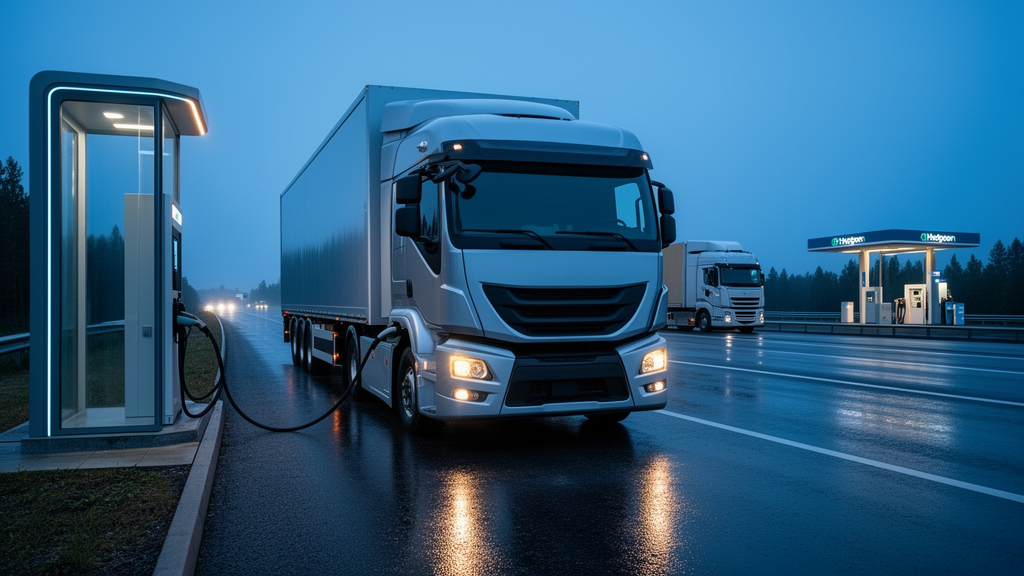
Battery electric heavy trucks, despite purchase prices that can reach several times those of a conventional diesel tractor, can achieve a total cost of ownership comparable to or lower than diesel, hydrotreated vegetable oil, natural gas, or biomethane trucks over a ten-year operating life, according to a multi-criteria sustainability assessment of heavy-duty freight technologies conducted under Swedish conditions. Hydrogen-based options, by contrast, remain substantially more costly across every economic measure the researchers examined. The study, published in Frontiers in Future Transportation by researchers at Linköping University, compared diesel, HVO, compressed and liquefied natural gas, compressed and liquefied biomethane, mild hybrid diesel, battery electric, fuel cell electric, and hydrogen combustion trucks using a framework of sixteen indicators spanning technical, economic, environmental, and social performance, fifteen of which were assessed in the published analysis.
The assessment deliberately avoided collapsing its results into a single weighted ranking. The authors describe their approach as a soft multi-criteria assessment, a decision-support method in which indicators are scored on a five-level scale from Very Poor to Very Good, each accompanied by a certainty rating, but the four key areas are not aggregated into one overall score. The researchers argue that the relative importance of indicators varies between actors, regions, and use cases, and that some sustainability aspects are incommensurable or only weakly commensurable, so a single number would obscure the trade-offs that decision-makers actually face. The framework itself was developed in a companion paper through a literature-based and participatory process, and the present study applies it to a current-to-near-term comparison rather than a long-term scenario analysis.
The vehicle configuration anchoring the comparison is a widely used heavy-duty setup: a three-axle semi-tractor with a three-axle trailer in the N3 class, with a gross combination weight of up to 50 tonnes under Swedish limits and a typical payload of 16.5 tonnes. Economic modelling assumed a ten-year vehicle lifetime and an annual driving distance of 165,000 kilometres, assumptions the authors chose to preserve comparability between technologies rather than to imply identical real-world service lives. Fuel and electricity prices were drawn from minimum and maximum values observed between 2020 and 2024, a period spanning both the COVID-19 pandemic and the war in Ukraine, so the operating-cost estimates reflect substantial price volatility rather than a single market moment.
The capital-cost gap between established and emerging technologies is stark. Diesel trucks carry an estimated purchase price of roughly €66,000 to €78,000 and serve as the reference case. Battery electric trucks range from approximately €188,000 to €577,000 when depot-charging infrastructure is excluded, and from roughly €211,000 to €763,000 when it is included, with the breadth reflecting uncertainty in battery costs, vehicle configuration, and charging assumptions. Fuel cell electric trucks show the widest and most uncertain range of all, from approximately €148,000 to €1,886,000, driven mainly by broad fuel-cell stack cost estimates in the literature and the absence of large-scale production. Hydrogen combustion trucks fall between €74,000 and €120,000, penalised chiefly by expensive hydrogen storage tanks.
Operating expenses partially reverse that picture. Battery electric trucks charged slowly at a depot with lower-cost electricity show estimated lifetime operating costs of €420,000 to €970,000, the lowest of any technology assessed and rated Very Good with high certainty, while a fast-charging scenario with higher electricity prices pushes the range to €1,030,000 to €1,840,000. Diesel trucks, the reference, fall between €870,000 and €1,580,000. Hydrogen combustion trucks fare worst, at €1,780,000 to €2,170,000, driven by high hydrogen costs and low engine efficiency. Combining capital and operating costs, the study concludes that battery electric trucks can reach a total cost of ownership comparable to or slightly lower than internal combustion alternatives, while natural gas and biomethane trucks show the lowest total costs among the studied options and hydrogen-based technologies carry significantly higher totals.
Technical performance tells a different story. Battery electric trucks were rated Very Poor for range, with most reported figures in the literature falling between 100 and 400 kilometres, although some manufacturer-reported configurations claim up to around 800 kilometres, values the authors treat as configuration-specific upper bounds requiring larger batteries. Battery electric trucks also lose approximately 14 percent of payload capacity to battery mass, the largest reduction assessed, and charging times vary from around 30 minutes with high-power chargers to as much as 20 hours, with most scenarios falling between two and four hours. Fuel cell trucks show enormous range variation, from 200 to as high as 1,900 kilometres, but their maturity was rated Poor to Very Poor, with several models still in prototype verification or pilot demonstration. Hydrogen combustion trucks scored worst of all on maturity, with many projects still underway and lacking operational data.
Infrastructure compounds these constraints. Sweden had only four publicly accessible and operational hydrogen refuelling stations as of 2024, earning both fuel cell and hydrogen combustion trucks a Very Poor infrastructure rating with high certainty. Battery charging is better but still limited: the country registers 4,756 fast-charging points above 22 kilowatts, a figure that includes private home installations, and dedicated high-power charging networks for heavy-duty vehicles remain absent. By contrast, diesel, HVO, and mild hybrid trucks benefit from a dense national fuelling network, and compressed gas trucks can use more than 200 public stations, though rural coverage is thinner.
On climate performance, the results are strongly pathway-dependent. Biomethane trucks running on waste and residue-based feedstocks achieved the lowest greenhouse gas emissions in the assessment, ranging from minus 52 to plus 22 kilograms of carbon dioxide equivalent per 100 kilometres compared with 128 to 135 for diesel, and earned a Very Good rating. Battery electric trucks ranged from 29 to 97 kilograms, with the highest production-phase emissions of any technology due to battery manufacturing, including an assumed one battery replacement over the truck’s lifetime. Fuel cell trucks spanned 18 to 136 kilograms depending almost entirely on whether the hydrogen came from renewable electrolysis or natural gas reforming. The authors stress that these figures sit within a defined assessment boundary combining well-to-wheel emissions with selected vehicle-production contributions, not a full life-cycle assessment, and that recent prospective studies show relative climate performance can shift across regions and time horizons as electricity mixes and fuel pathways develop.
The study also flags dependencies that temper any single-technology enthusiasm. Battery electric and mild hybrid trucks, along with fuel cell vehicles, were rated Very Poor on dependency on critical materials, relying on lithium, cobalt, nickel, rare earth elements, and platinum whose supply chains are geographically concentrated. Battery electric trucks were rated Poor to Good on sociotechnical system services, since large-scale electrification can strain transmission and distribution grids, although coordinated charging can support renewable integration and vehicle-to-grid services. Biomethane trucks earned the strongest social ratings, with Very Good scores for system services because biogas systems from sludge, food waste, and agricultural residues support waste recycling, sanitation, and nutrient recovery, and Good ratings for institutional conditions in Sweden. Yet the authors caution that waste and residue feedstocks are limited, geographically uneven, and face competing demands from maritime transport, industry, and grid injection, so biomethane should not be assumed to scale indefinitely.
The authors present their findings as structured decision support under defined Swedish and European baseline assumptions rather than static recommendations or universal rankings. They note that lower annual mileage or shorter service lives would make high-capital technologies such as battery electric and fuel cell trucks less favourable, that battery replacement assumptions materially affect both cost and emissions results, and that no full probabilistic sensitivity analysis was performed. Driver working conditions, risk factors such as fuel volatility, and noise were excluded, and several emerging technologies were evaluated as broad categories rather than specific vehicle models. As battery performance, charging infrastructure, hydrogen production, and policy support evolve, the researchers intend the framework to be revisited and recalibrated, offering policymakers and fleet operators a transparent map of trade-offs rather than a single answer to heavy-duty freight decarbonisation.
Subject of Research: A multi-criteria sustainability assessment comparing alternative heavy-duty truck technologies under Swedish conditions
Article Title: Sustainability assessment of heavy-duty trucks, part II: a multi-criteria comparison of alternative technologies
Article References: Smolarczyk, K., Ammenberg, J., & Feiz, R. (2026). Sustainability assessment of heavy-duty trucks, part II: a multi-criteria comparison of alternative technologies. Frontiers in Future Transportation, 7, Article 1851788. https://doi.org/10.3389/ffutr.2026.1851788
Image Credits: AI Generated
DOI: 10.3389/ffutr.2026.1851788
Keywords: heavy-duty trucks, battery electric vehicles, fuel cell electric vehicles, hydrogen, biomethane, total cost of ownership, greenhouse gas emissions, multi-criteria assessment, alternative fuels, Sweden, freight decarbonisation, charging infrastructure
News Source: Faith Mcneil. (October 29, 2026). Battery Trucks Rival Diesel on Cost While Hydrogen Stays Priced Out, Swedish Study Finds. Scienmag.



