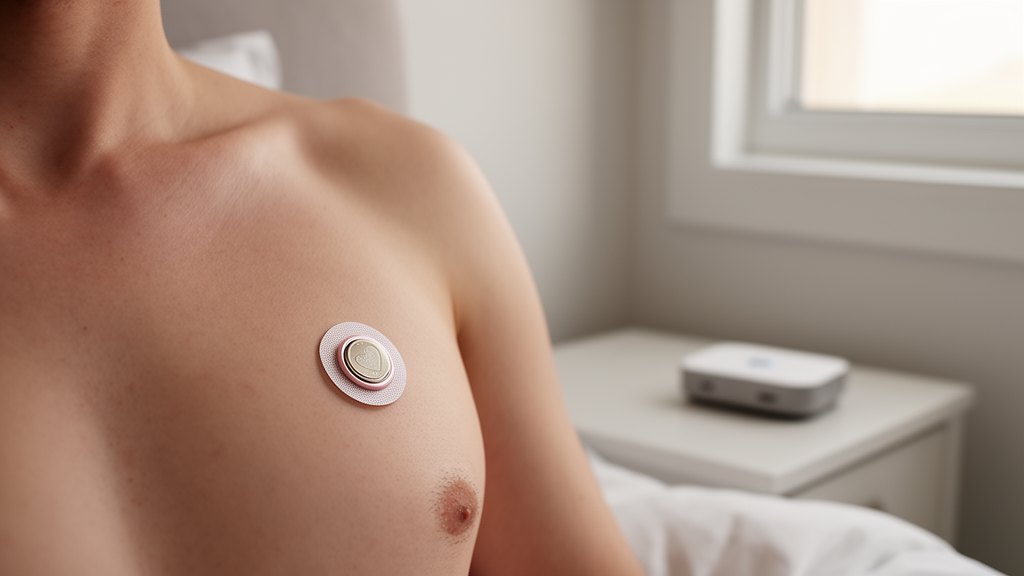
Wearable heart monitors have become a fixture of modern preventive medicine, yet the technology inside them still faces an awkward trade-off. Optical sensors, the green LEDs and photodiodes tucked beneath every smartwatch strap, can deliver impressively accurate pulse readings, but their performance depends on how well the light couples to the skin, how firmly the device presses against the wrist, and the particular sensing strategy each manufacturer has engineered. Skin tone, body composition, motion artifacts, and ambient light all conspire to degrade the signal. Now a team of researchers at Zhejiang University in Hangzhou, China, has unveiled a radically different approach: a wireless bio-interface tag that listens to the heart not with light, but with magnetism, and reports what it hears using almost no power at all.
The device, described in a study published in npj Flexible Electronics on 25 September 2026, couples magneto-mechanical cardiac sensing with analog backscatter communication, a combination that allows the tag to sidestep the two most power-hungry operations in conventional wearables: digitizing the signal on the device and actively transmitting it by radio. Instead of converting the heartbeat into digital data and broadcasting it, the tag lets the heartbeat itself shape the way an incoming radio wave is reflected. The result is a sensor that consumes just 1.26 milliwatts in active mode and a mere 113.9 microwatts when duty-cycled, enough to run for more than five months on a single coin cell battery.
To understand why this matters, it helps to consider what the heart actually does to the body’s surface. Every cardiac cycle sends a pressure wave through the vasculature and produces minute mechanical vibrations in the skin, displacements far too small to see but large enough to be detected by sensitive transducers. The Zhejiang team’s tag converts these heart-induced skin micro-vibrations into fluctuations of a magnetic field. Those magnetic fluctuations, in turn, modulate the reflection of an incident radio-frequency carrier supplied by an external reader. Because the tag never generates its own radio signal, it avoids the substantial energy cost of an active transmitter, and because it never digitizes the signal, it avoids the overhead of analog-to-digital conversion and the associated processing circuitry.
This architecture belongs to a family of techniques known as backscatter communication, which has attracted growing interest in low-power electronics. In a backscatter system, the tag is essentially a passive or semi-passive mirror: an external source illuminates it with a radio carrier, and the tag alters the properties of the reflected wave, its amplitude, phase, or frequency, to encode information. The elegance of the analog variant demonstrated here is that the encoding happens directly in the physical domain. The heartbeat modulates the magnetic element, the magnetic element modulates the reflection, and the reader reconstructs the cardiac signal from the reflected wave. No microcontroller, no data packets, no protocol stack on the tag itself.
The choice of a magneto-mechanical transducer rather than an optical one addresses one of the most persistent criticisms of wrist-worn pulse sensors: inclusivity. Optical photoplethysmography relies on light entering and leaving the skin, and the amount of light absorbed or scattered varies with pigmentation, perfusion, skin condition, and contact pressure. Studies over the past decade have documented systematic differences in accuracy across users. The new tag, by contrast, senses mechanical motion directly, a quantity that should in principle be independent of how light interacts with the skin. To test that claim rigorously, the researchers evaluated the device across 30 participants spanning all six Fitzpatrick skin types, the standard dermatological classification from type I, very fair skin, to type VI, deeply pigmented skin, and across a range of body weights.
The performance results under the tested protocol were notable. The tag maintained agreement between its measured RR intervals, the time intervals between successive R-wave peaks of the electrocardiogram that define beat-to-beat timing, and ECG-referenced ground truth. It also delivered accurate heart-rate estimation relative to a commercial smartwatch used as a benchmark. RR-interval fidelity matters because it is the foundation for heart-rate variability analysis, a clinically informative measure of autonomic nervous system function that coarse pulse trackers often fail to capture reliably. A wearable that preserves beat-to-beat timing without adhesive electrodes or chest straps opens the door to continuous, unobtrusive monitoring of a metric that is usually only assessed in clinical settings.
The power figures deserve particular attention, because battery life is arguably the single greatest obstacle to truly pervasive cardiac monitoring. A device that must be recharged every few days is a device that will be forgotten, removed, or abandoned, and every gap in the record is a gap in the clinical picture. By consuming 113.9 microwatts under duty-cycled operation, the tag stretches a coin cell, the small button-shaped battery used in watches and hearing aids, to more than five months of continuous service. That endurance profile changes the practical calculus of long-term studies: a participant could wear the device through an entire season of daily life without interruption, and clinicians could review months of uninterrupted cardiac data rather than snapshots.
The researchers also demonstrated that the platform extends beyond the heart. Multi-site monitoring during daily activities showed the tag operating in realistic, uncontrolled conditions rather than only in the laboratory, and hardware-in-the-loop replay experiments extended the concept to other biosignals, including electroencephalography, electromyography, and electrooculography, the electrical signatures of brain, muscle, and eye activity respectively. In these replay tests, recorded physiological signals were fed through the hardware to verify that the interface could faithfully carry them, pointing toward a future in which a single low-power backscatter architecture supports multimodal health monitoring, tracking sleep, movement, and neural activity alongside cardiac function.
The work arrives amid a broader surge of interest in magnetically coupled and backscatter-based bio-interfaces. Related recent studies have explored magnetoelectric backscatter communication for bioelectronic implants, flexible wearable ECG systems for freely moving animals, and even radar-based smart furniture for cardiac monitoring, all converging on the same goal: extracting physiological information while spending as little energy as possible. The Zhejiang device distinguishes itself by combining the mechanical robustness of magnetic sensing with the inclusivity of a skin-tone-independent measurement and the extreme efficiency of analog backscatter in a single wearable form factor.
Challenges remain before such tags become routine clinical or consumer tools. The system depends on an external radio-frequency carrier, so practical deployments will require readers integrated into the environment or into companion devices, and the study’s validation, while spanning a diverse participant group, was conducted under a defined testing protocol whose conditions may differ from the full chaos of everyday life. Long-term biocompatibility, mechanical durability, and regulatory pathways will all need attention. Nevertheless, the demonstration that a tiny tag can transduce the heartbeat magnetically, reflect it back over the air, and do so for five months on a coin cell represents a meaningful step toward cardiac monitoring that is genuinely pervasive, and genuinely inclusive, available to every skin type, every body, and every corner of daily life where the heart’s rhythm tells its story.
Subject of Research: A magneto-mechanical wearable bio-interface using ultra-low-power analog backscatter for inclusive long-term cardiac monitoring
Article Title: A magneto-mechanical bio-interface with ultra-low-power analog backscatter for inclusive cardiac monitoring
Article References: Huang, J., Guo, X., Tan, L., Chen, X., Shu, Y., Song, J., & Chen, J. (2026). A magneto-mechanical bio-interface with ultra-low-power analog backscatter for inclusive cardiac monitoring. npj Flexible Electronics. https://doi.org/10.1038/s41528-026-00642-5
Image Credits: AI Generated
DOI: 10.1038/s41528-026-00642-5
Keywords: wearable sensors, backscatter communication, cardiac monitoring, magneto-mechanical sensing, heart rate, RR intervals, low-power electronics, flexible electronics, biosignals, skin tone inclusivity, coin cell battery, health monitoring
News Source: Faith Mcneil. (October 8, 2026). Battery-Powered Heart Monitor Runs Five Months on a Coin Cell Using Backscatter. Scienmag.