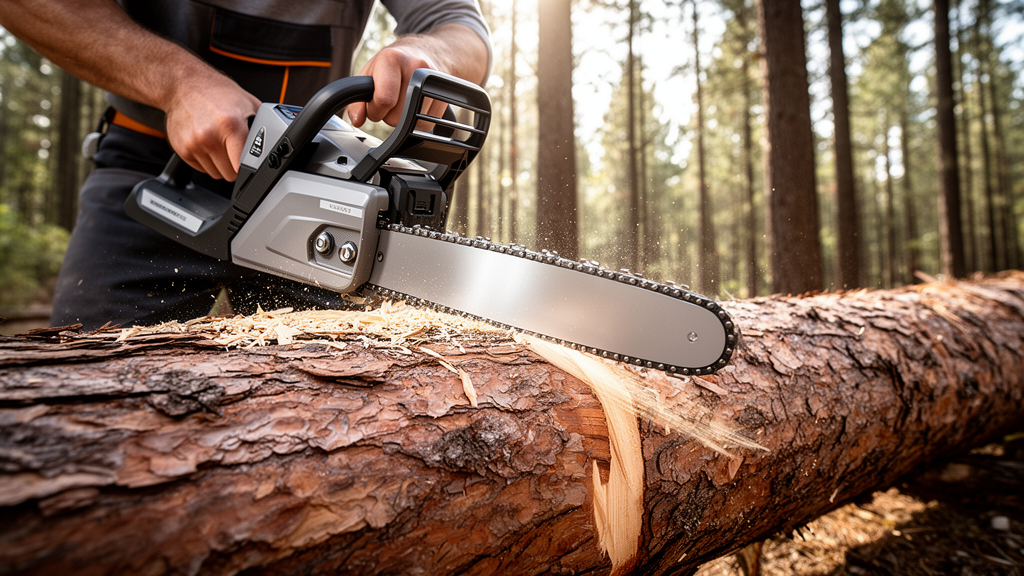
A controlled investigation into motor-manual forestry operations has revealed that switching from conventional internal combustion chainsaws to modern battery-powered alternatives significantly reduces worker noise exposure, yet fails to eliminate substantial ergonomic hazards linked to hand-arm vibration. Reporting in the journal Frontiers in Forests and Global Change, researcher Kıvanç Yüksel from the Faculty of Forestry at Kahramanmaras Sutcu Imam University in Türkiye examined operator exposure during the bucking of debarked softwood logs. By systematically comparing two high-performance commercial lithium-ion battery saws with a professional petrol-powered machine across varying timber dimensions and tree species, the study established a stark contrast between physical stressors. Personal daily noise exposure was governed primarily by the chainsaw model, providing clear acoustic benefits when operating battery-driven equipment. Conversely, daily hand-arm vibration exposure was driven predominantly by continuous log diameter and complex multi-factor interactions rather than the tool’s underlying power source, demonstrating that battery electrification alone cannot resolve all major physical strains inherent to timber harvesting.
Chainsaw operations in labor-intensive forestry harvesting present notorious occupational health hazards, combining an acute risk of traumatic cutting accidents with chronic physical strain from vibration, acoustic noise, exhaust emissions like carbon monoxide, wood dust, and strenuous working postures. Prolonged exposure to hand-arm vibration transmitted through chainsaw handles can induce severe vascular, sensorineural, and musculoskeletal disorders, collectively designated as hand-arm vibration syndrome, as well as carpal tunnel syndrome. Workers frequently develop chronic numbness, blanching of the fingers, tingling, paresthesia, and permanent loss of manual dexterity. At the same time, repetitive cross-cutting tasks and awkward biomechanical stances induce physical fatigue, which impairs cognitive focus and heightens accident vulnerability. While occupational health and safety regulations in Turkey and the European Union mandate rigorous threshold boundaries for physical stressors, forest harvesting operations historically reliant on semi-mechanized petrol chainsaws have struggled to reduce operator exposure, prompting growing scientific and industrial interest in battery-powered tools.
To evaluate these occupational hazards under rigorous experimental conditions, the investigation examined three distinct chainsaw models representing contrasting mechanical architectures and power configurations. The battery-powered Husqvarna 535i XP featured an operating weight of 5.46 kilograms including its 36-volt BLi 300 lithium-ion battery, delivering 1.45 kilowatts of mechanical power output, a maximum chain speed of 20 meters per second, a 40-centimeter guide bar, a 9.52-millimeter chain pitch, a 0.65-millimeter depth gauge, and no manufacturer-specified anti-vibration dampening system. The second electric machine, a Stihl MSA 300C, represented a more powerful commercial battery saw, weighing 7.52 kilograms with its AP500S 36-volt lithium-ion battery, offering 2.5 kilowatts of power output, a higher maximum chain speed of 30 meters per second, a 40-centimeter bar, an 8.25-millimeter chain pitch, and an integrated anti-vibration mechanism. These electric models were compared directly against a widely used heavy-duty petrol-powered Husqvarna 372 XP, which possessed an operating weight of 7.32 kilograms, an internal combustion engine producing 4.1 kilowatts, a maximum chain speed of 28.5 meters per second, a 50-centimeter guide bar, a 9.52-millimeter chain pitch, and built-in anti-vibration damping.
The experimental cutting trials were conducted on debarked logs from two commercially significant coniferous timber species: black pine, Pinus nigra, and Taurus fir, Abies species. Logs were stored under uniform atmospheric conditions and categorized into two standardized diameter ranges: a smaller D1 class spanning 20 to 30 centimeters and a larger D2 class spanning 30 to 40 centimeters. Across the experimental material, precise cutting points were designated at 10-centimeter intervals along each log. Because tree stems naturally exhibit irregular, non-circular cross-sections, researchers performed two perpendicular diameter measurements at every planned cutting point, using the arithmetic mean as the representative continuous diameter covariate for subsequent statistical modeling. A total of nine physical logs supplied 180 bucking cuts across twelve experimental groups comprising combinations of the three chainsaw models, two tree species, and two diameter classifications. Log 1 supplied 45 individual cuts, Log 5 provided 30 cuts, and seven additional logs provided 15 cuts each, with cuts from the same physical stem treated as repeated measurements rather than independent biological replicates.
All 180 cutting trials were performed on a single day under calm, overcast, rain-free forest conditions by a single professional forestry worker possessing approximately twenty years of full-time chainsaw operating experience. The operator stabilized logs at an elevated working height of 30 to 40 centimeters on dedicated support logs and executed downward cuts from the upper log surface using a standardized posture, resting for approximately ten minutes after every 45 to 50 minutes of continuous activity. Saw chains were uniformly sharpened before testing without subsequent mid-trial file intervention, and chain tensions were verified to prevent mechanical loosening. Battery-powered units commenced cutting fully charged and received fresh battery packs whenever residual capacity dropped to approximately 20 percent, while the petrol saw was idled for one to two minutes prior to recording to ensure thermal engine stabilization. These procedural controls minimized confounding variability associated with operator fatigue, progressive chain dulling, battery voltage depletion, and changing environmental temperatures.
Physical measurements captured acoustic and mechanical loads simultaneously during each 40-second cross-cutting trial. Hand-arm vibration was monitored using a Quest Technologies HAVPro vibration meter connected to a triaxial accelerometer positioned securely at the hand-handle interface on the front handle beneath the operator’s left gripping hand, following guidelines established by ISO 5349-1. Frequency-weighted acceleration components across orthogonal axes were combined into a total vibration vector value and normalized to an eight-hour reference period, designated as A(8), assuming an active daily cutting duration of seven hours or 420 minutes. Acoustic noise was recorded using an Extech SL400 personal noise dosimeter conforming to IEC 61672-1 Class 2 standards, mounted with its microphone fastened to the worker’s collar approximately 10 centimeters from the ear in compliance with ISO 9612. Sound pressure measurements captured A-weighted equivalent continuous noise levels over each cut and were similarly normalized to estimate personal eight-hour equivalent exposure levels, designated as LEX,8h, under the identical seven-hour operational cutting scenario.
Statistical evaluation via linear mixed-effects models revealed that personal hand-arm vibration was heavily governed by log geometry rather than chainsaw power type. Across the complete dataset, the estimated daily vibration exposure values averaged 3.79 meters per second squared for the Husqvarna 535i XP, 3.89 meters per second squared for the Stihl MSA 300C, and 4.00 meters per second squared for the petrol Husqvarna 372 XP. The linear mixed model demonstrated that the main effect of chainsaw model was statistically nonsignificant, as was the main effect of tree species and their mutual interaction. Instead, continuous log diameter exhibited an exceptionally strong statistical significance, accompanied by significant two-way and three-way interaction terms between log diameter, chainsaw model, and tree species. Across all models, mean vibration exposure increased noticeably from 3.25 meters per second squared in the smaller D1 diameter class to 4.54 meters per second squared in the larger D2 class, reflecting the substantially greater mechanical resistance, cutting duration, and torque loading encountered when severing larger timber cross-sections.
Individual experimental groups highlighted the pronounced variability introduced by timber species and log dimensions during cross-cutting. The lowest mean group vibration of 2.909 meters per second squared occurred when the Stihl MSA 300C cut smaller D1 fir logs, whereas the highest mean group vibration of 5.091 meters per second squared occurred when the petrol Husqvarna 372 XP bucked larger D2 fir logs. Concurrently, the Stihl MSA 300C registered both the absolute lowest individual cut measurement of 2.81 meters per second squared and the absolute highest individual cut measurement of 5.43 meters per second squared within D2 black pine. The researcher noted that while average vibration values appeared descriptively elevated for fir at 4.01 meters per second squared compared with 3.78 meters per second squared for black pine, the absence of a significant species main effect suggests that timber dimensions, internal knot structures, wood density variations, and specific mechanical interactions between the chain and wood fibers exerted far greater influence on handle acceleration than taxonomic classification alone.
In sharp contrast to vibration, operator noise exposure was heavily determined by chainsaw machinery rather than log diameter. The linear mixed-effects model identified a statistically significant main effect for chainsaw model, whereas continuous log diameter, tree species, and all associated interaction terms showed no statistically significant influence on acoustic levels. The Husqvarna 535i XP proved to be the quietest unit tested, generating a mean daily personal noise exposure of 90.62 A-weighted decibels, compared to 97.75 decibels for the high-powered Stihl MSA 300C and 102.12 decibels for the petrol-fueled Husqvarna 372 XP. When evaluated within identical timber species and diameter groupings, the Husqvarna 535i XP achieved noise reductions of 6 to 8 decibels relative to the Stihl MSA 300C and 10.3 to 13 decibels relative to the petrol Husqvarna 372 XP. These substantial acoustic disparities stemmed from the absence of internal combustion exhaust noise, differing mechanical power outputs, and distinct chain velocities, as the 535i XP operated at a slower chain speed of 20 meters per second compared to 28.5 and 30 meters per second for the other saws.
When assessed against statutory occupational safety regulations established by Turkey and the European Union, the experimental findings demonstrate that battery conversion does not remove the imperative for personal protective equipment and administrative controls. Under relevant health directives, the daily vibration exposure action value is established at 2.5 meters per second squared, while the statutory exposure limit value is set at 5.0 meters per second squared. All three tested chainsaws exceeded the action threshold under the assumed seven-hour cutting schedule, with several individual cuts and group means for the larger D2 logs surpassing the absolute 5.0 meters per second squared ceiling. For acoustic exposure, where the lower and upper statutory action values are 80 and 85 decibels and the workplace limit is 87 decibels, every chainsaw model substantially exceeded safe unprotected limits. Because personal hearing protection attenuation was not measured, the study could not determine whether protected workers complied with the legal 87-decibel limit, underscoring that mandatory hearing conservation programs remain essential even when operating relatively quiet battery equipment.
The study acknowledged several methodological limitations that warrant consideration when translating these experimental findings to commercial forestry operations. Measurements were obtained from a single professional operator utilizing one individual saw per model, restricting generalizability across broader worker populations, varied cutting techniques, and normal manufacturing variances among tool batches. Hand-arm vibration was recorded exclusively at the front handle supporting the operator’s left hand, precluding assessment of asymmetric vibration loads transferred to the rear control handle and the worker’s right hand. Furthermore, because physical logs were harvested without tracking the identities of individual standing parent trees, true biological independence among logs could not be fully verified, and dosimeter calibration was conducted solely before trials without post-experimental drift verification. Yüksel concluded that while battery saws offer substantial noise reductions and eliminate toxic exhaust emissions, mitigating forestry hazards requires holistic work organization, routine equipment maintenance, rotation schedules to curb daily active cutting durations, and careful matching of saw dimensions to tree diameter classes.
Subject of Research: Occupational noise and hand-arm vibration exposure from battery and petrol chainsaws during log bucking
Article Title: Effects of log diameter and tree species on noise and hand-arm vibration levels during log bucking with battery and petrol-powered chainsaws
Article References: Yüksel, K. (2026). Effects of log diameter and tree species on noise and hand-arm vibration levels during log bucking with battery and petrol-powered chainsaws. Frontiers in Forests and Global Change, 9, 2009394. https://doi.org/10.3389/ffgc.2026.2009394
Image Credits: AI Generated
DOI: 10.3389/ffgc.2026.2009394
Keywords: forestry ergonomics, hand-arm vibration, chainsaw noise exposure, battery-powered chainsaws, occupational safety, log bucking, Pinus nigra, Abies, vibration exposure A(8), daily noise exposure LEX,8h, linear mixed-effects models, workplace acoustics, exposure action value, exposure limit value, motor-manual harvesting, ISO 5349-1, ISO 9612
News Source: Faith Mcneil. (November 20, 2026). Battery Chainsaws Cut Forestry Noise but Log Diameter Drives Vibration Levels. Scienmag.