New research presented at the 2019 Astrobiology Science Conference in Bellevue, Wa.
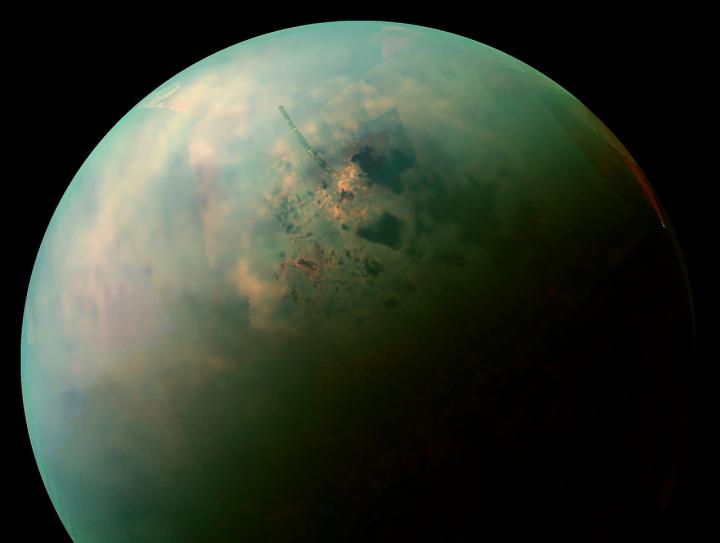
Credit: NASA / JPL-Caltech / Space Science Institute
BELLEVUE, WA –The frigid lakeshores of Saturn’s moon Titan might be encrusted with strange, unearthly minerals, according to new research being presented here.
Scientists re-creating Titan-esque conditions in their laboratory have discovered new compounds and minerals not found on Earth, including a co-crystal made of solid acetylene and butane.
Acetylene and butane exist on Earth as gases and are commonly used for welding and camp stove fuel. On Titan, with its extremely cold temperatures, acetylene and butane are solid and combine to form crystals, the new research found.
The new mineral might be responsible for the bathtub rings that are suspected to exist around Titan’s hydrocarbon lakes, according to Morgan Cable of NASA’s Jet Propulsion Laboratory at the California Institute of Technology, who will present the new research Monday at the 2019 Astrobiology Science Conference.
Titan’s lakes are filled with liquid hydrocarbons. Previous research using images and data gathered during the Cassini mission has shown that lakes in the moon’s dry regions near the equator contain signs of evaporated material left behind, like rings on a bathtub.
To create Titan-like conditions in the laboratory, the researchers started with a custom-built cryostat, an apparatus to keep things cold. They filled the cryostat with liquid nitrogen to bring the temperature down. They then warmed the chamber slightly, so the nitrogen turned to gas, which is mostly what Titan’s atmosphere contains. Next, they threw in what abounds on Titan, methane and ethane, as well as other carbon-containing molecules, and looked for what formed.
The first things to drop out of their Titan hydrocarbon soup were benzene crystals. Benzene is perhaps best known as a component of gasoline and is a snowflake-shaped molecule made out of a hexagonal ring of carbon atoms. But Titan benzene held a surprise: The molecules rearranged themselves and allowed ethane molecules inside, creating a co-crystal.
The researchers then discovered the acetylene and butane co-crystal, which is probably a lot more common on Titan than benzene crystals, based on what’s known about the moon’s composition, Cable said.
In the moon’s cold climate, the acetylene-butane co-crystals might form rings around the moon’s lakes as the liquid hydrocarbons evaporate and the minerals drop out – in the same way that salts can form crusts on the shores of Earth’s lakes and seas, according to Cable.
To confirm whether Titan has bathtub rings of co-crystals and other, undiscovered, hydrocarbon crystals, scientists will have to wait until a spacecraft can visit the shorelines of this moon, Cable said.
“We don’t know yet if we have these bathtub rings,” Cable said. “It’s hard to see through Titan’s hazy atmosphere.”
###
AGU and NASA will host the 2019 Astrobiology Science Conference (AbSciCon) in Bellevue, Washington, June 24-28, 2019, exploring the theme “Understanding and Enabling the Search for Life on Worlds Near and Far.” Among other topics, the conference will address planetary system interactions and habitability; alternative and agnostic biosignatures; understanding the environments of early Earth; evidence for early life on Earth; energy sources in the environment and metabolic pathways that use that energy; and ocean worlds near and far. #AbSciCon19
Notes for Journalists
Lead author Morgan Cable will deliver a poster presentation about this research at the 2019 Astrobiology Science Conference on Monday, 24 June 2019 from 7:00-9:00 p.m. PDT at the Hyatt Regency Bellevue, Evergreen Ballroom.
Presentation title:
“The acetylene-butane co-crystal: A potentially abundant molecular mineral on Titan “
Session:
132 – The Many Layers of Titan II Poster
Authors:
Morgan L Cable, Tuan Hoang Vu and Robert P Hodyss, NASA Jet Propulsion Laboratory, Pasadena, CA, United States
Helen Elizabeth Maynard-Casely, Australian Nuclear Science and Technology Organization, Kirrawee, NSW, Australia
Potentially newsworthy presentations:
Media tip sheets organized by scientific topic and by date highlight additional, potentially newsworthy presentations selected by AGU’s public information office.
The full scientific program for AbSciCon 2019, including abstracts for more than 800 oral and poster presentations, is available online.
AGU press contact:
Liza Lester
+1 (202) 777-7494
[email protected]
Researcher contacts:
Morgan Cable
Phone: 818-850-0823
Email: [email protected]
Media Contact
Liza Lester
[email protected]
Original Source
https:/