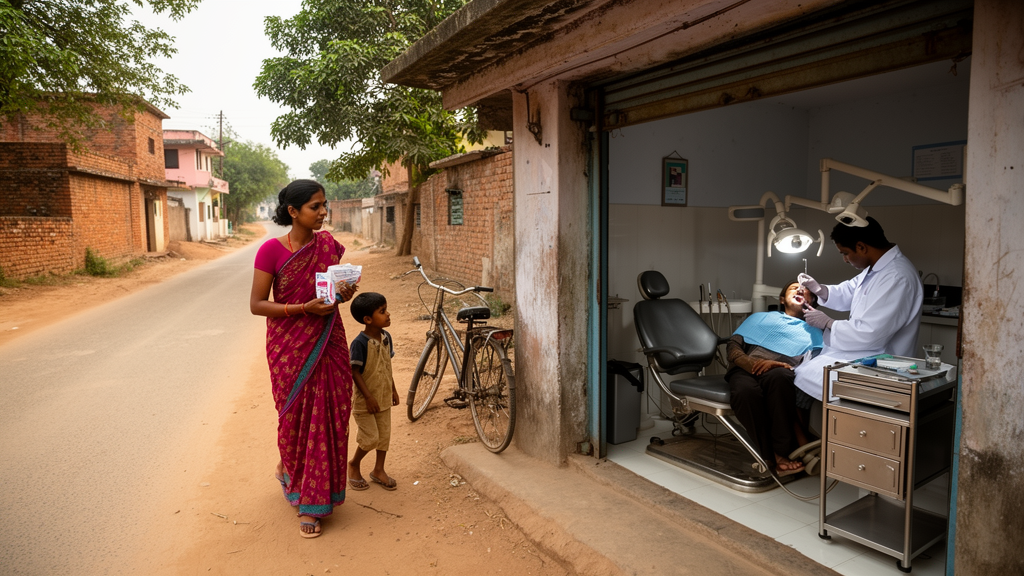
A mixed-methods household study in rural Lucknow found a high burden of oral disease and low use of dental services among adults: 81.8% of participants had clinical caries, 55.8% had periodontal disease, and 60.8% reported never visiting a dentist. The findings indicate that oral healthcare in the study setting was predominantly symptom-driven rather than routinely preventive. Researchers combined a cross-sectional quantitative survey of 400 adults with clinical examinations and qualitative evidence from two focus group discussions involving 12 participants.
The quantitative component assessed oral health with the World Health Organization’s Oral Health Assessment Form (2013), while the survey examined dental service-utilization patterns and financial and non-financial barriers to care. Among the reported barriers, transport difficulties were the most frequently identified, affecting 48% of participants. High treatment cost was reported by 40.3%, while 19.5% said they perceived a lack of need for dental care. These figures describe reported or measured barriers in the surveyed population; the study did not establish that any one barrier caused the observed oral disease or low attendance.
The focus groups helped place the numerical findings within the 5 A’s framework used to organize access barriers. Participants’ accounts confirmed constraints involving structural conditions, financial hardship, sociocultural factors and health-system limitations. The study also reports limited availability of nearby dental services, transport difficulties, the cost of treatment and acceptability-related barriers. The convergence of clinical examinations, survey responses and qualitative accounts shows that low service utilization was associated with several overlapping access conditions rather than a single reported factor.
The results characterize one rural district and do not necessarily represent all rural communities in India. Because the quantitative component was cross-sectional, it could not track changes over time, and the qualitative component was based on only two focus groups with 12 participants. The study did not test the effectiveness of any intervention. Nevertheless, its combined methods documented substantial oral health needs alongside infrequent dental attendance and multiple financial, geographic and social barriers. The authors identify these access domains as subjects for further context-specific implementation research, rather than as proof that a particular policy or service model would improve oral healthcare outcomes.
Subject of Research: Oral health status, dental service utilization and access barriers among adults in rural Lucknow
Article Title: Barriers to oral healthcare and patterns of service utilization in rural Lucknow: a mixed-methods household study
Article References: Gupta, V. K., Kankane, N., Mehta, A., Mathur, M. R., David, S. J., Agarwal, A., Garg, V. V., & Sahoo, M. (2026). Barriers to oral healthcare and patterns of service utilization in rural Lucknow: a mixed-methods household study. BMC Health Services Research. https://doi.org/10.1186/s12913-026-15456-4
Image Credits: AI Generated
DOI: 10.1186/s12913-026-15456-4
Keywords: oral health, rural Lucknow, dental caries, periodontal disease, healthcare access, service utilization, treatment costs, transport barriers, mixed-methods study, preventive dentistry, Barriers, oral
News Source: Ophelia Keating. (October 26, 2026). Barriers to oral healthcare and patterns of service utilization in rural Lucknow: a mixed-methods household study. Scienmag.