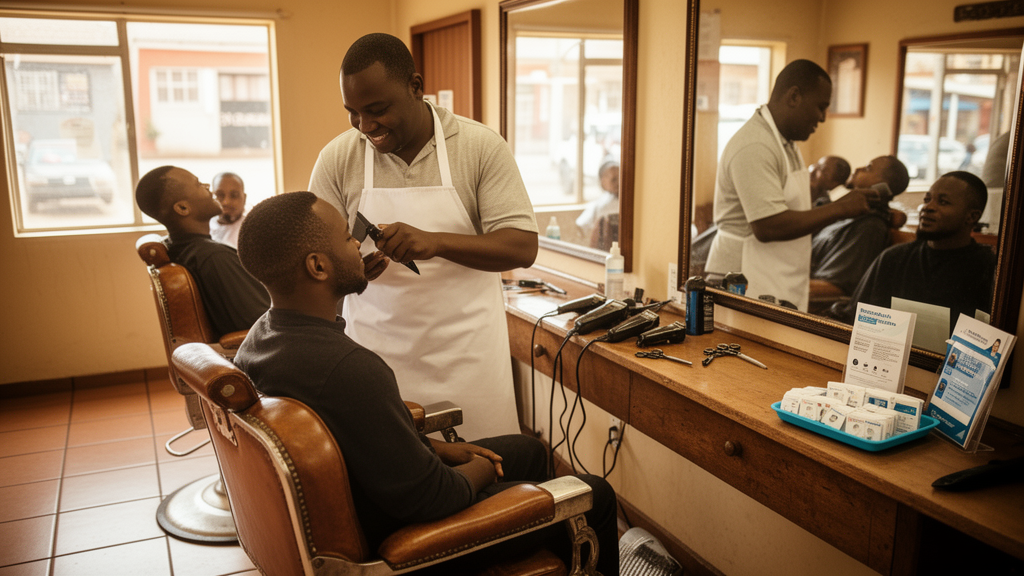
In the bustling townships of Durban, South Africa, barbershops have long served as more than just places to get a haircut. They are social hubs where men gather, talk, and share ideas. Now, a new study published in BMC Public Health suggests these neighborhood institutions could play a surprising role in the fight against HIV. Researchers from Massachusetts General Hospital, Harvard Medical School, and South African partners explored whether barbershops could serve as venues for delivering HIV prevention services, including pre-exposure prophylaxis (PrEP), HIV testing, and sexually transmitted infection (STI) screening. The findings reveal both enthusiasm and practical concerns from the very people who would make such a program work: the clients, the barbers, and the shop owners themselves.
South Africa continues to carry one of the world’s heaviest HIV burdens, and while prevention efforts have historically focused on young women and adolescent girls due to their high incidence rates, men have remained comparatively difficult to reach. Men are less likely to visit clinics, less likely to test for HIV, and less likely to engage with preventative health care in general. This gap has significant consequences not only for men’s own health but also for transmission dynamics across communities. The research team, led by Lyra S. Johnson of the Medical Practice Evaluation Center at Massachusetts General Hospital, recognized that if men are not walking into clinics, health services may need to meet men where they already are. Barbershops, with their steady flow of male clients and their deeply embedded role in community life, emerged as a promising candidate.
The study took the form of a qualitative investigation, conducting in-depth interviews with 14 barbershop owners, 14 barbers, and 26 male clients aged 18 and older across Durban. Rather than measuring outcomes with numbers, the researchers sought to understand perceptions, attitudes, and concerns. Three research assistants based in both the United States and South Africa coded the transcripts and conducted a thematic analysis, identifying recurring patterns in how participants viewed the prospect of health services being offered in the familiar setting of a barbershop. The work was nested within a larger clinical trial registered on ClinicalTrials.gov under identifier NCT04222504, providing a formative foundation for future implementation efforts.
The services under discussion were ambitious in scope. Researchers asked participants about delivering HIV testing, oral and injectable PrEP, STI screening, and referrals for male medical circumcision, all within or through the barbershop environment. PrEP, when taken consistently, dramatically reduces the risk of acquiring HIV, and injectable formulations offer the advantage of requiring only periodic administration rather than a daily pill. Offering these tools alongside routine HIV testing and STI screening in a non-clinical setting could, in theory, reach men who might never otherwise present to a health facility for prevention services.
The response from participants was far from uniform, but a strong current of enthusiasm ran through many of the interviews. Clients and barbers alike pointed to the convenience and accessibility of the barbershop as its greatest asset. Men already visit regularly, often on a predictable schedule, and the environment is one where they feel comfortable and at ease. One participant captured the appeal with a sentiment echoed by others: offering health services in the same visit as a haircut would be killing two birds with one stone. The efficiency of combining a routine errand with a health intervention resonated strongly, particularly for men who juggle work, family, and other obligations that make dedicated clinic visits feel burdensome.
Barbershop owners, whose livelihoods depend on the atmosphere and reputation of their businesses, offered a more nuanced perspective. Many saw potential benefits, both in serving their community and in potentially attracting customers, but they also raised concerns about how health service delivery might alter the character of their shops. The barbershop is, for many men, a space of relaxation, banter, and social connection. Introducing medical conversations, waiting periods, or clinical equipment could change that dynamic in ways owners were wary of. Some worried that clients who came for a quick, enjoyable experience might be deterred if the shop began to feel more like a clinic than a social refuge.
Privacy emerged as one of the most significant practical concerns across all three groups. HIV testing and counseling inherently involve sensitive conversations about sexual behavior, relationships, and health status. In a barbershop, where other clients are often seated nearby and conversations flow freely, maintaining confidentiality during testing and counseling sessions presents a real challenge. Participants emphasized that any successful program would need to address this directly, whether through private spaces within or adjacent to the shop, careful scheduling, or alternative models of service delivery that protect client dignity. Without adequate privacy protections, the very trust that makes barbershops effective community anchors could be undermined.
Space constraints posed another logistical hurdle. Many barbershops in Durban are small operations, often with just a chair or two and limited room beyond the cutting area. Accommodating a health worker, equipment, and a private area for counseling would require creative solutions. Participants also stressed the importance of choice and autonomy. Men should not feel pressured or ambushed into accepting health services while getting a haircut; rather, services should be offered as an option, with clients free to engage or decline without judgment. Respecting men’s agency, participants made clear, would be essential to building trust and ensuring the program feels like a genuine service rather than an intrusion.
The study’s authors conclude that barbershops may indeed be feasible venues for delivering HIV prevention and other sexual health services in South Africa, with the potential to reach men who might not otherwise engage with preventative health care. The enthusiasm expressed by many participants suggests real appetite for such programs, and the barbershop’s unique position as a trusted, male-centered community space offers advantages that traditional clinic-based outreach struggles to replicate. At the same time, the concerns raised about space, privacy, and atmosphere are not trivial obstacles to be dismissed but rather critical design considerations that must be addressed head-on in any future implementation.
As South Africa and other countries with high HIV burdens continue to search for strategies to engage men in prevention, the barbershop model represents a compelling example of meeting people where they are. The next steps will involve translating these formative findings into practical program designs that preserve what clients love about their barbershops while weaving in life-saving health services. If done thoughtfully, the humble barbershop chair could become a gateway to HIV prevention for thousands of men who might otherwise fall through the cracks of the health system.
Subject of Research: Community-based HIV prevention and sexual health service delivery through barbershops in Durban, South Africa
Article Title: “We would be killing two birds with one stone”: Assessing perceptions of barbershop-based HIV prevention and sexual health service delivery among clients, barbers, and owners across Durban, South Africa
Article References: Johnson, L. S., Khumalo, A. R., Ngcobo, L. M., Govere, S. M., Zwane, P.-G., Shezi, S., Zionts, D. L., Jarolimova, J., Psaros, C., & Bassett, I. V. (2026). “We would be killing two birds with one stone”: Assessing perceptions of barbershop-based HIV prevention and sexual health service delivery among clients, barbers, and owners across Durban, South Africa. BMC Public Health. https://doi.org/10.1186/s12889-026-29849-x
Image Credits: AI Generated
DOI: 10.1186/s12889-026-29849-x
Keywords: HIV prevention, PrEP, barbershops, South Africa, men's health, sexual health services, community-based health care, HIV testing, STI screening, Durban, qualitative research, public health
News Source: Ophelia Keating. (October 18, 2026). Barbershops Could Become Frontline HIV Prevention Hubs in South Africa. Scienmag.