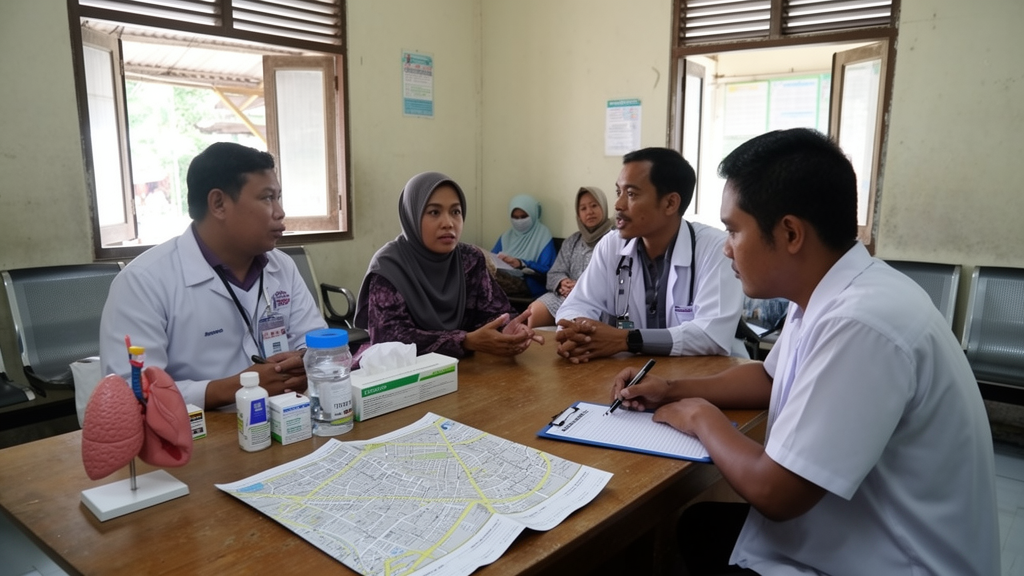
Private practitioners in Bandung, Indonesia, could make a substantial contribution to tuberculosis care because they were numerous, geographically distributed and available outside regular weekday office hours, according to a cross-sectional study conducted from August 2017 to April 2018. The survey identified 936 practicing private practitioners and interviewed 674 of them, a response rate of 72.0%. Most respondents reported managing patients with respiratory tract infection symptoms, while their clinics collectively reported 937 tuberculosis diagnoses during the preceding three months and 354 TB patients receiving treatment. These findings describe the observed scale and scope of private-sector activity rather than the success of a tuberculosis intervention.
Researchers mapped private healthcare facilities in the areas served by 30 of Bandung’s 73 randomly selected community health centers. Trained enumerators recorded facility locations and service characteristics, including provider qualifications, staffing arrangements and practice schedules. They also asked whether practitioners were managing patients with respiratory tract infection symptoms, had ordered a TB diagnosis in the previous three months or were treating patients with TB when interviewed. Among the 674 respondents, 594, or 88.1%, reported managing patients with respiratory tract infection symptoms. Of those 594 practitioners, 241, or 40.6%, reported encountering TB patients, and 101, or 17.0% of that group, had TB patients under treatment at the time of the interview.
The facilities offered varying levels of diagnostic and operational infrastructure. Only 10.1% of respondents worked in healthcare facilities equipped with an X-ray facility, while 27.1% worked in facilities containing a laboratory. Most, 78.6%, worked in clinics with multiple providers, and the remaining 21.4% worked in single-provider clinics. A pharmacy was present in the facility where 70.0% of respondents practiced, and 23.2% reported collaborating with the national health insurance system. Availability outside conventional weekday hours was reported by 33.3% of the 627 respondents who answered that question; 28.3% of all respondents offered both weekday and weekend clinics. The survey therefore documented a broad network of private practitioners, with uneven access to diagnostic facilities but substantial presence in pharmacies and multi-provider clinics.
The study assessed the potential role of private practitioners in Indonesia’s National TB Program but did not test a linkage strategy, compare patient outcomes or measure changes in tuberculosis incidence. Its findings were based on self-reported clinical activity in a cross-sectional survey confined to one city. The sampled community health center areas and the 72.0% interview rate may also limit how closely the results represent private practitioners elsewhere in Indonesia. Within those boundaries, the data show that Bandung’s private sector already contained providers who reported encountering and managing TB, as well as clinics with X-ray, laboratory and pharmacy resources. The authors concluded that ways to engage private practitioners optimally with the National TB Program should be sought, but their survey itself did not establish whether such engagement would improve diagnosis, treatment or other patient outcomes.
Subject of Research: Cross-sectional assessment of private practitioners’ characteristics and potential contribution to tuberculosis care in Bandung, Indonesia
Article Title: Private practitioner characteristics and their potential to contribute to tuberculosis management in Indonesia
Article References: Alisjahbana, B., Sujatmiko, B., Afifah, N., Dewi, N. F., Lestari, B. W., Hadisoemarto, P. F., McAllister, S., & Hill, P. C. (2026). Private practitioner characteristics and their potential to contribute to tuberculosis management in Indonesia. BMC Health Services Research. https://doi.org/10.1186/s12913-026-15446-6
Image Credits: AI Generated
DOI: 10.1186/s12913-026-15446-6
Keywords: tuberculosis, Indonesia, private healthcare, Bandung, health services, TB diagnosis, respiratory tract infection, National TB Program, Private, practitioner, characteristics, potential
News Source: Ophelia Keating. (October 26, 2026). Bandung survey maps private practitioners’ tuberculosis care role. Scienmag.