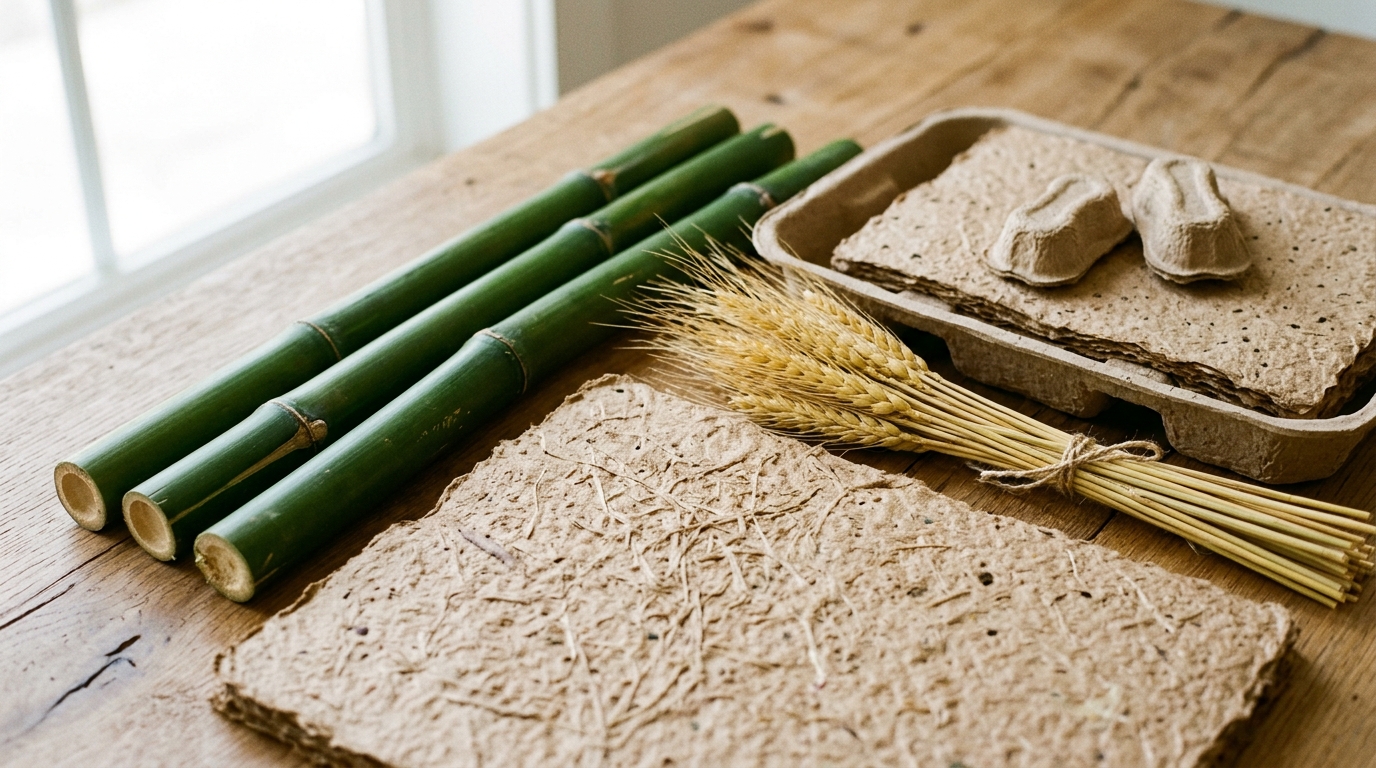
Non-wood plant feedstocks can substantially reduce the energy required for pulping while delivering mechanical strength suitable for paper packaging, according to an experimental study published in the Journal of Bioresources and Bioproducts. Investigators systematically evaluated the chemi-thermomechanical pulping performance of wheat straw, miscanthus, and bamboo, directly contrasting their processing behavior, energy demands, fiber dimensions, and resultant paper properties against eucalyptus wood and three established industrial reference pulps.
As growing global demand for fiber-based packaging drives manufacturers to investigate raw materials beyond traditional timber, agricultural residues and fast-growing plants have emerged as candidate alternatives to conventional wood resources. Researchers sought to address a persistent operational challenge in sustainable paper production: while alternative feedstocks frequently exhibit lower initial pulping energy requirements, those savings do not inherently translate into adequate mechanical strength, which remains a vital requirement for structural containerboard products.
To evaluate these raw materials, the research team applied a mild chemical pretreatment followed by mechanical refining to process the wheat straw, miscanthus, and bamboo.
The pulping trials demonstrated that the three non-wood feedstocks achieved considerable energy savings during initial processing compared with traditional hardwood. Wheat straw, miscanthus, and bamboo required between 280 and 393 kilowatt-hours per tonne for mechanical fiberization. By comparison, eucalyptus processing demanded 538 kilowatt-hours per tonne under identical testing parameters, representing an energy reduction of 27 percent to 48 percent across the evaluated alternative plants.
At a standardized Canadian standard freeness of 500 milliliters, bamboo pulp produced a burst index of 3.33 kilopascals square meters per gram. This performance surpassed both commercial unbleached softwood kraft pulp, which registered 2.65 kilopascals square meters per gram, and recycled corrugated container pulp, which reached 2.73 kilopascals square meters per gram.
Tensile performance evaluations further confirmed the mechanical viability of select agricultural residues for structural packaging applications. Bamboo and wheat straw achieved tensile indices of 40.4 and 36.4 Newton-meters per gram, respectively, both outperforming semi-chemical hardwood pulp. Conversely, miscanthus demonstrated markedly weaker strength development throughout the testing regimen, despite its advantageous low energy consumption during the initial fiberization phase.
Fiber morphology explained these differences, as bamboo featured narrow fibers, low coarseness, and a high slenderness ratio that favored network formation, whereas miscanthus had thicker, coarser fibers that hindered bonding.
The study authors conclude that bamboo and wheat straw represent promising complementary fiber streams capable of partially replacing wood in designated packaging grades. However, the researchers emphasize that further operational optimization, pulp-blending investigations, and pilot-scale trials remain imperative to resolve challenges regarding processing parameters, material contaminants, operational recyclability, and commercial integration before mill-scale implementation can proceed.
The experimental investigation, conducted by researchers affiliated with the Sustainable and Alternative Fibers Initiative within the Department of Forest Biomaterials at North Carolina State University, focused on evaluating sustainable fiber alternatives across a spectrum of containerboard-relevant benchmarks.
Subject of Research: Chemi-thermomechanical pulping efficiency and mechanical strength of non-wood packaging fibers
Article Title: Bamboo and wheat straw show promise as alternative fibers for stronger packaging paper
Article References: Bamboo and wheat straw show promise as alternative fibers for stronger packaging paper. Original publication (Bibliographic details unavailable.)
Image Credits: AI Generated
DOI: Not provided
Keywords: chemi-thermomechanical pulping, bamboo pulp, wheat straw, miscanthus, fiberization energy, paper packaging, containerboard, burst index, tensile index, fiber morphology, sustainable packaging, alternative fibers, pulp yield, handsheet strength, paper industry, Journal of Bioresources and Bioproducts
News Source: Alan Morgan. (November 12, 2026). Bamboo and Wheat Straw Cut Pulping Energy While Yielding Strong Packaging Paper. Scienmag.