Credit: Credit: AG Römer
Areas of skin that have been damaged by an injury are ideal niches for the concentration of Pseudomonas aeruginosa, a bacterium which impairs the healing process in tissue and creates favorable conditions for infections. Because of its resistance to most available antibiotics, this bacterium is in the “Priority 1 / CRITICAL” category of the World Health Organization’s (WHO) global list of priority pathogens. Prof. Dr. Winfried Römer and his research team at the University of Freiburg have recently discovered a new function of the Pseudomonas aeruginosa lectin LecB: LecB can block the cell cycle, meaning that host cells can no longer divide and ultimately die. Wound healing is therefore considerably slowed down or halted altogether. The team of scientists recently published their research in the online scientific journal “Life Science Alliance.”
LecB of Pseudomonas aeruginosa is a bacterial virulence factor that impairs signaling of growth factor receptors- in other words, proteins found on the surface of host cells that transmit signals to promote the growth and reproduction of tissues. As a result, the cell cycle is blocked.
Lectins are proteins that bind to sugar residues on surface receptors and are not catalytically active, meaning they do not accelerate chemical processes. Many bacteria use lectins to bind effectively to the epithelium and endothelium layers of cells coating the body’s surface area, thus facilitating the colonization of tissue. The researchers discovered that the bacterial lectin LecB is present in chronically infected human wounds, therefore making it possible for Pseudomonas aeruginosa to remain in those wounds. They also determined that LecB is capable of inducing the internalization – in other words, the uptake into the cell’s interior – and the degradation of growth factor receptors in keratinocytes, a type of cell in the epidermis. Normally, the binding of growth factors to growth factor receptors activates so-called downstream signaling pathways, which accelerate tissue growth. “We were surprised that LecB does not contribute to the activation of growth factor signaling pathways, but that it triggers this silent internalization of receptors without activation,” says Alessia Landi, one of the researchers from the University of Freiburg and the paper’s first author.
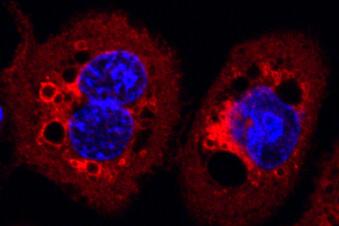
The scientists also demonstrated that LecB blocks the cell cycle and causes cell death. This process is preceded by intense vacuolization, which is the development of several larger, enclosed sacs (vacuoles) within the host cell. These vacuoles, which display unique morphological characteristics, are formed by structures of plasma membranes in which LecB is enriched. “Although lectins are not catalytically active, LecB appears to interfere with important host cell processes, like the cell cycle, in a way we don’t yet understand,” says Römer, adding: “This likely occurs through a restructuring of the cell membrane triggered by LecB.”
The discovery of this new function of the Pseudomonas aeruginosa lectin LecB has motivated the team to pursue more research. As Römer says, it is possible that LecB also has this function of promoting the further damage of tissue and facilitating the spread of bacteria in other cell types as well, including immune cells. Future studies will therefore focus on the effects of LecB on immune responses in chronic wound infections.
###
The team of researchers consists of members from the University of Freiburg’s excellence clusters in biological signaling studies BIOSS and CIBSS, the Spemann Graduate School of Biology and Medicine, the University Medical Center Freiburg, the Università della Svizzera italiana in Lugano, Italy, and the University Medical Center Groningen, Netherlands.
Original Publication:
Landi, A., Mari, M. C., Kleiser, S., Wolf, T., Gretzmeier, C., Wilhelm, I., Kiritsi, D., Thünauer, R., Geiger, R., Nyström, A., Reggiori, F., Claudinon, J., Römer, W. (2019): P. aeruginosa lectin LecB impairs keratinocyte fitness by abrogating growth factor signalling. Life Science Alliance. DOI: 10.26508/lsa.201900422
Contact:
Excellence Clusters in Biological Signaling Studies BIOSS and CIBSS
University of Freiburg
Media Contact
Prof. Dr. Winfried Römer
[email protected]
49-761-203-67500
Related Journal Article
http://dx.