• HOME
  • NEWS
  • EXPLORE
    • CAREER
      • Companies
      • Jobs
    • EVENTS
    • iGEM
      • News
      • Team
    • PHOTOS
    • VIDEO
    • WIKI
  • BLOG
  • COMMUNITY
    • FACEBOOK
    • INSTAGRAM
    • TWITTER
Friday, August 14, 2026
BIOENGINEER.ORG
No Result
View All Result
  • Login
  • HOME
  • NEWS
  • EXPLORE
    • CAREER
      • Companies
      • Jobs
        • Lecturer
        • PhD Studentship
        • Postdoc
        • Research Assistant
    • EVENTS
    • iGEM
      • News
      • Team
    • PHOTOS
    • VIDEO
    • WIKI
  • BLOG
  • COMMUNITY
    • FACEBOOK
    • INSTAGRAM
    • TWITTER
  • HOME
  • NEWS
  • EXPLORE
    • CAREER
      • Companies
      • Jobs
        • Lecturer
        • PhD Studentship
        • Postdoc
        • Research Assistant
    • EVENTS
    • iGEM
      • News
      • Team
    • PHOTOS
    • VIDEO
    • WIKI
  • BLOG
  • COMMUNITY
    • FACEBOOK
    • INSTAGRAM
    • TWITTER
No Result
View All Result
Bioengineer.org
No Result
View All Result
Home NEWS Science News Biology

Bacterial nanowire mystery solved

Bioengineer by Bioengineer
April 4, 2019
in Biology
Reading Time: 2 mins read
0
IMAGE
Share on FacebookShare on TwitterShare on LinkedinShare on RedditShare on Telegram

IMAGE

Credit: Yale University

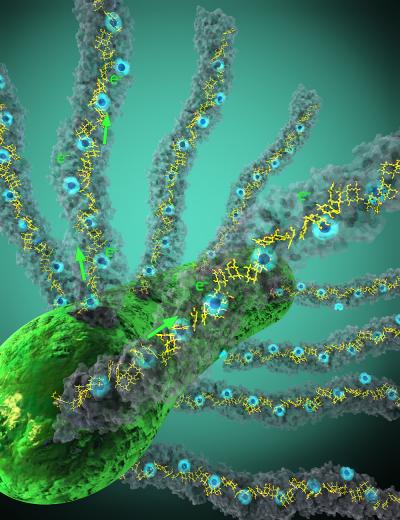
Deep in the ocean or underground, where there is no oxygen, Geobacter bacteria “breathe” by projecting tiny protein filaments called “nanowires” into the soil, to dispose of excess electrons resulting from the conversion of nutrients to energy.

These nanowires enable the bacteria to perform environmentally important functions such as cleaning up radioactive sites and generating electricity. Scientists have long known that Geobacter make conductive nanowires – 1/100,000 the width of a human hair – but to date no one had discovered what they are made of and why they are conductive.

A new study by researchers at Yale, University of Virginia and the University of California at Irvine published April 4 in the journal Cell reveals a surprise: the protein nanowires have a core of metal-containing molecules called hemes.

Previously nobody suspected such a structure. Using high-resolution cryo-electron microscopy, the researchers were able to see the nanowire’s atomic structure and discover that hemes line up to create a continuous path along which electrons travel.

“This study solves a longstanding mystery of how nanowires move electrons to minerals in the soil,” said lead author Nikhil Malvankar, assistant professor of molecular biophysics and biochemistry at Yale and a faculty member at the Microbial Sciences Institute.

“It is possible we could use these wires to connect cells to electronics to build new types of materials and sensors.”

###

Edward Egelman of Virginia and Allon Hochbaum of UC-Irvine are other senior authors. Fengbin Wang of Virginia and Yale’s Yangqi Gu and are co-first authors. Other authors are Yale’s Patrick O’Brien, Sophia Yi, Sibel Ebru Yalcin, Vishok Srikanth, Cong Shen, Dennis Vu and UC Irvine’s Nicole Ing.

Media Contact
Bill Hathaway
[email protected]

Original Source

http://westcampus.yale.edu/news/bacterial-nanowire-mystery-solved?refresh=2

Tags: BacteriologyBiology
Share15Tweet8Share2ShareShareShare2

Related Posts

Scientists Reveal Hidden Mechanism Driving RNA Synthesis

Scientists Reveal Hidden Mechanism Driving RNA Synthesis

August 14, 2026
Natural or Synthetic Grafts: Which Is Better for Cranial Duraplasty?

Natural or Synthetic Grafts: Which Is Better for Cranial Duraplasty?

August 13, 2026

Study reveals how pioneering osprey pairs drive population recovery

August 13, 2026

Antibodies, antiretrovirals and CCR5 blockade limit HIV reservoir seeding in infant macaques

August 13, 2026
Please login to join discussion

POPULAR NEWS

  • Experts say poorest nations’ health systems are failing smokers

    29 shares
    Share 12 Tweet 7
  • Scientists Reveal Hidden Mechanism Driving RNA Synthesis

    29 shares
    Share 12 Tweet 7
  • Random Forest Models Predict Land-Use Changes Along China’s Rongwu Expressway

    29 shares
    Share 12 Tweet 7
  • Researchers demonstrate physical device can take over Boeing 737 electronics

    29 shares
    Share 12 Tweet 7

About

BIOENGINEER.ORG

We bring you the latest biotechnology news from best research centers and universities around the world. Check our website.

Follow us

Recent News

Experts say poorest nations’ health systems are failing smokers

Scientists Reveal Hidden Mechanism Driving RNA Synthesis

Random Forest Models Predict Land-Use Changes Along China’s Rongwu Expressway

Subscribe to Blog via Email

Enter your email address to subscribe to this blog and receive notifications of new posts by email.

Join 85 other subscribers
  • Contact Us

Bioengineer.org © Copyright 2023 All Rights Reserved.

Welcome Back!

Login to your account below

Forgotten Password?

Retrieve your password

Please enter your username or email address to reset your password.

Log In
No Result
View All Result
  • Homepages
    • Home Page 1
    • Home Page 2
  • News
  • National
  • Business
  • Health
  • Lifestyle
  • Science

Bioengineer.org © Copyright 2023 All Rights Reserved.