

• HOME
  • NEWS
  • EXPLORE
    • CAREER
      • Companies
      • Jobs
    • EVENTS
    • iGEM
      • News
      • Team
    • PHOTOS
    • VIDEO
    • WIKI
  • BLOG
  • COMMUNITY
    • FACEBOOK
    • INSTAGRAM
    • TWITTER
Wednesday, August 5, 2026
BIOENGINEER.ORG
No Result
View All Result
  • Login
  • HOME
  • NEWS
  • EXPLORE
    • CAREER
      • Companies
      • Jobs
        • Lecturer
        • PhD Studentship
        • Postdoc
        • Research Assistant
    • EVENTS
    • iGEM
      • News
      • Team
    • PHOTOS
    • VIDEO
    • WIKI
  • BLOG
  • COMMUNITY
    • FACEBOOK
    • INSTAGRAM
    • TWITTER
  • HOME
  • NEWS
  • EXPLORE
    • CAREER
      • Companies
      • Jobs
        • Lecturer
        • PhD Studentship
        • Postdoc
        • Research Assistant
    • EVENTS
    • iGEM
      • News
      • Team
    • PHOTOS
    • VIDEO
    • WIKI
  • BLOG
  • COMMUNITY
    • FACEBOOK
    • INSTAGRAM
    • TWITTER
No Result
View All Result
Bioengineer.org
No Result
View All Result
Home NEWS Science News Health

Bacteria can ‘divide and conquer’ to vanquish their enemies

Bioengineer by Bioengineer
July 2, 2018
in Health
Reading Time: 2 mins read
0
Share on FacebookShare on TwitterShare on LinkedinShare on RedditShare on Telegram
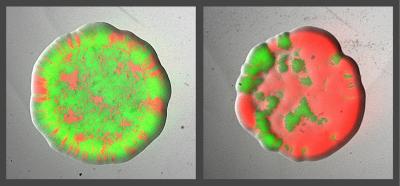
IMAGE

Credit: Despoina Mavridou

Some bacteria can release toxins that provoke their neighbours into attacking each other, a tactic that could be exploited to fight infections.

Bacteria often engage in 'warfare' by releasing toxins or other molecules that damage or kill competing strains. This war for resources occurs in most bacterial communities, such as those living naturally in our gut or those that cause infection.

As well as producing toxins that directly kill their competitors, bacteria can release toxins that can act as 'provoking agents'. These provoking toxins make other strains increase their aggression levels by boosting their toxic response.

In a new study, led by Imperial College London and the University of Oxford and published today in Proceedings of the National Academy of Sciences, researchers used a combination of experiments and mathematical models to see what happens when bacteria provoke their competitors.

They found that when used against a single competitor, provocation backfires: the provoked strain mounts a strong toxic counterattack and harms the provoking strain.

However, when there are three or more strains present, provocation causes the other competing strains to increase their aggression and attack each other. This can lead to the competitors wiping each other out, especially when the provoking strain is shielded from, or resistant to, their toxins.

Senior author Dr Despoina Mavridou, from the Department of Life Sciences at Imperial, said: "This behavior is strongly reminiscent of the human 'divide and conquer' strategy, famously delineated by Niccolò Machiavelli in his book The Art of War and shows that bacteria are capable of very elaborate warfare tactics."

The researchers suggest that the strategy could be exploited to manipulate microbial communities. Lead author Dr Diego Gonzalez, from the University of Lausanne, said: "We could envisage exploiting provocation in alternative antimicrobial approaches. For example, exposing established bacterial communities to low levels of known antimicrobials could promote warfare and cross-elimination of different strains."

This approach could be particularly useful to help eradicate resistant biofilms – layers of bacteria that form for example in industrial water pipes and are hard to remove. It could also be used to treat some bacterial infections if the composition of the bacterial community responsible for the infection is well known.

Dr Mavridou added: "By provoking other strains to attack each other, the toxin of the provoker is more effective than what would be expected based on its real toxicity. Using toxin-mimicking chemicals, we could potentially manipulate microbial aggression to our own benefit."

###

The study's other authors are Akshay Sabnis from the Medical Research Council Centre for Molecular Bacteriology and Infection at Imperial and Professor Kevin Foster from the Department of Zoology at the University of Oxford.

Media Contact

Hayley Dunning
[email protected]
020-759-42412
@imperialspark

http://www3.imperial.ac.uk/college/news

Original Source

https://www.imperial.ac.uk/news/187010/bacteria-divide-conquer-vanquish-their-enemies/ http://dx.doi.org/10.1073/pnas.1801028115

Share14Tweet8Share2ShareShareShare2

Related Posts

Parkinson’s-linked LRRK2 mutation disrupts astrocyte development and induces senescence-like changes

Parkinson’s-linked LRRK2 mutation disrupts astrocyte development and induces senescence-like changes

August 5, 2026

Study links fitness, barriers, and health beliefs to activity among older adults

August 5, 2026

Occupational pesticide exposure linked to 60–70% higher motor neuron disease risk

August 5, 2026

How Life’s Hardships Can Make Conspiracy Theories Seem More Appealing

August 5, 2026
Please login to join discussion

POPULAR NEWS

  • Parkinson’s-linked LRRK2 mutation disrupts astrocyte development and induces senescence-like changes

    29 shares
    Share 12 Tweet 7
  • Study links fitness, barriers, and health beliefs to activity among older adults

    29 shares
    Share 12 Tweet 7
  • Zhou and Yin Secure Funding for Collaborative Research Project

    29 shares
    Share 12 Tweet 7
  • Study suggests Viagra may reduce cancer spread

    29 shares
    Share 12 Tweet 7

About

We bring you the latest biotechnology news from best research centers and universities around the world. Check our website.

Follow us

Recent News

Parkinson’s-linked LRRK2 mutation disrupts astrocyte development and induces senescence-like changes

Study links fitness, barriers, and health beliefs to activity among older adults

Zhou and Yin Secure Funding for Collaborative Research Project

Subscribe to Blog via Email

Enter your email address to subscribe to this blog and receive notifications of new posts by email.

Join 86 other subscribers
  • Contact Us

Bioengineer.org © Copyright 2023 All Rights Reserved.

Welcome Back!

Login to your account below

Forgotten Password?

Retrieve your password

Please enter your username or email address to reset your password.

Log In
No Result
View All Result
  • Homepages
    • Home Page 1
    • Home Page 2
  • News
  • National
  • Business
  • Health
  • Lifestyle
  • Science

Bioengineer.org © Copyright 2023 All Rights Reserved.