• HOME
  • NEWS
  • EXPLORE
    • CAREER
      • Companies
      • Jobs
    • EVENTS
    • iGEM
      • News
      • Team
    • PHOTOS
    • VIDEO
    • WIKI
  • BLOG
  • COMMUNITY
    • FACEBOOK
    • INSTAGRAM
    • TWITTER
Monday, May 18, 2026
BIOENGINEER.ORG
No Result
View All Result
  • Login
  • HOME
  • NEWS
  • EXPLORE
    • CAREER
      • Companies
      • Jobs
        • Lecturer
        • PhD Studentship
        • Postdoc
        • Research Assistant
    • EVENTS
    • iGEM
      • News
      • Team
    • PHOTOS
    • VIDEO
    • WIKI
  • BLOG
  • COMMUNITY
    • FACEBOOK
    • INSTAGRAM
    • TWITTER
  • HOME
  • NEWS
  • EXPLORE
    • CAREER
      • Companies
      • Jobs
        • Lecturer
        • PhD Studentship
        • Postdoc
        • Research Assistant
    • EVENTS
    • iGEM
      • News
      • Team
    • PHOTOS
    • VIDEO
    • WIKI
  • BLOG
  • COMMUNITY
    • FACEBOOK
    • INSTAGRAM
    • TWITTER
No Result
View All Result
Bioengineer.org
No Result
View All Result
Home NEWS Science News Biology

Baby sea snails ride waves into shallower waters, study suggests

Bioengineer by Bioengineer
August 7, 2018
in Biology
Reading Time: 2 mins read
0
Share on FacebookShare on TwitterShare on LinkedinShare on RedditShare on Telegram
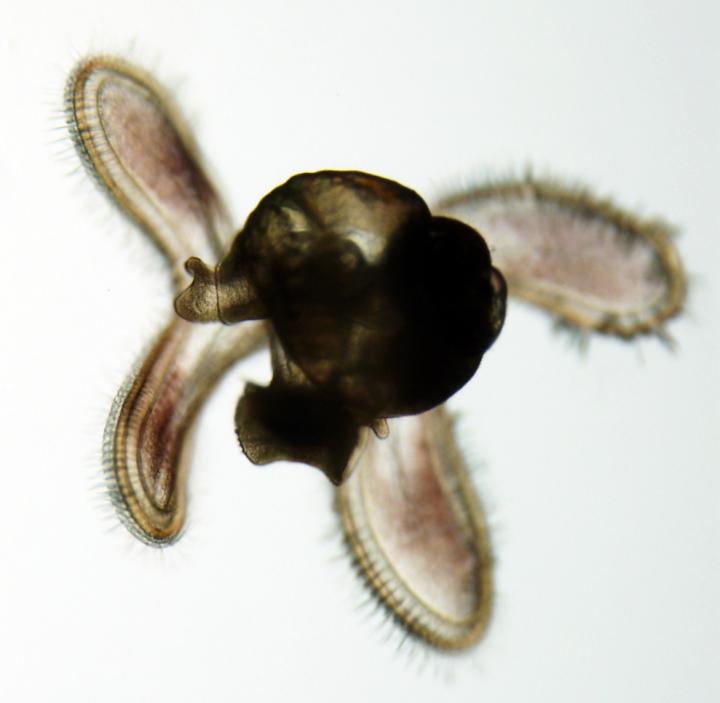
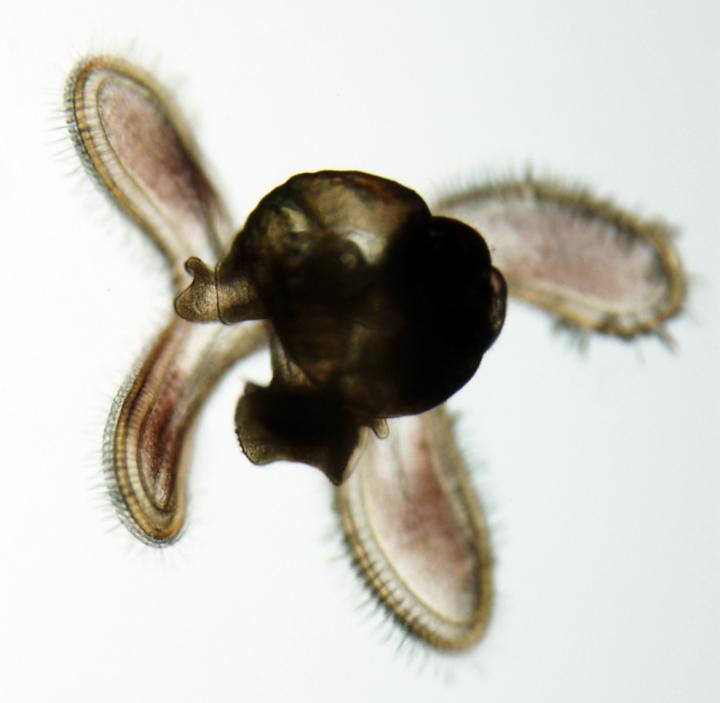
IMAGE

Credit: Heidi L. Fuchs/Rutgers University-New Brunswick.

The warming ocean may cause the larvae of bottom-dwelling snails to hatch earlier in the spring, when waves are larger, potentially impacting their ability to survive and serve as food for other sea creatures.

A Rutgers University-New Brunswick study sheds new light on the sensory organs the snail larvae use to feel – and perhaps even hear – whether the water is turbulent or wavy, and improve their odds of being carried to a good habitat where they can settle down as adults.

The study, published online in the Proceedings of the National Academy of Sciences, focuses on two species of snail, both of which live along North America's East Coast: eastern mudsnails (Tritia obsoleta), which live in inlets, and threeline mudsnails (Tritia trivittata), which live in the deeper waters of the continental shelf.

The inlet-dwelling snails more often experience water that is turbulent but not very wavy. The continental shelf-dwelling snails live in a less turbulent, wavier environment.

In experiments, the researchers found that the larvae experienced turbulence as rotation or tilting of the body and sensed waves as acceleration in a straight line. Both signals are detected by a statocyst – a small organ similar to the human inner ear.

The experiments suggest larvae can detect waves as both motion and low-frequency sound, according to lead researcher Heidi L. Fuchs, an associate professor in the Department of Marine and Coastal Sciences in the School of Environmental and Biological Sciences.

When the larvae of both species experience turbulence, they respond either by swimming with more effort or by sinking. Waves triggered a similar, stronger reaction and resulted in upward swimming only in the larvae that dwell in the continental shelf. Swimming upward may allow them to use the shoreward drift of the waves to avoid being carried over the open ocean where they would be lost, Fuchs said.

"More than 99 percent of the snail larvae we studied die in transit, partly because they're carried away from any place where they could survive," Fuchs said. "Probably one in 20,000 of these larvae survives through adulthood, so it's critical that survivors wind up in a tolerable habitat."

But climate change complicates things. Over the last few decades, these larvae probably have been hatching earlier and exposed to larger waves, which could push them into shallower, warmer water that is less tolerable to adults. How this affects their population is a subject of a new study.

###

Media Contact

Todd Bates
[email protected]
848-932-0550
@RutgersU

http://www.rutgers.edu

Original Source

https://news.rutgers.edu/baby-sea-snails-ride-waves-shallower-waters-study-suggests/20180806#.W2mdTShKi70 http://dx.doi.org/10.1073/pnas.1804558115


Share12Tweet8Share2ShareShareShare2

Related Posts

In-Depth Analysis Reveals Advances in Multiple Sclerosis Research Models — Biology

In-Depth Analysis Reveals Advances in Multiple Sclerosis Research Models

May 18, 2026
Uncovering C. elegans Immunity via Genetic Screens — Biology

Uncovering C. elegans Immunity via Genetic Screens

May 16, 2026

Single mother must adapt swiftly — the survival of her colony depends on it

May 15, 2026

Why Are Nearly Everyone Right-Handed? It Might Be Linked to How We Learned to Walk

May 15, 2026
Please login to join discussion

POPULAR NEWS

  • Research Indicates Potential Connection Between Prenatal Medication Exposure and Elevated Autism Risk

    845 shares
    Share 338 Tweet 211
  • New Study Reveals Plants Can Detect the Sound of Rain

    731 shares
    Share 292 Tweet 182
  • Salmonella Haem Blocks Macrophages, Boosts Infection

    62 shares
    Share 25 Tweet 16
  • Breastmilk Balances E. coli and Beneficial Bacteria in Infant Gut Microbiomes

    58 shares
    Share 23 Tweet 15

About

We bring you the latest biotechnology news from best research centers and universities around the world. Check our website.

Follow us

Recent News

ESTRO: Certain Breast Cancer Patients Could Avoid Surgery After Ablative Radiation, Study Suggests

Record 112 Gbps Wireless at 560 GHz via Microcombs

ctDNA Enhances Treatment Monitoring in Patients Undergoing Metastasis-Directed Therapy, Study Finds

Subscribe to Blog via Email

Enter your email address to subscribe to this blog and receive notifications of new posts by email.

Join 82 other subscribers
  • Contact Us

Bioengineer.org © Copyright 2023 All Rights Reserved.

Welcome Back!

Login to your account below

Forgotten Password?

Retrieve your password

Please enter your username or email address to reset your password.

Log In
No Result
View All Result
  • Homepages
    • Home Page 1
    • Home Page 2
  • News
  • National
  • Business
  • Health
  • Lifestyle
  • Science

Bioengineer.org © Copyright 2023 All Rights Reserved.