• HOME
  • NEWS
  • EXPLORE
    • CAREER
      • Companies
      • Jobs
    • EVENTS
    • iGEM
      • News
      • Team
    • PHOTOS
    • VIDEO
    • WIKI
  • BLOG
  • COMMUNITY
    • FACEBOOK
    • INSTAGRAM
    • TWITTER
Monday, July 6, 2026
BIOENGINEER.ORG
No Result
View All Result
  • Login
  • HOME
  • NEWS
  • EXPLORE
    • CAREER
      • Companies
      • Jobs
        • Lecturer
        • PhD Studentship
        • Postdoc
        • Research Assistant
    • EVENTS
    • iGEM
      • News
      • Team
    • PHOTOS
    • VIDEO
    • WIKI
  • BLOG
  • COMMUNITY
    • FACEBOOK
    • INSTAGRAM
    • TWITTER
  • HOME
  • NEWS
  • EXPLORE
    • CAREER
      • Companies
      • Jobs
        • Lecturer
        • PhD Studentship
        • Postdoc
        • Research Assistant
    • EVENTS
    • iGEM
      • News
      • Team
    • PHOTOS
    • VIDEO
    • WIKI
  • BLOG
  • COMMUNITY
    • FACEBOOK
    • INSTAGRAM
    • TWITTER
No Result
View All Result
Bioengineer.org
No Result
View All Result
Home NEWS Science News Biology

Auxin signaling pathway controls root hair formation for nitrogen uptake

Bioengineer by Bioengineer
September 11, 2023
in Biology
Reading Time: 3 mins read
0
Arabidopsis thaliana responds to nitrogen deficiency by forming longer root hairs
Share on FacebookShare on TwitterShare on LinkedinShare on RedditShare on Telegram

Plants have evolved diverse adaptive strategies to optimize the exploration of light and soil resources from their environments. One of the most prominent adaptive responses is the developmental plasticity of their root systems, which enables plants to efficiently forage nutrient pools that fluctuate in space and time. As a crucial component determining the active root surface, root hairs represent a powerful morphological trait to improve water and nutrient acquisition. Root hairs are extensions of epidermal cells that effectively enlarge the root surface area and facilitate soil exploration for water and nutrients. Root hair development starts with cell fate specification, which determines whether an epidermal cell becomes a hair-forming cell (trichoblast) or a hairless cell (atrichoblast).
Arabidopsis thaliana responds to nitrogen deficiency by forming longer root hairs

Credit: IPK Leibniz Institute

Plants have evolved diverse adaptive strategies to optimize the exploration of light and soil resources from their environments. One of the most prominent adaptive responses is the developmental plasticity of their root systems, which enables plants to efficiently forage nutrient pools that fluctuate in space and time. As a crucial component determining the active root surface, root hairs represent a powerful morphological trait to improve water and nutrient acquisition. Root hairs are extensions of epidermal cells that effectively enlarge the root surface area and facilitate soil exploration for water and nutrients. Root hair development starts with cell fate specification, which determines whether an epidermal cell becomes a hair-forming cell (trichoblast) or a hairless cell (atrichoblast).

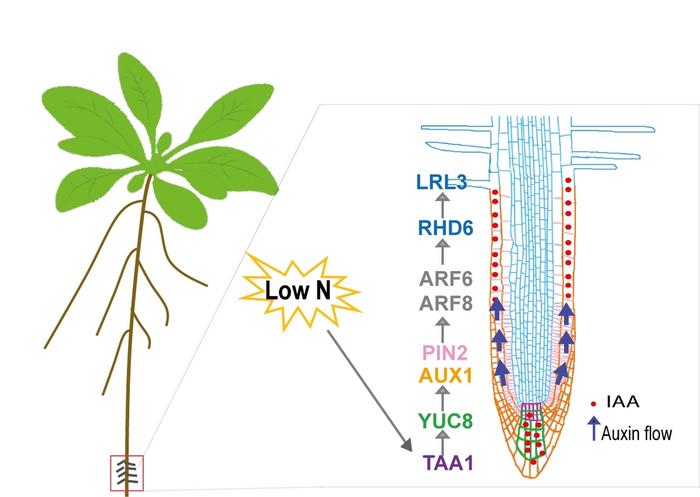
“In our study, we first showed that nitrogen deficiency strongly stimulates root hair elongation in the model species Arabidopsis thaliana and that this response is crucial for plant fitness under low nitrogen”, explains Prof. Dr. Nicolaus von Wirén, head of the department “Physiology and Cell Biology” at IPK Leibniz Institute. “And we then integrated transcriptomics, molecular genetics and cell biology approaches to establish that low nitrogen-induced root hair elongation builds on a spatially coordinated auxin signaling cascade that enters the root hair developmental program via the epidermal transcriptional module RHD6–LRL3.”


The signaling cascade consists of three stages. Through upregulation of the enzymes TAA1 and YUCCA8, low nitrogen increases auxin accumulation in the root apex (step 1, synthesis). Auxin is then directed shootward to the root hair differentiation zone via the transporters AUX1 and PIN2 (step 2, transport). Upon arrival, auxin activates the transcription factors ARF6 and ARF8 to promote the transcriptional module RHD6–LRL3, which is confined to the epidermis and steers root hair elongation in response to low nitrogen (step 3, signaling).

 “Overall, our results suggest that root hair elongation represents an additional systemically-induced foraging response strategy to explore the soil for nitrogen, gaining even more relevance as nitrogen deficiency becomes more severe”, says Dr. Zhongtao Jia, first author of the study. “These findings add a new feature to our understanding of root foraging responses in low-nutrient environments and expand the mechanistic framework of hormone-regulated nutrient sensing in plant roots.”

Since more abundant and longer root hairs represent a low-cost strategy for plants to bring roots in contact with soil nutrients, understanding how root hair development is regulated by nitrogen provides new breeding targets for developing crops with enhanced nitrogen-uptake efficiency.


Journal

Current Biology

DOI

10.1016/j.cub.2023.08.040

Article Title

A spatially-concerted epidermal auxin signaling framework steers the root hair foraging response under low nitrogen

Article Publication Date

11-Sep-2023

Share12Tweet8Share2ShareShareShare2

Related Posts

Here are a few rewritten headlines for a science magazine post, each with a slightly different tone: Intriguing & poetic: How do organs sculpt themselves? Sea stars hold the secret Direct & research-focused: Sea stars reveal the hidden rules of organ formation Metaphorical & inviting: Tiny architects beneath the waves: What sea stars teach us about building organs Short & punchy: Star-shaped clues to how our organs take shape Question-led: Could a sea star show us how organs form? Elegant & feature-style: The body’s blueprint, glimpsed in a sea star’s arm

July 6, 2026
Bacteria evolve faster with unconventional gene copies — Biology

Bacteria evolve faster with unconventional gene copies

July 6, 2026

Neighbours rewire soil feedback via root microbiome shifts

July 6, 2026

Evolution-Inspired Biosensors Revolutionize Lipid Tracking in Real Time

July 2, 2026

POPULAR NEWS

  • Detection of EDCs in Breast Milk and Infant Urine Up to Six Months Highlights Early Exposure Risks

    77 shares
    Share 31 Tweet 19
  • New Drug Candidate Developed at McMaster Shows Potential for Treating Brain Cancer

    58 shares
    Share 23 Tweet 15
  • Saying Goodbye to PGY-6: Pediatric Fellowship Realities

    103 shares
    Share 41 Tweet 26
  • KTU Researchers Explore Ultrasound’s Role in Enhancing Blood Flow Beyond Diagnostics

    53 shares
    Share 21 Tweet 13

About

We bring you the latest biotechnology news from best research centers and universities around the world. Check our website.

Follow us

Recent News

Flame retardant BDE-209 targets molecularly linked to ulcerative colitis

Ultra-high frequency particle impacts mimic rockbursts to shatter hard rock

Kidney transplant outcomes in older adults studied by German researchers

Subscribe to Blog via Email

Enter your email address to subscribe to this blog and receive notifications of new posts by email.

Join 83 other subscribers
  • Contact Us

Bioengineer.org © Copyright 2023 All Rights Reserved.

Welcome Back!

Login to your account below

Forgotten Password?

Retrieve your password

Please enter your username or email address to reset your password.

Log In
No Result
View All Result
  • Homepages
    • Home Page 1
    • Home Page 2
  • News
  • National
  • Business
  • Health
  • Lifestyle
  • Science

Bioengineer.org © Copyright 2023 All Rights Reserved.