

• HOME
  • NEWS
  • EXPLORE
    • CAREER
      • Companies
      • Jobs
    • EVENTS
    • iGEM
      • News
      • Team
    • PHOTOS
    • VIDEO
    • WIKI
  • BLOG
  • COMMUNITY
    • FACEBOOK
    • INSTAGRAM
    • TWITTER
Saturday, February 7, 2026
BIOENGINEER.ORG
No Result
View All Result
  • Login
  • HOME
  • NEWS
  • EXPLORE
    • CAREER
      • Companies
      • Jobs
        • Lecturer
        • PhD Studentship
        • Postdoc
        • Research Assistant
    • EVENTS
    • iGEM
      • News
      • Team
    • PHOTOS
    • VIDEO
    • WIKI
  • BLOG
  • COMMUNITY
    • FACEBOOK
    • INSTAGRAM
    • TWITTER
  • HOME
  • NEWS
  • EXPLORE
    • CAREER
      • Companies
      • Jobs
        • Lecturer
        • PhD Studentship
        • Postdoc
        • Research Assistant
    • EVENTS
    • iGEM
      • News
      • Team
    • PHOTOS
    • VIDEO
    • WIKI
  • BLOG
  • COMMUNITY
    • FACEBOOK
    • INSTAGRAM
    • TWITTER
No Result
View All Result
Bioengineer.org
No Result
View All Result
Home NEWS Science News Biology

Auxin drives leaf flattening

Bioengineer by Bioengineer
September 25, 2017
in Biology
Reading Time: 2 mins read
0
Share on FacebookShare on TwitterShare on LinkedinShare on RedditShare on Telegram
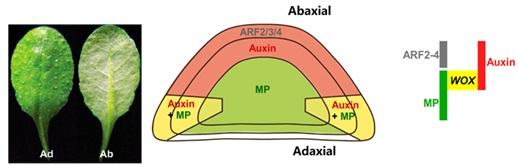
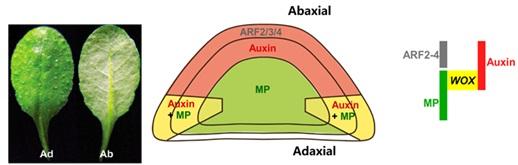
IMAGE

Credit: IGDB

Leaves are fundamental light-capturing organs of plants. The vast majority of higher plants utilize leaves as their solar panels to harvest solar energy. A common feature of leaves is their flat blades.

Scientists from the Institute of Genetics and Developmental Biology in Beijing discovered that the classical phytohormone auxin enables leaf blade expansion and leaf flattening.

The flattening of leaves to form broad blades is an important adaptation that maximizes photosynthesis. However, the molecular mechanism underlying this process remains unclear.

A new research led by JIAO Yuling from the Institute of Genetics and Developmental Biology of the Chinese Academy of Sciences (CAS), shows that spatial auxin signaling defines the expression of two redundant genes WOX1 and PRS, which enables leaf blade expansion and flattening.

Following their previous report on the auxin regulation of leaf polarity patterning, the researchers further found that auxin and auxin response factors (ARFs) have limited overlaps, which refines auxin signaling in the middle domain of leaf primordium.

Furthermore, they found that MP/ARF5, an ARF activator directly activates the expression of WOX1 and PRS, which promote the marginal meristem and enable leaf flattening. On the other hand, ARF repressors expressed in the abaxial (ventral) domain inhibit WOX1 and PRS expression.

"The new findings in this work explain how adaxial-abaxial (dorsal-ventral) polarity patterns the mediolateral axis and subsequent lateral expansion of leaves", said Dr. JIAO Yuling.

He also mentioned that other recent research of their group described auxin regulation of leaf development at the biomechanical level.

"Finding how leaves get flattened will be necessary to maintain and enhance yield in cultivated plants and crops" said JIAO.

This study entitled "Spatial auxin signaling controls leaf flattening in Arabidopsis" has been published online in Current Biology.

###

This study was supported by the National Basic Research Program of China (973 Program), the National Natural Science Foundation of China, and the State Key Laboratory of Plant Genomics.

Media Contact

Jiao Yuling
[email protected]

http://english.cas.cn/

Original Source

http://english.cas.cn/newsroom/research_news/201709/t20170920_183333.shtml http://dx.doi.org/10.1016/j.cub.2017.08.042


Share12Tweet8Share2ShareShareShare2

Related Posts

Florida Cane Toad: Complex Spread and Selective Evolution

Florida Cane Toad: Complex Spread and Selective Evolution

February 7, 2026
New Study Uncovers Mechanism Behind Burn Pit Particulate Matter–Induced Lung Inflammation

New Study Uncovers Mechanism Behind Burn Pit Particulate Matter–Induced Lung Inflammation

February 6, 2026

DeepBlastoid: Advancing Automated and Efficient Evaluation of Human Blastoids with Deep Learning

February 6, 2026

Navigating the Gut: The Role of Formic Acid in the Microbiome

February 6, 2026
Please login to join discussion

POPULAR NEWS

  • Robotic Ureteral Reconstruction: A Novel Approach

    Robotic Ureteral Reconstruction: A Novel Approach

    82 shares
    Share 33 Tweet 21
  • Digital Privacy: Health Data Control in Incarceration

    63 shares
    Share 25 Tweet 16
  • Study Reveals Lipid Accumulation in ME/CFS Cells

    57 shares
    Share 23 Tweet 14
  • Breakthrough in RNA Research Accelerates Medical Innovations Timeline

    53 shares
    Share 21 Tweet 13

About

We bring you the latest biotechnology news from best research centers and universities around the world. Check our website.

Follow us

Recent News

Decoding Prostate Cancer Origins via snFLARE-seq, mxFRIZNGRND

Digital Health Perspectives from Baltic Sea Experts

Florida Cane Toad: Complex Spread and Selective Evolution

Subscribe to Blog via Email

Enter your email address to subscribe to this blog and receive notifications of new posts by email.

Join 73 other subscribers
  • Contact Us

Bioengineer.org © Copyright 2023 All Rights Reserved.

Welcome Back!

Login to your account below

Forgotten Password?

Retrieve your password

Please enter your username or email address to reset your password.

Log In
No Result
View All Result
  • Homepages
    • Home Page 1
    • Home Page 2
  • News
  • National
  • Business
  • Health
  • Lifestyle
  • Science

Bioengineer.org © Copyright 2023 All Rights Reserved.