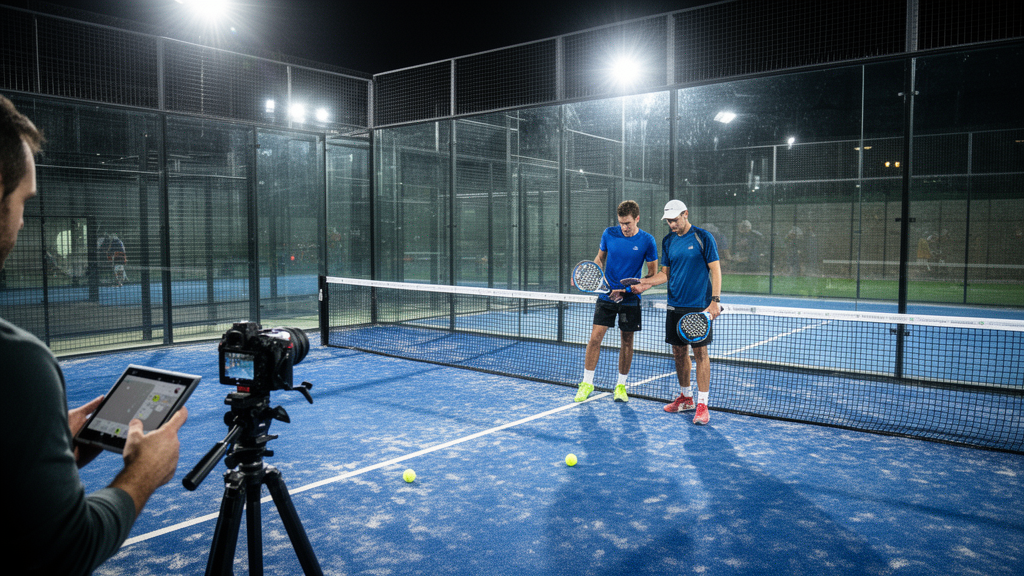
When tracking match play across three amateur contests, manual observational coding identified a cumulative total of 891 shots, whereas Padmi’s user-facing aggregate display reported only 757 shots, representing an overall undercount of 15.0 percent.
To address this uncertainty, the research team designed an evaluation to describe discrepancies between the aggregate match statistics displayed by the Padmi app and rigorous manual observational coding in amateur padel competition.
Published in Frontiers in Sports and Active Living, the descriptive case study evaluated three amateur male padel matches involving one focal player, analyzing performance retrospectively from video recordings. The automated analysis was conducted using version 1.3 of the Padmi application. For the manual comparison, researchers coded six distinct technical shot types: the forehand, the backhand, the forehand volley, the backhand volley, the bandeja, and the smash. Alongside shot frequencies, three distinct outcome categories were coded manually and directly compared against the aggregate analytical summaries provided by Padmi’s user-facing reports.
To rigorously quantify the differences between automated tracking and manual coding, the authors calculated both signed and absolute differences for shot frequencies across the matches. In assessing shot effectiveness and play results, percentage-point differences were calculated for the three outcome categories. A key methodological characteristic highlighted by the researchers was that shot-level agreement metrics could not be calculated because raw, event-level data from the Padmi platform were unavailable. As a consequence, the comparative analysis focused exclusively on discrepancies between user-facing aggregate reports and observational totals rather than individual shot-by-shot tracking accuracy.
The comparative results showed that Padmi displayed fewer shots than manual coding in all three matches, with match-level deficits ranging between −11.4 percent and −19.2 percent. Furthermore, the magnitude and direction of discrepancies varied substantially across different technical shot types. The smash showed the largest undercount, with Padmi recording 44.8 percent fewer smashes than manual observation. Groundstrokes were also substantially underrepresented, with forehands undercounted by 28.3 percent and backhands undercounted by 20.0 percent. The bandeja showed a much smaller discrepancy of −3.5 percent. In contrast, Padmi displayed higher counts than manual observation for net play, overreporting forehand volleys by +27.2 percent and backhand volleys by +5.9 percent.
In terms of performance execution, overall outcome distributions across all shots were broadly similar between manual coding and Padmi’s reports. However, the researchers identified larger, shot-specific outcome discrepancies when examining specific actions, notably the smash, the bandeja, and the forehand volley. Based on these findings, the authors concluded that Padmi’s user-facing aggregate statistics differed from manual observational coding in this descriptive case study.
Subject of Research: Discrepancies between automated and manual match analysis in amateur padel
Article Title: Comparison of automated and manual performance analysis tools in amateur padel: a descriptive case study
Article References: Sánchez-Alcaraz Martínez, B. J., Sánchez-Frutos, S., Maguillo-Gómez, E., & Conde-Ripoll, R. (2026). Comparison of automated and manual performance analysis tools in amateur padel: a descriptive case study. Frontiers in Sports and Active Living, 8, Article 1915133. https://doi.org/10.3389/fspor.2026.1915133
Image Credits: AI Generated
DOI: 10.3389/fspor.2026.1915133
Keywords: padel, performance analysis, automated match analysis, Padmi, observational coding, sports analytics, racket sports, Comparison, automated, manual, performance, analysis
News Source: Ophelia Keating. (November 9, 2026). Automated Padel Tracking App Disagrees With Manual Coding in Amateur Case Study. Scienmag.