


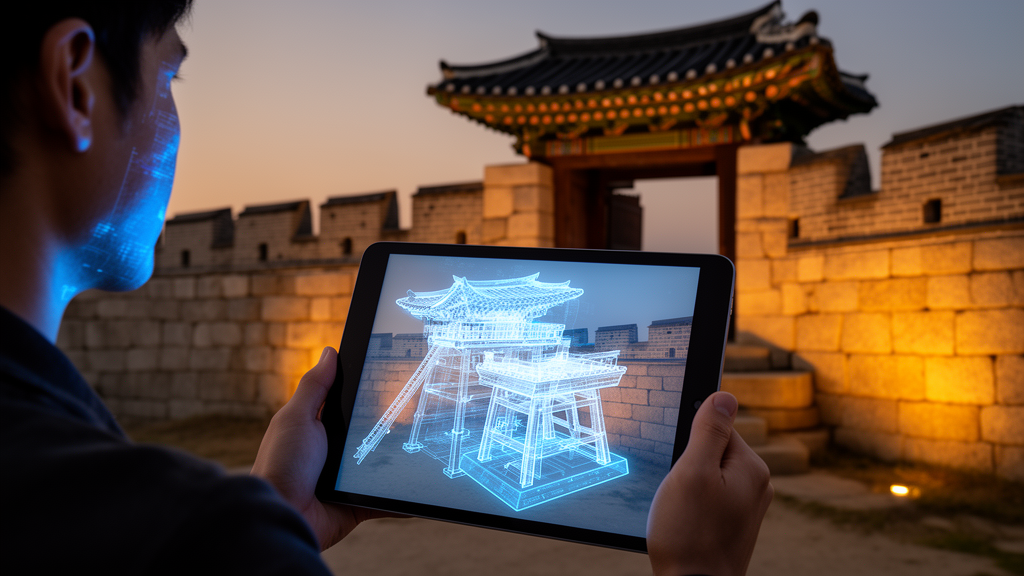
At Hwaseong Fortress, the late eighteenth-century walled palace complex in Suwon, South Korea, visitors may soon be able to watch a holographic King Jeongjo recount his grief and reformist ambitions in the very courtyard where he once walked. A new exploratory study published in the journal Architectural Research on 31 July 2026 proposes exactly that, along with three other augmented reality interventions designed to deepen emotional engagement at the UNESCO World Heritage site without physically touching a single stone.
The study, conducted by Anwesha Mallick and Eun Joo Park, set out to answer a question that troubles heritage managers worldwide: how can immersive digital technology improve the visitor experience at a historically sensitive site while preserving its traditional sanctity? The researchers chose Hwaseong Fortress as their case study because of its historical significance, spatial complexity and strong potential for digital enhancement. Constructed between 1794 and 1796 under King Jeongjo of the Joseon dynasty, the fortress exemplifies late eighteenth-century Korean military architecture, blending traditional forms with innovative construction techniques, including the Geojunggi lifting system. Built in honor of Crown Prince Sado, it embodies themes of filial devotion, reformist vision and strategic ingenuity expressed through engineered walls, gates, pavilions and watchtowers.
The researchers adopted an exploratory design-research methodology that combined site visits, photographic and architectural documentation, visitor movement observation and on-site interviews. Their diagnosis of the fortress’s current condition was blunt. Structural conservation issues stem from exposure to environmental factors and weathering. Visitors rely largely on static information boards and traditional guided tours, and there is minimal integration of augmented reality, virtual reality or artificial intelligence-based systems to enhance the experience. Security and maintenance limitations add further pressure, since keeping the fortress open to tourists while protecting it is an ongoing challenge.
Before proposing any technology, the team listened to visitors. Semi-structured interviews with fifteen participants of varied demographic backgrounds, including domestic and international tourists, revealed strong emotional attachment to the site. Yet many participants identified a gap between the monument’s grandeur and the limited interpretive tools available. Existing QR codes were seen as insufficient, and participants expressed interest in AR reconstructions, voice-guided narratives and immersive storytelling. The survey data showed that ten of the fifteen participants, or 66.7 percent, were Korean visitors while five, or 33.3 percent, were international. Eight participants, 53.3 percent, reported not using any existing digital interpretation tools during their visit. Looking forward, thirteen participants, 86.7 percent, expressed interest in virtual reality tours inside historical structures, twelve, 80.0 percent, preferred multilingual smart audio guides, fourteen, 93.3 percent, supported interactive maps with historical overlays, and six, 40.0 percent, suggested improved lighting for night-time visits. The researchers stress that because of the limited sample size these findings should be interpreted as exploratory insights rather than statistically generalizable results.
Visitor experience mapping added a spatial dimension to the diagnosis. Visitors spend the most time, around sixty minutes, at the Haenggung Palace Courtyard and Interior, followed by the Fortress Wall Trail at forty-five minutes and the Hwaseong Fortress Museum at thirty-five minutes. Engagement drops at gates, trails and forecourts, while gift shops and exit zones receive the least attention, around ten minutes, marking them as high-priority zones for interpretive enhancement.
From this groundwork the researchers developed four site-specific digital interventions, each tied to a location with ceremonial, military or emotional significance that is not fully recognized by today’s visitors. The Memory Light Corridors would run along the ceremonial route between Janganmun Gate and Paldalmun Gate, integrating ambient light trails, symbolic projections on the fortress walls and subtle soundscapes to reactivate a path once significant for royal patrols. An Immersive Hologram of King Jeongjo is proposed within the courtyard of Haenggung Palace, the emotional core of the fortress, using life-sized holographic projection, coordinated lighting, ambient sound and interactive triggers to convey the king’s personal grief, reformist vision and filial devotion. The Whispering Wall at Changnyongmun Gate, the fortress’s eastern gate, would employ motion-activated directional audio embedded within the walls to deliver soft first-person narratives from the workers, soldiers and residents historically connected to the site, transforming the space into what the authors call a living memory wall. Finally, Interactive Smart Benches at Dongjangdae, the eastern command post, would integrate touch panels and embedded speakers offering historical voices, diary reflections and traditional music through proximity-based and user-initiated interaction.
Crucially, none of these features was physically installed. Instead, the team built a mobile-based augmented reality prototype that simulated the intended experiences. QR codes were mounted on temporary sign holders positioned adjacent to existing visitor circulation paths to avoid visual interference with the historic fabric. Participants scanned the codes with their personal smartphones, and each code launched an AR scene that overlaid digital content onto the existing environment through image recognition and spatial alignment. Every participant followed the same sequence of interactions, received identical instructions and experienced the same digital content at each of the four locations, a standardized workflow the authors say improves methodological transparency and provides a repeatable procedure for future heritage AR evaluations.
The prototype evaluation generated strikingly positive feedback. Participants demonstrated high levels of engagement across all four interventions, frequently describing the transition from the physical environment to the digital overlays as intuitive and immersive. The holographic representation of King Jeongjo elicited the strongest emotional response, enabling visitors to better understand his personal grief and reformist vision. Participants with design backgrounds emphasized the clarity of spatial integration, while others highlighted ease of use and the enjoyment of uncovering hidden narratives, collectively reporting a stronger emotional connection to the site. A Likert-scale evaluation showed consistently high levels of agreement across all four interventions, with holographic storytelling receiving the highest overall rating. Participants agreed that the AR overlays respected the sanctity and historical character of the fortress, describing them as subtle, non-intrusive and perceptually detached from the existing fabric. Beyond emotional engagement, the interventions appeared to enhance cognitive understanding of the site’s spatial organization and layered narratives: the Memory Light Corridor clarified ceremonial movement, the Whispering Wall foregrounded overlooked voices, the hologram fostered historical empathy, and the Smart Benches encouraged quiet reflection.
The evaluation was not without friction. Participants noted reduced visibility of the AR content in strong daylight and a preference for audio-led content over text-heavy elements, which the authors treat as opportunities for refinement rather than conceptual limitations. Narrative-driven and low-intrusion installations, particularly the holographic storytelling and ambient sensory elements, were consistently described as intuitive, respectful and well-integrated with the site’s atmosphere, suggesting that context-aware immersive storytelling can maintain cultural integrity rather than erode it.
The authors are careful to frame their conclusions within the study’s limits. With only fifteen participants, the generalizability of the findings to broader visitor populations is constrained, and the results should be regarded as preliminary evidence informing the proposed design framework rather than definitive conclusions. They call for future research with larger and more diverse participant groups across multiple heritage sites, comparative studies under different environmental conditions and visitor profiles, and technical repeatability tests through multiple implementation cycles and different AR software platforms. Still, the study contributes a transferable design framework for smart and experiential architectural design, one that emphasizes emotional engagement, narrative clarity and spatial integrity. By demonstrating that user-centered, low-intrusion augmented reality can be integrated into a UNESCO World Heritage site through reversible, adaptive and user-centered means, the research positions AR not as a technological novelty but as a meaningful cultural tool, one that could transform static monuments into dynamic experiential landscapes where preservation and innovation coexist.
Subject of Research: An exploratory design-research study testing augmented reality interventions for visitor engagement at Hwaseong Fortress, a UNESCO World Heritage site in South Korea.
Article Title: Reimagining Cultural Heritage Site: Integrating Augmented Reality for Immersive Heritage and User Engagement
Article References: Mallick, A., & Park, E. J. (2026). Reimagining Cultural Heritage Site: Integrating Augmented Reality for Immersive Heritage and User Engagement. Architectural Research, 28(1), Article 16. https://doi.org/10.1007/s44515-026-00017-x
Image Credits: AI Generated
DOI: 10.1007/s44515-026-00017-x
Keywords: augmented reality, cultural heritage, Hwaseong Fortress, UNESCO World Heritage, visitor engagement, immersive storytelling, smart heritage, holographic projection, UX design, Suwon, digital interpretation, architectural research
News Source: Denise Maddox. (October 29, 2026). Augmented Reality Prototype Brings a Korean Fortress’s Hidden Stories to Life. Scienmag.



