


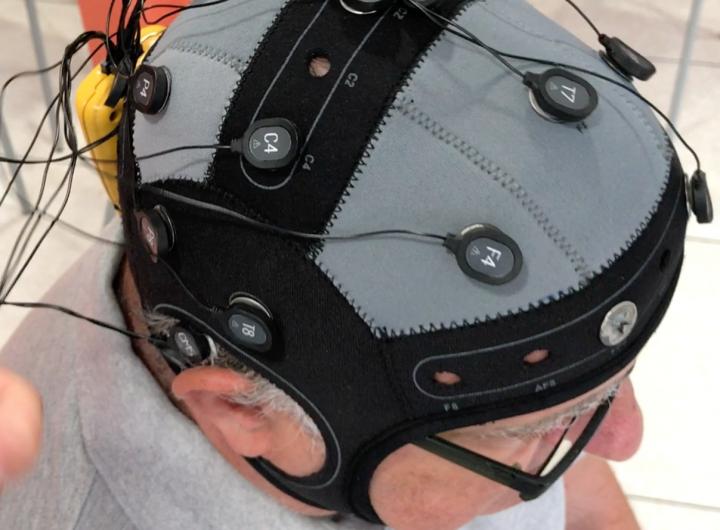
Credit: Neuro-Com (UAB), Instituto RTVE and the Neuroscience Division (UPO).
Professionalisation in any field requires long-term experience and training. In the past decades, studies have demonstrated that the professionalisation of athletes and artists create differences in the behaviour of the brain while carrying out activities related to their area of expertise.
To detect the effects of media professionalisation in the brain, a research team from the Universitat Autònoma de Barcelona, the Instituto Ràdio Televisió Espanyola and the Universidad Pablo de Olavide in Seville conducted a study published in Frontiers in Systems Neuroscience in which audiovisual contents were presented to a group of media professionals and a control group, with the aims of registering and analysing their brain activity. The study covers what happens to professionals in audiovisuals when they view media works, using a triple approach: eyeblink rate, electrical activity of the brain and functional connectivity.
Researchers observed that audiovisual cuts have a greater impact on media professionals, generating a decrease in their eyeblink rate, while non-professionals are not affected in the same manner when viewing these cuts. They also detected that the experience of media professionals has a greater effect on the brain’s mu rhythm in the somatosensory area immediately after a cut. Non-media professionals, however, demonstrate a highly diverse Granger causality in terms of connectivity when compared to their media professional counterparts, whose connectivity is much more concise in the visual cortex, somatomotor and frontal areas.
Videos and other audiovisual contents are filled with cuts that artificially segment narrative content. Films can contain dozens or hundreds of cuts and viewers are nevertheless not conscious of them. Previous studies conducted by the same team of researchers demonstrated that scene cuts have an impact on the management of viewer’s attention. In this study, researchers aimed to discover how this impact differs among media professionals. The experience acquired through years of producing and working with media contents causes a long-term impact on how professionals process these contents. Given that society produces and consumes more and more of these types of contents, there is an interest in discovering the effects the visual perception of these contents have on brain activity.
Doctor Celia Andreu-Sánchez, head researcher of this study and member of the Neuro-Com Group at the Universitat Autònoma de Barcelona, considers that the results can be of interest for neuroscience, given that “knowing that spending many hours with media works as a professional not only affects visual perception, but also the brain rhythms such as the mu rhythm, is without a doubt of great interest to science. These results present neuroscience with a highly important work tool: audiovisuals. We know that working and consuming these contents professionally affect the brain’s behaviour, therefore, it seems plausible that the design of consumption strategies for videos may be relevant in several areas of neuroscience research”.
Doctor Miguel Ángel Martín-Pascual, from the Instituto Radio Televisión Española and the Universitat Autònoma de Barcelona, also author of this research published in Frontiers in Systems Neuroscience, believes that these results are of utmost importance in the professional audiovisual production field. According to Martín-Pascual, “knowing the impact audiovisual professionalisation has on its professionals is of vital importance for the development of long-term strategies related to the occupational health of this group”.
José María Delgado, researcher at the Neuroscience Division of the Universidad Pablo de Olavide, highlights that “this study and other similar ones conducted by our two groups points out the enormous amount of unconscious processing taking place in the brain (particularly in the non-media profesional group) during the viewing of videos and films, especially when the material is edited to contain very short scenes. However, in some way this unconscious processing can have an effect, for example, on our emotional state: although we do not fully perceive all the shots in the video as displaying aggressive interactions, we are able to detect them from an emotional point of view”.
###
This study was developed by the Neuro-Com Research Group of the Universitat Autònoma de Barcelona, the Instituto Radio Televisión Española and the Neuroscience Division of the Universidad Pablo de Olavide in Seville. It was conducted under the framework of public grants from the Spanish Ministry for Economics and Competitiveness and from the Regional Government of Andalusia.
Media Contact
Celia Andreu-Sánchez
[email protected]
Related Journal Article
http://dx.



