In an in vitro investigation modeling hormone-related decidual dysfunction linked to recurrent pregnancy loss, researchers found that the tocolytic medication atosiban partially mitigates cellular and transcriptomic abnormalities induced by supraphysiological estradiol exposure in decidualizing human endometrial stromal cells. Recurrent miscarriage affects between one and five percent of couples attempting conception, yet the precise etiological factors driving pregnancy failure often remain unexplained. During early gestation, endometrial stromal cells undergo decidualization, a tightly choreographed process characterized by coordinated shifts in proliferation, cytoskeletal architecture, secretory activity, and senescence-associated signaling pathways that establish a receptive uterine environment for blastocyst implantation and subsequent placental development. When hormonal signaling becomes imbalanced, particularly through excess exposure to estrogen, the regular differentiation trajectory of these stromal cells is disrupted, impairing receptivity and compromising embryonic support. The newly reported experimental findings indicate that atosiban, an oxytocin receptor antagonist conventionally administered to inhibit myometrial contractions during preterm labor, exerts direct regulatory actions on decidualizing stromal cells under conditions of estrogen excess.
Hormonal homeostasis between estrogen and progesterone governs healthy decidualization, and disruption of this physiological equilibrium impairs stromal differentiation while promoting pathological changes that mirror aspects of recurrent miscarriage. While therapeutic attempts to improve pregnancy rates with atosiban in unselected populations undergoing assisted reproduction have yielded limited success, clinical observations have shown measurable benefits in women affected by specific uterine pathologies such as adenomyosis, obesity, or recurrent implantation failure. These clinical nuances prompted researchers to evaluate whether atosiban influences the uterine microenvironment independently of its established contractility-inhibiting properties. Previous mechanistic studies established that estrogen can modulate the expression of both oxytocin and the oxytocin receptor, suggesting that estradiol-driven biological effects within the endometrium may rely partly on oxytocin receptor-dependent signaling cascades. Furthermore, earlier investigations detected aberrant upregulation of oxytocin receptors in hormonally simulated miscarriage conditions and at embryo resorption sites in animal models, supporting the premise that the oxytocin receptor axis actively contributes to decidual pathology rather than operating solely within the muscular myometrium.
To contextualize molecular pathways operating in clinical recurrent miscarriage, the investigators integrated and re-analyzed three independent transcriptomic datasets retrieved from the Gene Expression Omnibus database, comprising decidual tissue samples from affected patients and fertile controls who underwent elective pregnancy terminations at matched gestational stages. Following ComBat batch correction to remove platform-associated technical variance while preserving biological group distinctions, weighted gene co-expression network analysis was applied to the top five thousand most variable genes across thirteen high-quality samples. This co-expression modeling identified twenty-six discrete modules, among which two correlated significantly with recurrent miscarriage status across iterative leave-one-out cross-validation tests. A magenta gene module, negatively correlated with recurrent miscarriage, showed significant functional enrichment in tissue morphogenesis, endothelium development, cellular senescence, transforming growth factor-beta signaling, hypoxia-inducible factor-1 signaling, and vascular smooth muscle contraction. Conversely, a brown module positively correlated with pregnancy loss was enriched in inflammatory pathways, innate immune responses, complement and coagulation cascades, and cytokine-cytokine receptor interactions, confirming that aberrant tissue remodeling, senescence programs, and vascular-hormonal signaling characterize the clinical disease state.
Because pathways linked to cellular senescence and vascular smooth muscle regulation were prominent within the clinical miscarriage modules, the research team examined oxytocin receptor expression across placental and decidual compartments using spatial transcriptomic and single-cell sequencing resources. Analysis of a spatiotemporal transcriptomic atlas of mouse placentation revealed that oxytocin receptor transcripts were distributed throughout the decidual region in addition to the expected myometrial layer, demonstrating localized receptor presence beyond contractile uterine muscle. Correspondingly, human single-cell transcriptomic profiles from the Human Protein Atlas demonstrated detectable oxytocin receptor expression across multiple placental cell populations, with the highest relative expression levels concentrated within decidual stromal cells. To confirm this spatial distribution in human clinical specimens, immunofluorescence staining was conducted on paraffin-embedded decidual sections from healthy first-trimester pregnancies using CD45 antibodies to delineate decidual leukocytes. Confocal visualization confirmed distinct oxytocin receptor protein localization within the CD45-demarcated decidual stromal compartment, substantiating the receptor as an active component of the human decidual microenvironment.
To test whether atosiban directly alters hormone-induced decidual dysfunction, the researchers cultured human endometrial stromal cells and induced decidualization using medroxyprogesterone acetate and dibutyryl cyclic adenosine monophosphate over multiple time points. Dose-response characterization demonstrated that exposing decidualizing cells to twenty nanomolar estradiol provoked a significant increase in oxytocin receptor protein abundance, establishing a supraphysiological hormonal environment modeling estrogen-associated stromal stress. Subsequent treatment with four hundred nanomolar atosiban—a concentration approximating the therapeutic plasma levels achieved during clinical intravenous tocolytic infusions—significantly suppressed this aberrant oxytocin receptor protein elevation without depressing baseline receptor levels in normally decidualizing control cells. Temporal evaluation revealed that oxytocin receptor upregulation peaked at day two of decidual induction before declining by day four in all groups, establishing day two as the optimal experimental window for intervention. While atosiban attenuated the high-estradiol-driven induction of oxytocin receptor protein, quantitative polymerase chain reaction showed that oxytocin receptor messenger RNA levels remained unchanged across groups, whereas oxytocin transcript levels increased, indicating that atosiban predominantly modulates receptor abundance via post-transcriptional or protein-level mechanisms.
High-throughput bulk RNA sequencing performed on day two of stromal decidualization uncovered substantial transcriptomic divergence between healthy decidual controls and cells cultured under supraphysiological estradiol conditions. Principal component analysis illustrated a clear separation between healthy decidual cells and the high-estradiol cohort, while cells co-treated with atosiban exhibited an intermediate global expression profile shifting away from the hormone-impaired cluster and toward healthy controls. Differential expression analysis revealed that high estradiol markedly suppressed key decidualization-related genes, including PEG10 and NOMO3, which are essential for normal placental development and stromal physiology. Co-treatment with atosiban significantly altered a broad subset of these dysregulated transcripts, upregulating genes essential for cellular proliferation and growth, such as TOP2A, MKI67, and NOMO3, while downregulating reproductive regulatory genes that had been abnormally induced, such as CBX7, TRIB3, and CCIN, thereby demonstrating that oxytocin receptor antagonism partially reshapes aberrant hormonal transcriptional programs.
Pathway enrichment evaluations using the Reactome database provided further mechanistic insight into the functional consequences of these transcriptomic shifts. Genes suppressed under high-estradiol exposure were strongly enriched in biological cascades governing cytoskeletal architecture, cellular adhesion, and intercellular communication, notably the RHO GTPase cycle, tight junction interactions, and cell-cell junction organization, alongside metabolic and antimicrobial defense pathways including glutathione synthesis and recycling. These pathway perturbations indicate that excessive estrogen exposure impairs structural cohesion, barrier integrity, and stress-defense responses in decidualizing stroma. In contrast, genes whose expression was restored or elevated following atosiban intervention mapped predominantly to cell-cycle progression, mitotic transitions, and genomic maintenance pathways, including the G1/S transition, G2/M DNA damage checkpoints, mitotic metaphase and anaphase execution, and homology-directed repair machinery, indicating that the antagonist helps preserve genome stability and proliferative capacity under hormonal imbalance.
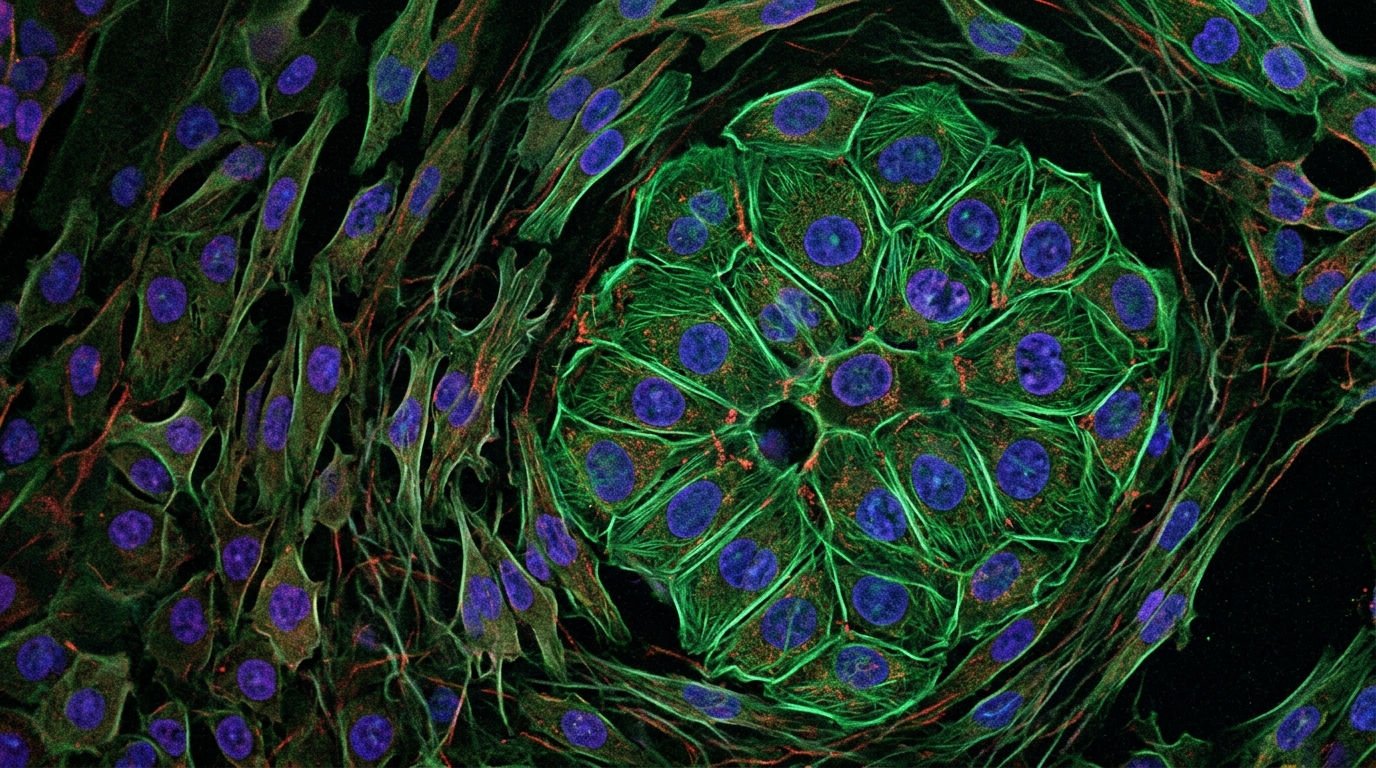
Phenotypic and targeted molecular assays substantiated the transcriptomic findings, demonstrating that atosiban rescues specific aspects of the decidual differentiation program while leaving others unaltered. Quantitative real-time polymerase chain reaction revealed that atosiban significantly increased the expression of the classical decidual secretory marker prolactin in high-estradiol-treated cells, whereas the induction of insulin-like growth factor-binding protein-1 showed no statistically significant change, illustrating a marker-specific and partial phenotypic rescue. Fluorescent phalloidin staining showed that stromal cells exposed to excess estradiol exhibited disrupted actin filament organization and irregular cellular morphology, whereas atosiban co-treatment preserved structured cytoskeletal networks and typical decidual cell shape. Moreover, gene set enrichment analysis indicated that high-estradiol exposure produced negative enrichment scores for cell-cycle checkpoint signaling, which was reversed toward positive enrichment following atosiban administration, corroborating the selective reactivation of proliferative pathways in treated stromal cells.
The regulatory effects of atosiban on the cell cycle and cellular lifespan were further verified through biochemical quantification of checkpoint regulators and direct measurements of senescence. Western blot analyses demonstrated that high estradiol reduced levels of cyclin-dependent kinase 1 while elevating the cyclin-dependent kinase inhibitor P21, a regulatory shift that was effectively reversed by atosiban co-treatment. In parallel, Cell Counting Kit-8 assays confirmed that atosiban improved overall cell viability over time relative to the high-estradiol condition. Direct assessment of cellular proliferation by EdU incorporation revealed that the proportion of actively replicating stromal cells dropped significantly under high-estradiol conditions but recovered upon atosiban exposure. Furthermore, senescence-associated beta-galactosidase staining revealed that excessive estradiol provoked a significant increase in senescence-positive stromal cells, which was significantly diminished in the presence of atosiban, confirming that pharmacological oxytocin receptor inhibition limits premature senescence and maintains proliferative competence in decidualizing stroma.
Despite these demonstrable cellular improvements, the study authors emphasized that atosiban provides only partial protection against hormone-induced decidual dysfunction rather than a comprehensive restoration of the healthy state. The persistence of dysregulated decidual markers, including the incomplete recovery of insulin-like growth factor-binding protein-1, demonstrates that high estradiol activates complex pathological mechanisms that extend beyond the oxytocin receptor axis alone. The authors noted several key experimental limitations: the in vitro human endometrial stromal cell model captures endocrine-driven decidual stress but does not replicate the full biological heterogeneity of clinical recurrent miscarriage; direct genetic validation through oxytocin receptor gene silencing or overexpression will be required to establish unequivocal causality; and senescence assessments were restricted to enzymatic staining and P21 quantification. Consequently, these laboratory findings cannot be interpreted as direct evidence of clinical efficacy, and further translational studies involving primary patient-derived cells and stratified patient cohorts will be essential to establish whether oxytocin receptor-targeted interventions offer therapeutic potential in women experiencing recurrent pregnancy loss.
Subject of Research: Modulation of high-estradiol decidual dysfunction by atosiban in human endometrial stromal cells
Article Title: Atosiban modulates high-estradiol-induced decidual dysfunction beyond its tocolytic role in recurrent miscarriage
Article References: Guo, M., Shi, J.-Z., Wei, S.-Q., Shi, W.-H., Zheng, P.-S., & Li, Y.-X. (2026). Atosiban modulates high-estradiol-induced decidual dysfunction beyond its tocolytic role in recurrent miscarriage. Frontiers in Endocrinology, 17, Article 1968031. https://doi.org/10.3389/fendo.2026.1968031
Image Credits: AI Generated
DOI: 10.3389/fendo.2026.1968031
Keywords: atosiban, recurrent miscarriage, decidualization, human endometrial stromal cells, estradiol, oxytocin receptor, cellular senescence, transcriptomics, WGCNA, prolactin, cell cycle checkpoints, endometrial receptivity, reproductive endocrinology, in vitro cell models, CDK1, P21
News Source: Ophelia Keating. (November 28, 2026). Atosiban Partially Mitigates Hormone-Induced Decidual Cell Dysfunction in Miscarriage Model. Scienmag.