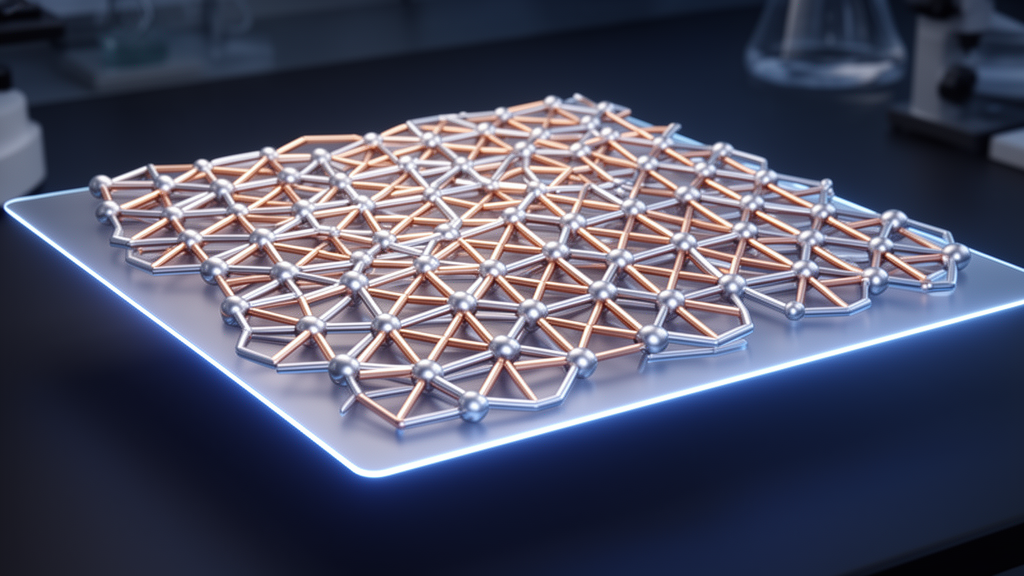
Physicists have long been captivated by the kagome lattice, an arrangement of atoms first catalogued in traditional Japanese basketry, in which corner-sharing triangles and hexagons weave a pattern that seems almost purpose-built for producing strange quantum behavior. When electrons move through such a geometry, destructive interference can trap them in place, generating an energy band with essentially no dispersion — a flat band — where interactions between electrons overwhelm their kinetic energy and exotic phases such as ferromagnetism, charge order and unconventional superconductivity can take root. Now, a large collaborative team working across South Korea, the United States, Sweden and the United Kingdom reports in Nature Physics the experimental realization of an ideal two-dimensional kagome system, achieved not by clever engineering of twisted bilayers but by exfoliating a naturally layered crystal family down to a single atomic sheet.
The material family in question carries the chemical formula A2T3X4, where A is an alkali metal such as rubidium or cesium, T is a transition metal such as palladium or nickel, and X is a chalcogen such as sulfur or selenium. Within each van der Waals layer, the transition metal atoms form a perfect kagome network, sandwiched between alkali atoms and chalcogen ligands. Although the bulk crystals of these compounds were chemically characterized decades ago, with early work on rubidium and potassium niobate and palladium chalcogenides establishing their kagome structure, their two-dimensional electronic behavior had never been directly measured. The new study demonstrates that these crystals can be exfoliated like graphene, encapsulated in inert layers, and probed atom by atom — and that the kagome band structure survives all the way down to a monolayer.
The central experimental tool was nanofocused angle-resolved photoemission spectroscopy, or nano-ARPES, a technique in which an extremely bright synchrotron beam is focused to a spot small enough to interrogate micron-scale flakes. Using this method at facilities including the Advanced Light Source in Berkeley, Diamond Light Source in the UK and the MAX IV Laboratory in Sweden, the researchers mapped the momentum-resolved electronic structure of A2Pd3S4 devices of varying thickness, from eight layers down to a single layer. The measurements revealed the characteristic kagome fingerprint: a nearly flat band sitting just below the Fermi level, flanked by linearly dispersing Dirac bands, together forming the textbook three-band spectrum of the kagome model.
What makes the result striking is the isolation of that flat band. In most real kagome materials, the idealized dispersion is smeared out by extra hopping pathways, multiple competing orbitals and interlayer coupling, so the flat band blends into a congested spectrum of other states. In A2T3X4, a strong crystal-field splitting arising from the particular local geometry of each transition metal atom — four chalcogen ligands arranged in a planar configuration with D2h symmetry — pushes all other d orbitals well away from the Fermi energy, leaving an isolated manifold of dxy-derived kagome bands. Density functional theory calculations, cross-checked against polarization-dependent ARPES measurements, confirmed this orbital hierarchy in every compound the team surveyed, spanning palladium and nickel variants with both sulfur and selenium.
The comparison with existing flat-band platforms is telling. Since the 2018 discovery of magic-angle twisted bilayer graphene, the dominant strategy for creating flat electronic bands has been geometric: stack two atomically thin crystals, rotate one by a precise twist angle, and let the resulting moiré interference pattern slow the electrons down. That approach has delivered spectacular physics, including correlated insulating states and signatures of fractional quantum anomalous Hall effect in twisted bilayer MoTe2, but it comes with inherent limitations. Moiré bands are confined to minuscule unit cells containing only a few electrons, which means the electron density in the flat band is extremely low, and the delicate superlattice potential produces particle-like quasiparticles with tiny energy scales that only reveal themselves at temperatures measured in fractions of a kelvin.
The monolayer kagome crystals change the calculus entirely. Because the flat band is an intrinsic property of the atomic lattice rather than an artifact of a superlattice, its electron density is set by the actual atomic spacing of the kagome network. According to the team’s analysis, the flat band in A2T3X4 hosts more than 220 times the electron density achievable in moiré-based artificial flat-band systems. Higher density translates directly into larger characteristic interaction energies, and larger interaction energies mean that the collective phenomena expected in flat bands — from ferromagnetism predicted by Mielke’s theorem for line-graph lattices to fractional Chern insulator states — should become accessible at far higher temperatures than the millikelvin regime that currently defines the field.
The theoretical analysis supporting this prospect is unusually thorough. The researchers evaluated the quantum geometry of the topmost Chern band in these materials, a mathematical quantity that determines how closely an engineered band resembles the lowest Landau level of a two-dimensional electron gas in a magnetic field — the ideal setting for fractional quantum Hall physics. They found that while individual local values fall short of the ideal, the Brillouin-zone-averaged quantum metric and Berry curvature for cesium and rubidium palladium sulfide remain in the same order of magnitude as those of twisted bilayer MoTe2. Exact diagonalization calculations at one-third filling of the topmost Chern band produced energy spectra exhibiting the hallmark threefold ground-state degeneracy and spectral flow of a Laughlin state, the canonical fractional quantum Hall phase, even when band mixing was included.
Equally important for practical experimentation is the tunability and robustness of the platform. In the pristine monolayer devices, the flat band sits slightly below the Fermi level, which would normally keep it fully occupied and inert. The team demonstrated, however, that electrostatic gating — applying a voltage through the graphite back-gate of the encapsulated device — can shift the band up to the Fermi level, realizing the partially filled flat band that theorists prize as the starting point for interaction-driven states. The fabrication itself required considerable finesse: the kagome flake is encapsulated between top graphene and bottom graphite using a polymer stamp, released by heating above the polymer’s glass transition temperature, cleaned in chloroform, and polished with an atomic force microscopy tip before nano-ARPES spatial maps verify that only the encapsulated regions retain their kagome electronic structure while exposed regions degrade.
The study also charts the family’s chemical versatility as a design axis. Across the surveyed compounds, the bandwidth of the flat band, the size of the spin-orbit coupling gap at the Dirac point and the degree of electronic correlation all vary systematically with composition, giving researchers a tunable toolkit rather than a single fixed material. Environmental stability tests showed that cesium palladium sulfide flakes survive ten days in an inert atmosphere and endure heating to 300 degrees Celsius without visible degradation, although bilayer samples show measurable air sensitivity and nickel-based variants prove less thermally robust — reminders that the two-dimensional limit always demands careful handling.
The path from this demonstration to a confirmed high-temperature correlated phase remains open, as the authors themselves frame the work as establishing a platform rather than reporting a broken-symmetry state. Nonetheless, the implications ripple across several active frontiers. Flat-band ferromagnetism, which has recently been observed in kagome metals at cryogenic temperatures, could gain hundreds of times more thermal headroom. Fractional Chern insulators, currently confined to the coldest corners of experimental physics, might one day operate in a dilution-refrigerator-free device. And because the kagome layers are genuine van der Waals crystals, they can be stacked with other two-dimensional materials into heterostructures combining flat-band physics with superconducting contacts, spintronic layers or optical cavities. What began as a decorative weaving pattern, abstracted by physicists into a lattice model and hunted for in three-dimensional crystals for decades, has now been isolated in its purest two-dimensional form — a single atomic sheet in which electrons arrive already arranged for the quantum collective behavior that researchers have been trying to coax into existence by ever more elaborate means.
Subject of Research: Monolayer van der Waals kagome materials hosting gate-tunable isolated flat bands for high-temperature flat-band physics
Article Title: Monolayer van der Waals kagome lattice for high-temperature flat-band physics
Article References: Bong, H., Won, C., Lee, S., Oh, S., Nguyen, P. X., Chaturvedi, R., Oh, S., Han, J., Malinowski, P., Mowers, C., Kim, J., Ryu, S. H., Lee, H., Choi, J., Yer, S., Jozwiak, C., Bostwick, A., Rotenberg, E., Polley, C. M., … Kang, M. (2026). Monolayer van der Waals kagome lattice for high-temperature flat-band physics. Nature Physics. https://doi.org/10.1038/s41567-026-03492-0
Image Credits: AI Generated
DOI: 10.1038/s41567-026-03492-0
Keywords: kagome lattice, flat band, two-dimensional materials, van der Waals, nano-ARPES, topological matter, Chern band, electrostatic gating, quantum geometry, fractional quantum Hall effect, correlated electrons, A2T3X4
News Source: Denise Maddox. (October 16, 2026). Atomically Thin Kagome Crystal Delivers Inherently Flat Bands Without Any Twisting. Scienmag.