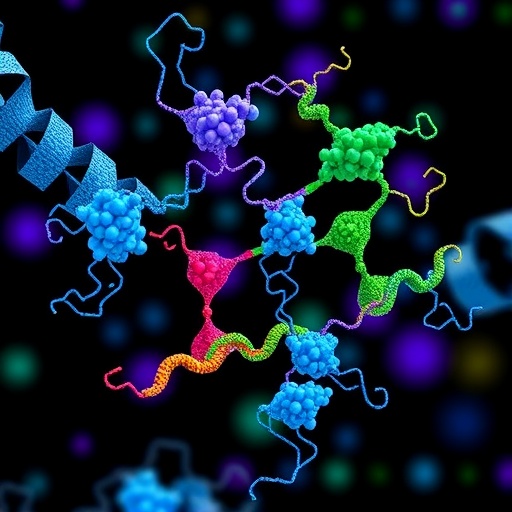
In the relentless quest to expedite drug discovery and enhance the precision of molecular probe identification, a new breakthrough emerges from the intersection of artificial intelligence and molecular chemistry. Researchers have developed PBCNet2.0, a state-of-the-art protein–ligand binding affinity prediction model that promises to revolutionize early-stage pharmaceutical research. This Cartesian tensor-based Siamese neural network shifts the paradigm by combining staggering computational efficiency with unprecedented accuracy, a combination that has long eluded traditional simulations and machine learning frameworks alike.
At the heart of this innovation is PBCNet2.0’s training foundation, which encompasses an expansive dataset of 8.6 million protein–ligand complex pairs. This carefully curated and colossal data reservoir empowers the model to generalize across diverse protein targets and ligand structures, enabling zero-shot predictions with fidelity comparable to that of intricate physics-based simulations. Unlike conventional computational chemistry methods notoriously bottlenecked by long processing times, PBCNet2.0 delivers rapid predictions without sacrificing scientific rigor, thus addressing a critical bottleneck in pipeline throughput.
Underlying PBCNet2.0’s performance is its novel Cartesian tensor-based architecture, designed to inherently encode the spatial geometric constraints and detailed intermolecular interactions that dictate binding affinity. This nuanced molecular representation surpasses simpler graph- or sequence-based models by directly considering atomic-level positional information in three-dimensional space. By operating as a Siamese neural network, PBCNet2.0 efficiently learns the relative differences in binding energies between pairs of complexes, a strategy that inherently aligns with the chemical reality of affinity optimization during early drug discovery campaigns.
The repercussion of such predictive power on compound prioritization, lead optimization, and resource allocation is profound. Retrospective studies have illustrated that PBCNet2.0 can boost optimization efficiency by a factor of over seven, simultaneously slashing resource usage by 41%. Such enhancements mean that pharmaceutical and biotech researchers can pivot more quickly to candidates with promising binding profiles, accelerating experimental cycles and substantially reducing costs that traditionally plague the development process.
Mechanistic investigations into the model’s learned representations reveal that it not only captures canonical effects like hydrophobic contacts and hydrogen bonding but also encodes subtle atomic-level interactions often overlooked in conventional models. Notably, the model shows sensitivity to fluorine orthogonal multipolar interactions—an esoteric but critical aspect that influences binding specificity and pharmacological outcomes. This depth of mechanistic insight emerges naturally from the geometrically rich tensor representation combined with the model’s training regimen.
Perhaps most compellingly, PBCNet2.0 demonstrates an unexpected emergent ability: it predicts how mutations in the protein binding pocket alter ligand affinity, despite being trained solely on ligand variation without explicit mutational data. This capacity to infer how amino acid changes influence binding energies opens new avenues for drug resistance prediction and rational design against evolving targets, a major challenge in combating diseases like cancer and viral infections.
The prospective validation of PBCNet2.0’s capabilities was conducted against two challenging enzymatic targets—ENPP1 and ALDH1B1—where subtle structural differences markedly influence ligand binding. In these systems, PBCNet2.0 successfully resolved intricate affinity shifts driven by minor conformational nuances and pinpointed critical binding residues with remarkable accuracy. Experimental hit rates for identified residues stood at five out of six, underscoring the model’s practical utility in guiding rational probe design and mutagenesis studies.
This breakthrough not only advances computational modeling but also emphasizes the integral role of high-dimensional geometric data in molecular recognition tasks. PBCNet2.0’s ability to marry accuracy with efficiency showcases how sophisticated representations combined with vast datasets can tackle the complexity of biomolecular interactions. The confluence of big data, geometric deep learning, and chemical intuition embedded in PBCNet2.0 heralds a new era for precision molecular design.
For drug developers, the real-world implications are immense: accelerating the discovery timeline, improving hit-to-lead conversion rates, and mitigating the risk of late-stage failures due to poor binding characteristics. The model’s interpretability-friendly architecture also facilitates hypothesis generation around key determinants of binding, supporting experimentalists’ iterative design workflows in a more informed manner.
In essence, PBCNet2.0 exemplifies the transformative potential of AI-driven methodologies calibrated on atomic-resolution molecular data. It bridges the longstanding divide between the theoretical sophistication of physics-based simulations and the pragmatic demands of industrial drug discovery pipelines, thus presenting a scalable and generalizable platform for relative binding affinity assessment.
As the pharmaceutical sector grapples with soaring development costs and the urgent demand for novel therapies, tools like PBCNet2.0 could prove pivotal in tipping the balance. By empowering researchers with the capability to rapidly and accurately predict protein–ligand interactions at atomic granularity, this neural network ushers in more rational, data-driven strategies that may ultimately translate to better medicines reaching patients sooner.
Looking ahead, integrating PBCNet2.0 within broader computational and experimental ecosystems could foster deeper understanding of pharmacodynamics and resistance mechanisms. Its demonstrated adaptability across diverse proteins and ligands hints at versatility that can extend beyond standard small molecule drugs, potentially impacting biologics, covalent inhibitors, and allosteric modulators.
This innovation epitomizes how machine learning, grounded in robust physicochemical principles and vast empirical data, can surmount longstanding barriers to molecular discovery. PBCNet2.0’s success marks a milestone in computational chemistry, underlining the imperative to continue advancing geometric deep learning techniques toward ever more predictive and interpretable molecular models.
In summary, the arrival of PBCNet2.0 represents a compelling fusion of computational elegance and practical applicability. It transforms the landscape of protein–ligand binding affinity prediction by delivering a highly accurate, mechanistically insightful, and computationally efficient platform. As a tool for probe discovery and lead optimization, it promises to empower scientific discovery with unprecedented speed and precision—ushering in a new dawn for medicinal chemistry and chemical biology.
Subject of Research: Protein–ligand binding affinity prediction using advanced neural network architectures for accelerating molecular probe discovery and lead optimization.
Article Title: Atomic-level protein–ligand recognition with PBCNet2.0 for probe discovery.
Article References:
Yu, J., Sheng, X., Fan, Z. et al. Atomic-level protein–ligand recognition with PBCNet2.0 for probe discovery. Nat Chem Biol (2026). https://doi.org/10.1038/s41589-026-02241-x
Image Credits: AI Generated
DOI: https://doi.org/10.1038/s41589-026-02241-x
Tags: 3D spatial encoding in proteinsatomic-level molecular interactionsCartesian tensor-based neural networkearly-stage pharmaceutical research AIhigh-throughput drug discovery modelslarge-scale protein-ligand datasetmolecular probe identification AIphysics-based simulation alternativesprotein-ligand binding affinity predictionrapid computational chemistry methodsSiamese neural network in drug discoveryzero-shot prediction in molecular modeling