• HOME
  • NEWS
  • EXPLORE
    • CAREER
      • Companies
      • Jobs
    • EVENTS
    • iGEM
      • News
      • Team
    • PHOTOS
    • VIDEO
    • WIKI
  • BLOG
  • COMMUNITY
    • FACEBOOK
    • INSTAGRAM
    • TWITTER
Thursday, May 14, 2026
BIOENGINEER.ORG
No Result
View All Result
  • Login
  • HOME
  • NEWS
  • EXPLORE
    • CAREER
      • Companies
      • Jobs
        • Lecturer
        • PhD Studentship
        • Postdoc
        • Research Assistant
    • EVENTS
    • iGEM
      • News
      • Team
    • PHOTOS
    • VIDEO
    • WIKI
  • BLOG
  • COMMUNITY
    • FACEBOOK
    • INSTAGRAM
    • TWITTER
  • HOME
  • NEWS
  • EXPLORE
    • CAREER
      • Companies
      • Jobs
        • Lecturer
        • PhD Studentship
        • Postdoc
        • Research Assistant
    • EVENTS
    • iGEM
      • News
      • Team
    • PHOTOS
    • VIDEO
    • WIKI
  • BLOG
  • COMMUNITY
    • FACEBOOK
    • INSTAGRAM
    • TWITTER
No Result
View All Result
Bioengineer.org
No Result
View All Result
Home NEWS Science News

Atom swapping could lead to ultra-bright, flexible next generation LEDs

Bioengineer by Bioengineer
September 6, 2025
in Science News
Reading Time: 2 mins read
0
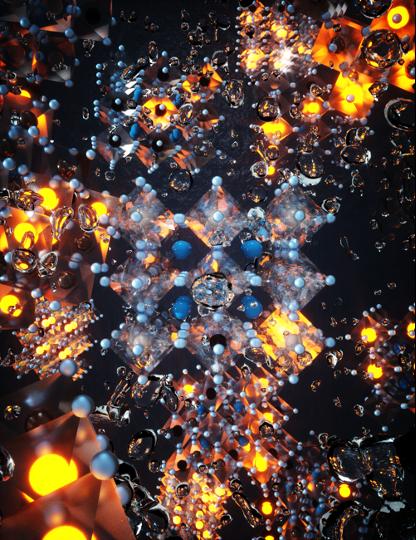
IMAGE
Share on FacebookShare on TwitterShare on LinkedinShare on RedditShare on Telegram

An international group of researchers has developed a new technique that could be used to make more efficient low-cost light-emitting materials which are flexible and can be printed using ink-jet techniques.

The researchers, led by the University of Cambridge and the Technical University of Munich, found that by swapping one out of every one thousand atoms of one material for another, they were able to triple the luminescence of a new material class of light emitters known as halide perovskites.

This ‘atom swapping’, or doping, causes the charge carriers to get stuck in a specific part of the material’s crystal structure, where they recombine and emit light. The results, reported in the Journal of the American Chemical Society, could be useful for low-cost printable and flexible LED lighting, displays for smartphones or cheap lasers.

Many everyday applications now use light-emitting devices (LEDs), such as domestic and commercial lighting, TV screens, smartphones and laptops. The main advantage of LEDs is they consume far less energy than older technologies.

The team studied a new class of semiconductors called halide perovskites in the form of nanocrystals which measure only about a ten-thousandth of the thickness of a human hair. These ‘quantum dots’ are highly luminescent materials: the first high-brilliance QLED TVs incorporating quantum dots recently came onto the market.

The Cambridge researchers, working with Daniel Congreve’s group at Harvard, who are experts in the fabrication of quantum dots, have now greatly improved the light emission from these nanocrystals. They substituted one out of every one thousand atoms with another – swapping lead for manganese ions – and found the luminescence of the quantum dots tripled.

A detailed investigation using laser spectroscopy revealed the origin of this observation. “We found that the charges collect together in the regions of the crystals that we doped,” said Sascha Feldmann from Cambridge’s Cavendish Laboratory, the study’s first author. “Once localised, those energetic charges can meet each other and recombine to emit light in a very efficient manner.”

“We hope this fascinating discovery: that even smallest changes to the chemical composition can greatly enhance the material properties, will pave the way to cheap and ultrabright LED displays and lasers in the near future,” said senior author Felix Deschler, who is jointly affiliated at the Cavendish and the Walter Schottky Institute at the Technical University of Munich.

In the future the researchers hope to identify even more efficient dopants which will help making these advanced light technologies accessible to every part of the world.

###

Media Contact
Sarah Collins
[email protected]

Related Journal Article

http://dx.doi.org/10.1021/jacs.1c01567

Tags: Chemistry/Physics/Materials SciencesEnergy/Fuel (non-petroleum)MaterialsNanotechnology/MicromachinesOptics
Share12Tweet8Share2ShareShareShare2

Related Posts

UofL Pediatrics Researcher Discovers Novel Signaling Mechanism Linked to Anxiety and Overgrooming

May 14, 2026
New Study Finds No Evidence Linking First Trimester Pain Reliever Use to Birth Defects — Medicine

New Study Finds No Evidence Linking First Trimester Pain Reliever Use to Birth Defects

May 14, 2026

Absolute Quantification of IgG Glycans Unlocks New Avenue for Predicting Biological Age

May 14, 2026

Mathematical Analysis Uncovers a Hidden “Golden Rule” in Abstract Art

May 14, 2026
Please login to join discussion

POPULAR NEWS

  • Research Indicates Potential Connection Between Prenatal Medication Exposure and Elevated Autism Risk

    842 shares
    Share 337 Tweet 211
  • New Study Reveals Plants Can Detect the Sound of Rain

    729 shares
    Share 291 Tweet 182
  • Salmonella Haem Blocks Macrophages, Boosts Infection

    62 shares
    Share 25 Tweet 16
  • Breastmilk Balances E. coli and Beneficial Bacteria in Infant Gut Microbiomes

    57 shares
    Share 23 Tweet 14

About

We bring you the latest biotechnology news from best research centers and universities around the world. Check our website.

Follow us

Recent News

UofL Pediatrics Researcher Discovers Novel Signaling Mechanism Linked to Anxiety and Overgrooming

New Study Finds No Evidence Linking First Trimester Pain Reliever Use to Birth Defects

Absolute Quantification of IgG Glycans Unlocks New Avenue for Predicting Biological Age

Subscribe to Blog via Email

Enter your email address to subscribe to this blog and receive notifications of new posts by email.

Join 82 other subscribers
  • Contact Us

Bioengineer.org © Copyright 2023 All Rights Reserved.

Welcome Back!

Login to your account below

Forgotten Password?

Retrieve your password

Please enter your username or email address to reset your password.

Log In
No Result
View All Result
  • Homepages
    • Home Page 1
    • Home Page 2
  • News
  • National
  • Business
  • Health
  • Lifestyle
  • Science

Bioengineer.org © Copyright 2023 All Rights Reserved.