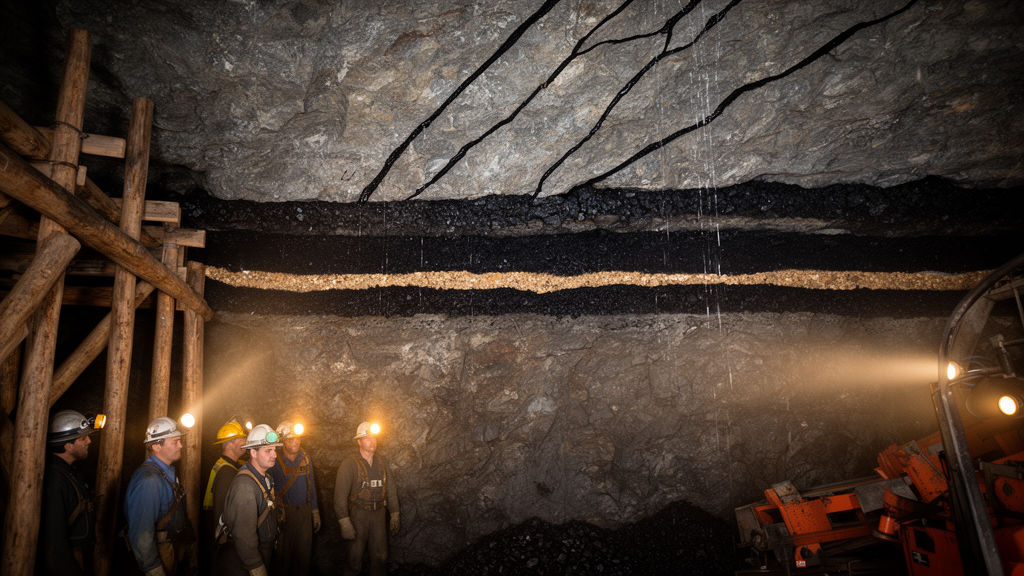
Sequential mining of closely spaced coal seams creates a tangled interplay of residual fractures, cumulative rock damage, current loading, and roof water hazards, and a new open-access study at Hujia-ta Coal Mine shows that these elements do not develop symmetrically or in the same places. Researchers investigated panels 11,201, 11,200, and 22,201 in their actual extraction sequence, drawing on empirical calculation, physical simulation, abutment-pressure and microseismic monitoring, 3DEC numerical modeling, transient electromagnetic (TEM) surveys, and drainage drilling to build a layered picture of where roof damage and goaf water actually concentrate.
One of the study’s clearest findings concerns fracture geometry. After adjacent extraction of panels 11,201 and 11,200, the visible fracture height increased only modestly, from 55.3 to 56.2 meters, a change of 1.6 percent. Yet over the same step, the difference in boundary angles grew from 0 to 7 degrees. In other words, under the present experimental conditions, the boundary-fracture geometry responded far more sensitively to adjacent mining than did the maximum visible macroscopic fracture height, making asymmetric boundary geometry a more informative indicator of cumulative disturbance.
The study also documented a spatial mismatch between damage and load. After repeated extraction of panel 22,201, the maximum fracture-height ratio between the zones above panels 11,200 and 11,201 reached KH = 1.65, while the ratio of right-to-left abutment-pressure peaks reached KP = 1.93. Because these two ratios differ substantially, the location of the cumulative visible-damage extreme and the location of the current load peak do not coincide. The authors argue that mechanical damage, electrical response, and hydraulic connectivity should therefore be treated as distinct but complementary evidence layers when selecting drilling targets and setting drainage priorities.
To quantify the overall damage envelope, the team used an empirical formula at a mean burial depth of 254.3 meters with an interburden thickness of 44 meters between the seams, yielding an empirical damage height of 110.2 meters. Integrating this estimate with the physical simulation, monitoring, numerical, and geophysical evidence, the researchers delineated hazard zones into classes: Class I coupled priority zones and Class III anomaly target zones were identified, while no Class II target emerged. Areas not assigned to Classes I through III were classified as Class IV background zones, and a 1520–1940 meter section affected by equipment interference was left unclassified rather than forced into a category.
The practical payoff came in the drainage campaign. Working from the integrated zoning, two drainage stages completed 8 drill sites, 27 boreholes, 2450 meters of drilling, and removal of 15,024 cubic meters of water. All 21 Stage-2 boreholes reached their target goafs, with maximum inflow of 22 cubic meters per hour and maximum water pressure of 0.32 megapascals, confirming that the targeting had placed the holes where the water actually was.
Post-drainage verification supported the interpretation. Under comparable surveys, the low-resistivity response associated with goaf water was no longer detected, and roof-aquifer anomalies decreased from three to one. This before-and-after geophysical contrast links the electrical evidence layer to actual hydraulic intervention, although the authors frame mechanical, electrical, and hydraulic observations as complementary rather than interchangeable.
The work is published in Geomechanics and Geophysics for Geo-Energy and Geo-Resources and is currently shared as an early-access, peer-reviewed accepted article carrying a permanent DOI, subject to further edits before the final Version of Record. Its case-study scope is a single mine with three panels, so the specific zone classes, ratios, and drainage figures describe these conditions rather than universal rules for every multi-seam mining layout.
Even so, the methodological message travels well: when seams are mined close together, the damage left behind by earlier panels reshapes how the overburden fails under later ones, and neither fracture height nor abutment pressure alone captures the hazard. Combining empirical height estimates, physical models, field monitoring, numerical simulation, and geophysical surveys allowed the team to separate cumulative damage from current loading and to convert that separation into concrete drilling and drainage decisions.
Subject of Research: Asymmetric overburden fracture evolution and roof water-hazard zoning during sequential mining of closely spaced coal seams
Article Title: Asymmetric evolution of overburden fractures and roof water-hazard zoning during sequential mining of closely spaced coal seams
Article References: Xie, P., Du, Y., Wu, Y., Ru, X., Huangfu, J., Deng, J., Gao, Y., & Wu, J. (2026). Asymmetric evolution of overburden fractures and roof water-hazard zoning during sequential mining of closely spaced coal seams. Geomechanics and Geophysics for Geo-Energy and Geo-Resources. https://doi.org/10.1007/s40948-026-01260-1
Image Credits: AI Generated
DOI: 10.1007/s40948-026-01260-1
Keywords: coal mining, overburden fractures, water hazard, sequential mining, microseismic monitoring, 3DEC modeling, TEM survey, goaf drainage, abutment pressure, Hujia-ta Coal Mine, Asymmetric, evolution
News Source: Denise Maddox. (October 27, 2026). Asymmetric Overburden Fractures Guide Roof Water-Hazard Zoning in Closely Spaced Coal Seams. Scienmag.