Credit: Mary Zhu
A team of scientists from Arizona State University has taken a significant step closer to unlocking the secrets of photosynthesis, by determining the structure of a very large photosynthetic supercomplex.
This important discovery is laid out in their paper published today in Nature Structural & Molecular Biology. The paper is titled “The structure of the stress induced photosystem I – IsiA antenna supercomplex.”
“Supercomplexes are associations between antennae proteins and photochemical reaction centers that exist in all photosynthetic organisms,” explained Yuval Mazor, an assistant professor in the School of Molecular Sciences and the Biodesign Institute’s Center for Applied Structural Discovery. “This particular one comes from cyanobacteria, the class (phyla) of bacteria in which oxygenic photosynthesis first appeared (a few billion years ago) and later evolved, into all types of oxygenic photosynthesis that we know today.”
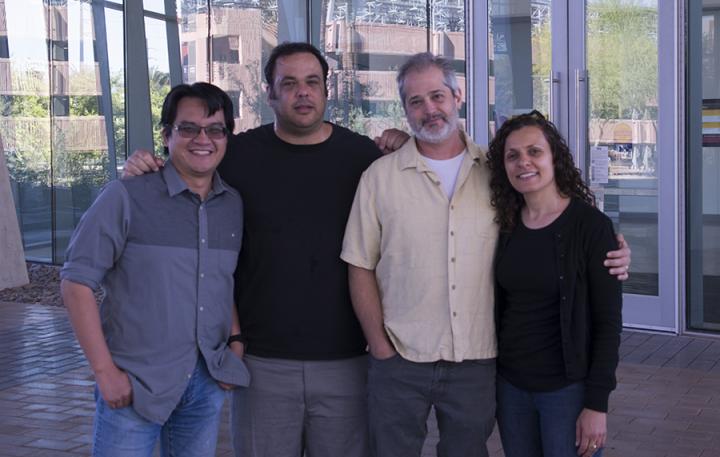
Mazor’s team includes Hila Toporik, a postdoctoral fellow, and Jin Li, a graduate student; and a collaboration with Assistant Professor Po-Lin Chiu, who all belong to the School of Molecular Sciences and the Center for Applied Structural Discovery, as well as Dewight Williams, an associate research scientist in the John M. Cowley Center for High Resolution Electron Microscopy.
Plants, algae and cyanobacteria use photosynthesis to produce oxygen and reduced carbon, like carbohydrates, which builds and fuels our entire biosphere. There are two pigment-protein complexes that orchestrate the primary light reactions in oxygenic photosynthesis: photosystem I (PSI) and photosystem II (PSII). Understanding how these photosystems work their magic is one of the long-sought goals of science.
Physicist and Nobel laureate Richard Feynman once famously stated, “It is very easy to answer many fundamental biological questions; you just look at the thing!” Indeed, the central idea behind structural biology is that once one is able to “look” at “things” in great enough detail to discern their atomic structures, one will naturally be able to answer how and why the components and players of complex biological processes work the way they do.
In the past few years, single-particle cryogenic electron microscopy (cryo-EM) in particular has triggered a revolution in structural biology and has become a newly dominant discipline. Cryo-EM allows researchers to take a look at biological structures that were simply not accessible just a few years ago, and is now exposing structures of unprecedented complexity in great detail.
Indeed it is this technique utilized by the experts in the School of Molecular Sciecnes and The College of Liberal Arts and Sciences at ASU that has enabled the elucidation of the structure of the PSI-IsiA complex. In the lab, this particular super-complex is produced by cyanobacteria under low iron environment or excessive light fluxes. However, in the “real world” iron exists at very low concentrations and high light can be the rule rather than the exception, so ultimately PSI-IsiA is a very common form of photosystem I, one of the two essential engines of photosynthesis.
The complex is unique in size, the largest photosynthetic supercomplex with a known molecular structure, and in complexity with more than 700 different molecules (mostly light-harvesting molecules) making up the complete structure.
There are 591 chlorophylls in the PSI-IsiA supercomplex, by far the largest number of bound pigments in any of the photosynthetic super-complexes with known structures.
The ability of cyanobacteria to express this complex when they are under stress plays an important role in their survival under these conditions. This complex also represents a large class of antennae that are very common in marine cyanobacteria, which are responsible for a considerable fraction of the total global photosynthesis output (estimates vary between 15% and 25%). Mazor emphasizes that their work was done on a common laboratory strain, not on one of the marine species.
The current structure uncovers the most crucial details of this enormous machine. As the first example from the cyanobacterial branch of the membrane embedded antenna proteins, it lays a path for evaluating the light-harvesting and photoprotection mechanism (from excess or fluctuating light conditions) in cyanobacteria.
Understanding the complexity and functions of the IsiA photosynthetic supercomplex will ultimately help to ensure that we have a stable energy supply on Earth, undoubtedly one of the central challenges of the 21st century.
###
The authors would like to acknowledge the use of the Titan Krios at the Erying Materials Center at Arizona State University and the funding of this instrument by NSF MRI 1531991. This study is funded by a startup grant from Arizona State University.
Media Contact
Jenny Green
[email protected]
Original Source
https:/