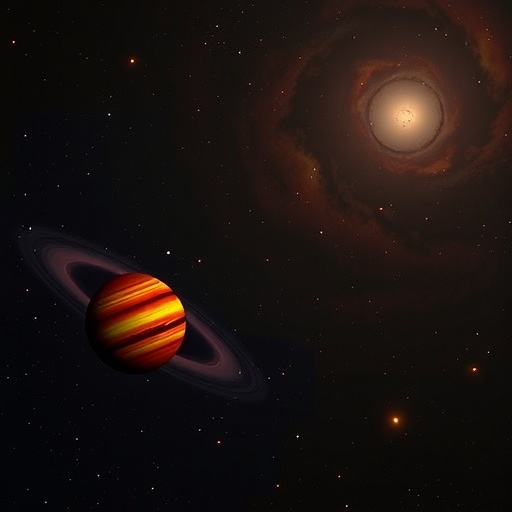
At last, astronomers have obtained strong, direct evidence that Betelgeuse—the iconic red supergiant in Orion—is accompanied by a faint stellar companion. Using the European Southern Observatory’s Very Large Telescope (VLT), a team led by French researcher Miguel Montargès captured what is likely the clearest image yet of Betelgeuse B, the star predicted to orbit Betelgeuse for decades.
For hundreds of years, Betelgeuse has been monitored because its brightness varies in a periodic pattern. While those changes were once suspected to reflect the influence of a nearby companion, earlier searches failed to deliver convincing proof. In 2024, however, two separate studies refined the expected orbit and pointed to a rare window in December, when the companion would appear farthest from Betelgeuse as seen from Earth—making it more detectable.
Montargès and colleagues acted on that forecast. They used ESO’s VLT in December 2024 and spent months processing the data with advanced image-reconstruction techniques designed to separate faint objects from a bright source. The result is a processed view in which Betelgeuse is effectively removed, revealing a signal consistent with Betelgeuse B.
The team’s analysis indicates that the companion is more massive than earlier estimates suggested. Rather than being close to the Sun’s mass, Betelgeuse B appears to have roughly two to three times the Sun’s mass. “Because it is more massive than predicted, we see it,” Montargès noted, emphasizing how unexpected the discovery remains despite the target being well studied.
Betelgeuse B was detected through direct imaging, meaning the companion’s own light was captured rather than inferred indirectly. Observations were made with SPHERE, an instrument on the VLT optimized for high-contrast imaging and capable of working in the glare-dominated environments around bright stars.
A prior tentative sighting of the companion had been reported using the Gemini North Telescope, but the VLT/SPHERE data provide the strongest evidence to date. Co-author Anthony Boccaletti highlighted how tools originally developed to find exoplanets can also reveal companions orbiting massive, evolved stars like Betelgeuse.
The discovery also arrives with scientific urgency. Betelgeuse is an evolved supergiant expected to end its life in a supernova. The possibility of a companion raises a new question: whether Betelgeuse B will influence the red supergiant’s evolution and ultimately the nature of its impending explosion.
To confirm the companion’s reality beyond doubt, astronomers plan to observe it again as the orbit places it on the opposite side of Betelgeuse. With only limited orbital phase remaining, the team expects the next observations to further validate the detection and sharpen the system’s parameters.
Subject of Research: Betelgeuse’s companion star (Betelgeuse B) and its influence on the evolution of a red supergiant
Article Title: VLT/SPHERE images the candidate companion of Betelgeuse
News Publication Date: Not provided in the provided text
Web References: https://www.eso.org/public/archives/releases/sciencepapers/eso2611/eso2611a.pdf
References: https://iopscience.iop.org/article/10.3847/1538-4357/ad93c8 ; https://iopscience.iop.org/article/10.3847/1538-4357/ad87f4 ; https://iopscience.iop.org/article/10.3847/2041-8213/adeaaf ; https://www.nature.com/articles/s41586-021-03546-8
Image Credits: Credit: ESO/M. Montargès et al. Background: N. Rissinger (skysurvey.org)
Keywords
Binary stars, Observational astrophysics, Stellar physics, Stellar dynamics
Tags: advanced image reconstruction in astronomyBetelgeuse B star orbitBetelgeuse brightness variabilityBetelgeuse stellar companion detectiondirect imaging of Betelgeuse partnerEuropean Southern Observatory VLT imagingimpact of stellar companions on supergiant evolutionOrion constellation star systemrare observational window December 2024red supergiant star binary systemstar companionship confirmationstellar mass estimation of Betelgeuse B